(This also helps explain why I have little patience with dreamy rosy candyfloss people these days. You can’t live in England for as long as I have and keep seeing the world through pink-tinted spectacles.)
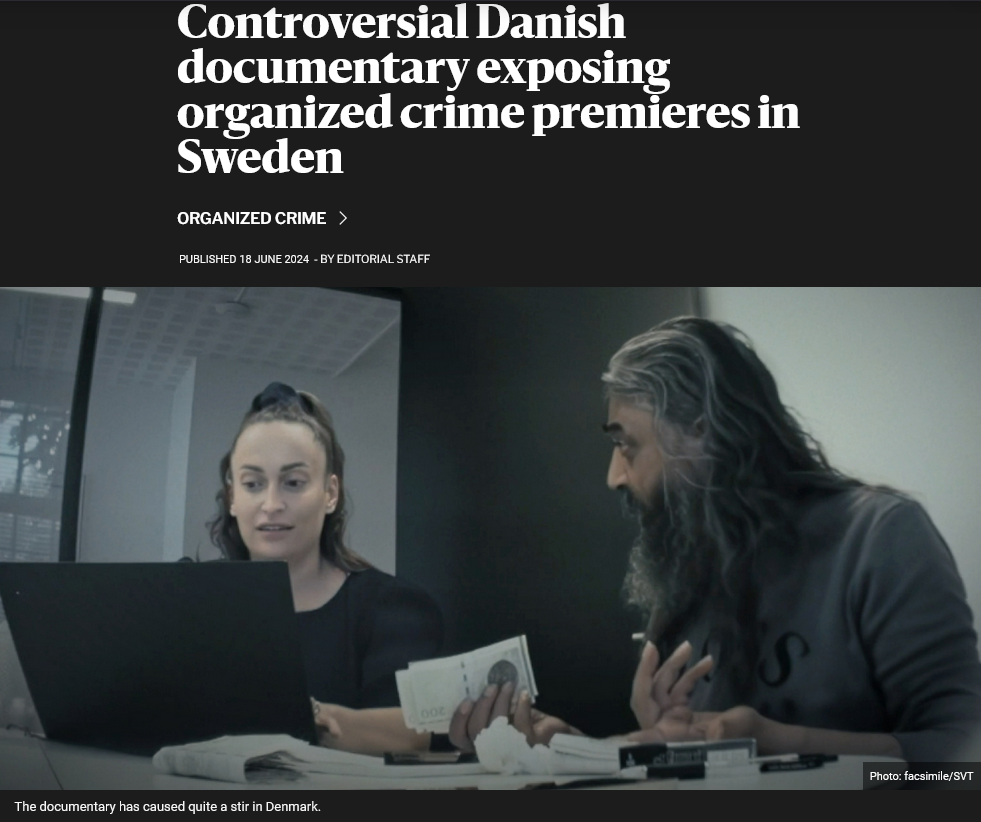
- https://www.avallone.io/resources/danish-documentary-den-sorte-svane-impact-global-compliance-industry (in English, published on 3 June 2024)
- https://cphpost.dk/2024-05-30/news/round-up/the-first-police-report-has-come-after-shocking-documentary/ (in English, published on 30 may 2024)
- https://nos.nl/artikel/2525372-witwassen-fraude-en-verborgen-camera-s-documentaire-schokt-denen (in Dutch, published on 20 June 2024)
- https://nyheter.sh/n/en/shocking-crime-documentary-rocks-denmark (in English, more or less a summary of the Dutch news item)
- https://en.365nyt.dk/2024/05/28/danish-minister-responds-to-the-black-swan-documentary-controversy/ (in English, published on 28 May 2024)
- https://nordictimes.com/the-nordics/the-black-swan-controversial-documentary-exposing-organized-crime-in-denmark-premieres-in-sweden/ (published on 18 June 2024)
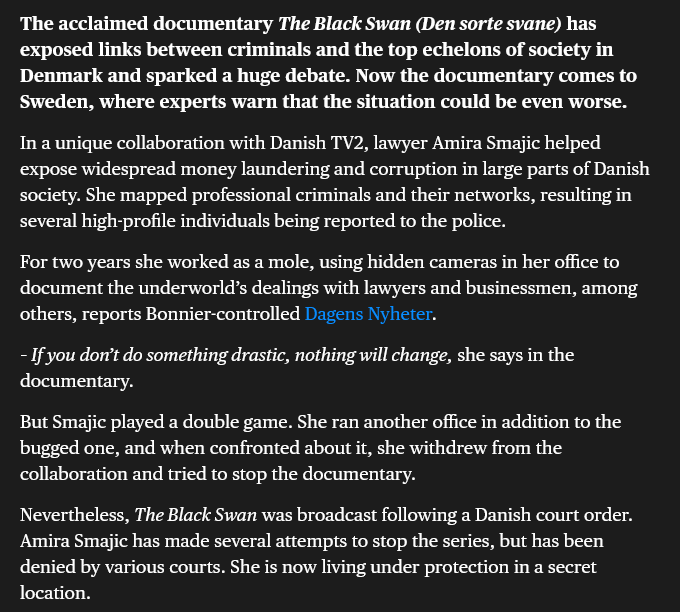
Here is an unedited ChatGPT translation of the Dutch news article:
A lawyer with connections to the Danish underworld feels remorse and offers to become an informant for a group of journalists. For ten months, every conversation in her office is recorded by hidden cameras. The result is a revealing look behind the scenes, showing how the upper and underworlds in Denmark are deeply intertwined.
The scenario seems perfect for one of the many acclaimed Scandinavian crime series. However, instead of fiction, “The Black Swan” is a documentary series that dominates conversations among Danes at the coffee machine this week.
Torture Chambers and Contract Killings
Central to the story is Amira Smajic, a lawyer who represents criminals from organized crime. After contacting a TV station, she opens a new office and equips it with hidden cameras. These cameras film officials, lawyers, and businessmen advising criminals on various matters, from money laundering through municipal funds to tax fraud and bribery. Criminals themselves openly discuss torture chambers and contract killings.
Everyone who visits the office believes they are unobserved and speaks freely. Financial-economic crime is facilitated by legal companies and service providers, resulting in millions of crowns, which belong to the state treasury, ending up in the pockets of criminals.

It all contradicts the self-image of Denmark, which is known for its transparency. For years, the country has topped the list of least corrupt nations. The public administration is highly accessible: every Dane has the possibility to inspect public decisions, while government agencies are obliged to accurately record communications around decision-making. That in such a society, lawyers and businesses consciously collaborate with criminals to circumvent the law and embezzle state funds, shocks many Danes.
This systematic undermining has caused a significant stir. Several complaints have already been filed against involved lawyers and businessmen, some of whom have already been dismissed or have resigned from their board positions. The Danish Bar Association is investigating multiple lawyers, some of whom work at the largest law firms in the country.
Uproar at the Highest Level
The issue is also affecting politicians. A local social-democratic politician has already resigned after it was revealed that he had connections with one of the businessmen featured in the documentary.
National politics is also abuzz with the documentary. Prime Minister Mette Frederiksen publicly thanked the creators for their work, and the government met with opposition parties to discuss the documentary. The question arises whether the authorities possess sufficient economic knowledge to detect and prevent such crimes.
Does the End Justify the Means?
However, part of the outrage in the country is also directed at the documentary makers themselves. The public debate, for example, questions whether the end justifies the means. Is it permissible to secretly record conversations with hidden cameras? Are crimes not being incited this way?
There is also the question of the extent to which lawyer Smajic should have been protected: when it became clear upon completion of the documentary that it would not portray her entirely positively, she tried to prevent its broadcast. She says she fears reprisals from the criminal network she helped expose as a whistleblower.
It took two court rulings before the documentary could be aired. Since then, Smajic has gone into hiding.
According to the documentary makers, the societal interest weighed more heavily. They aptly named the series ‘Black Swan,’ referring to the theory that an unexpected event with enormous impact can make people view the world differently. This certainly applies to the Danish government: after the summer vacation, they will present a bill to strengthen money laundering controls.
My two cents
Clue: This is not about money laundering. Money laundering comes at the tail end.
Attempting to combat money laundering – among other things, forcing banks to do a lot of crazy stuff to their customers – is probably something that governments focus on if they don’t know what else to do to stop organized crime.
An example of what I mean is the Dutch plumber who is relentlessly being targeted by a crazy nutcase who keeps paying others to place explosives and who has now been banned from living in his own home with his family, because the authorities don’t know what else to do about it.
Another example is the epidemic of random explosions that is raging in the Netherlands. Why is it so difficult to solve these cases? The answer has to be that the people tasked with solving these challenges are focusing on the wrong things, possibly because they are forced to. Instead, people rant about refugees and other migrants and other people like me, people who just want to be allowed to live their lives and support themselves.
This is not even organized crime, it is not the kind of crime that this documentary reveals, but that makes it so much more puzzling that the Dutch authorities are clueless as to is who is behind all this and not able to stop any of this. I’m sure it’s not much different in other countries.
Most police officers still barely know what a computer is, let alone how computers are used in all kinds of criminal activities. How is that even possible? Is that what is behind this? Or have they become slaves to digital reporting activities and no time for actual crime-solving? Many or most police officers are into crowd control these days, aren’t they?
Yes, I find it baffling. It’s like police officers these days are like horses pulling horse-drawn carts and ploughing fields in a world that no longer uses horses.
