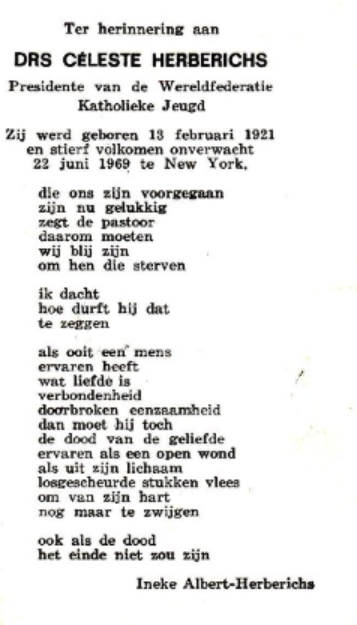
The woman in the above photo is one of my mother’s cousins, Céleste Herberichs M.A. Her grave is gone now (but I have a photo of it).

She had a master’s in psychology. She passed away in New York, due to a stroke at age 48, only shortly before my mother died, at 42. She’d been sitting on a swing, playing or talking with children and suddenly quite literally dropped dead. She’d just flown to the US.
She too was an odd duck within the family, just like me, or so I was led to believe. (Was she seen as an odd duck in the branch of the family that spells its last name wit gh, perhaps, and if so, was it because she was a woman?) Some relatives – notably Jeanne – occasionally compared me to her, but I was not quite sure what to make of that. I think I’ve met her once. A lady with glasses who asked me what I wanted to be when I grew up.
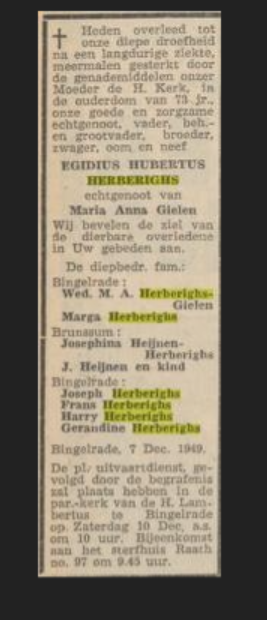
Update 8 August 2025: The family spelled the name with “gh” until 1880 when they began spelling it with “ch”; that is, the children did. It appears that this coincided with a move, probably to the farm that I knew as a child (and which went a with a heck of a lot of land), but in any case to the same village. So it likely was the result of a clerical error. One of the sons – the eldest, actually – married my grandmother; he was about 15 years older than she. He didn’t die of an accident or a mysterious illness, as I had sometimes wondered about, but of a long illness, which is probably some form of cancer as that runs in the family, although not one specific type (see below). He was 73 at the time and that was in 1949. That helps to explain why he was never talked about. The family originally came from France; they had a coat of arms / family crest with a horseshoe. I don’t think I still have an image of it, but I remember it as mostly cobalt blue and silver, with touches of gold. It is part of an archive somewhere (Maastricht, I think).
Finding out about Céleste and also about her brother finally gave me a sense of belonging, a sense of a place within my family. She was president of an organization call the World Federation of Catholic Youth (WFCY; see also FIMCAP), which was founded in Berlin, Germany in 1968. At the end of the World Congress of Catholic Youth there, 80 delegates representing the International Catholic Youth Federation (ICYF) and the World Federation of Catholic Young Women and Girls (WFCYWG) voted to merge the two organizations to form the World Federation of Catholic Youth (WFCY). Céleste was elected president of the new federation, with headquarters in Brussels, Belgium. (Source: The Catholic Northwest Progress, Volume 71, Number 23, 31 May 1968.)

She wrote and published articles, in several languages.


Her brother Gérard was a Dutch- and French-educated lawyer and political scientist at the Council of Europe in Strasbourg, France (human rights) and had a doctorate. He too wrote and published.
His nickname was Geert. I’ve forgotten their mother’s name, but she was the one who (more or less) changed my dad’s nickname from “Sjir” into “Sjra”, both abbreviations of “Gerard” pronounced the French way. Many men in Zuid-Limburg are called Gerard, after Gerardus Majella and the monastery in Wittem.

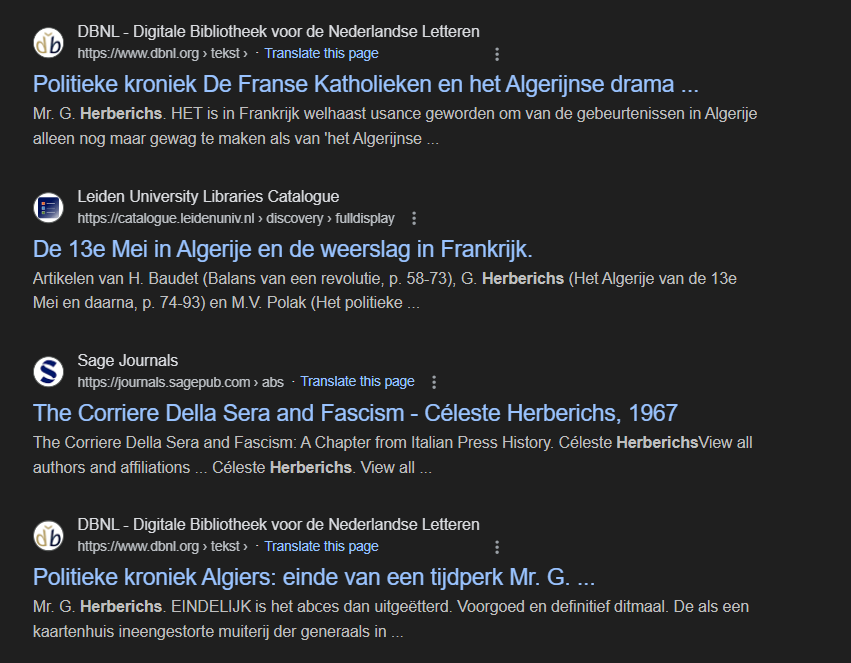
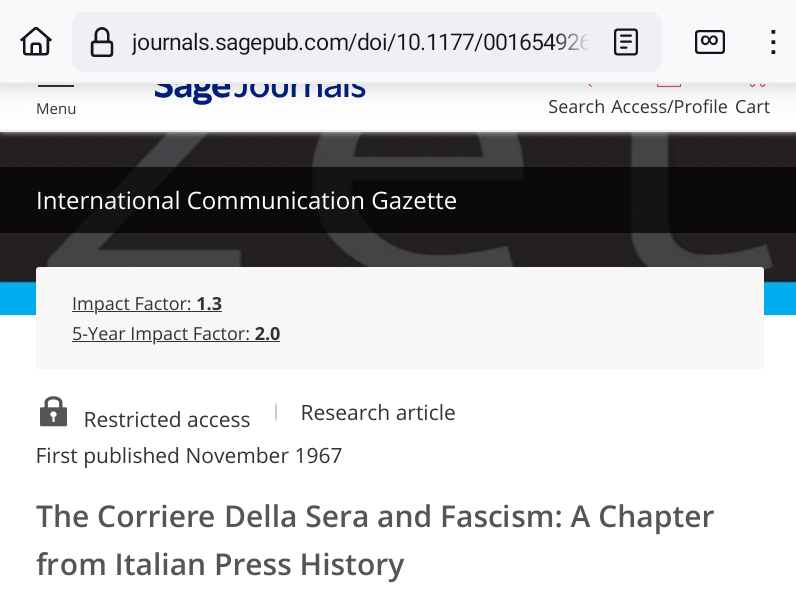
They both still fairly recently got cited, the brother for what he wrote about torture in Algeria (see the above screenshots) and she for what she wrote about the Italian press under Mussolini (see the screenshots and link below).

https://journals.sagepub.com/doi/10.1177/001654926701300404
Gérard also appears to be mentioned in this publication: https://www.degruyterbrill.com/document/doi/10.4159/harvard.9780674729964.intro/html


Céleste also had three sisters.
One of them – Maria – was married to a Wageningen University graduate who worked for or advised the Dutch government on agricultural matters, or so I seem to recall. I remember visiting them in Tilburg once.
Two of the sisters lived nearby, but we only interacted with one of them, namely Paula. Her husband got us our first TV, a Metz, and we had a rotating TV antenna in our attic space for optimal reception. We controlled the antenna with a button next to the TV. Paula moved to Australia for her health, with her electrician husband (who was supposed to get a teaching position there, but it didn’t materialize) and their three sons. The Dutch climate did not agree with Paula and her GP or specialist advised her to move to a better climate. (I have that in common with her; the Dutch climate and environment do not agree with me either. I became so much healthier after I moved to Florida.) Paula and her family spent the last night in the Netherlands at our home. That was in 1970, I think. For years, I corresponded with the eldest of those three sons. He was a very serious guy. He has a master’s in economics from Adelaide University.
The third sister – Ineke – wrote poetry under the pseudonym Francine Rijkegras. See https://collectie.letterenhuis.be/doc/au::53480:1 and https://www.dbnl.org/tekst/_chr007197801_01/_chr007197801_01_0033.php?q=sla as well as https://link.springer.com/chapter/10.1007/978-90-313-7659-9_16
Ineke, apparently, also felt like an outcast. I do remember vaguely that people in my family didn’t understand her and felt that she made too much of a fuss of things or something and they certainly didn’t like the way she wrote. She talks about her place within the family in this Springer chapter, in Dutch.
“When I dare to be powerful, to use my strength in the service of my vision, then it becomes less and less important whether I am afraid.” – Audre Lorde
“The thing that makes you exceptional, if you are at all, is inevitably that which must also make you lonely.” – Lorraine Hansberry
I read these two quotes in a campus newspaper in Florida in the 1990s. These were things that I needed to learn or hear or be told because nobody’s ever really believed in me (other than my mother who passed away when I was 14). You need to get your strength from within you, but it helps to have some support, even if it is only through a sense of connection with women who’ve gone before you.
Céleste never married. She was engaged at some point, but to a guy who turned out to be married, if I remember the latter correctly. She was already a little older then, certainly no longer in her twenties. It went and still often goes with attending university, for women. It does not look like she got her doctorate.

That this paper by her was mentioned in 2014, 45 years after her death, by a social communications professor, would likely make her smile now.
There is newspaper archive in Schiedam, the Netherlands with another item written by her, in Dutch, published in 1966, under which she lists her degree. She had a Master’s in Psychology. She was a feminist too, by the sound of it. She emphasized the importance of women’s roles in households as opposed to seeing women as part of the furniture.
Isn’t it strange how much we seem to have been alike, how we went our own way? We got degrees, developed opinions, so we wrote and published, traveled the world and were active in international organizations.
I was often made to feel like an outcast within my family (though that is probably mainly on the part of my two siblings, who were taught to vilify me by my dad and to treat me like a sacrificial carer by my mother). As it turns out – thanks to the interwebz – I fit in just fine.