Some time ago, I spotted this (in relation to Trump’s deal with Ukraine):
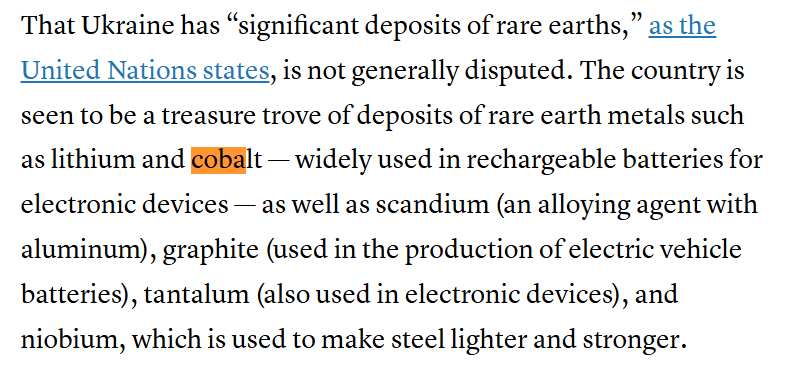
Lithium, cobalt, niobium, graphite etc are not “rare earth metals”, however, and this is why the China angle remains so important. China has the monopoly on extracting rare earth elements (processing the ore and separating the elements) which is hard.
The United Nations are the source of this rare earth element confusion:
https://unric.org/en/rare-earths-and-strategic-minerals-in-ukraine/

What the author may have meant was that lithium etc are also of strategic importance. That is correct.
The UN report also called nickel and graphite a rare earth element.
Nickel is a base metal.
Graphite is the stuff in your regular pencils or the stuff that some people use to grease locks and what not. It’s carbon. Specifically, graphite is carbon in a layered crystal structure with electrons hovering between and able to move within a layer – and layers able to slip past each other – but not across it. I’m saying this off the top of my head. (A different crystal structure for carbon but that only develops under great pressure? Diamonds.)

A little bit later in the same CNBC article, CNBC’s Holly Ellyatt correctly writes:
“There’s been a lot of buzz about Ukraine’s rare earth minerals, but the country does not in fact have large quantities of rare earth elements, according to experts at the Atlantic Council.”
“What it has instead is significant reserves of titanium, graphite, and lithium, which are foundational resources for the U.S. defense industry and wider high-tech economy,” Reed Blakemore, director of research and programs at the Atlantic Council’s Global Energy Center, commented online Wednesday.”
For those who don’t know that: I’ve done quite a bit of rare earth element (REE) research, within a scientific context. I’ve also extracted and separated REEs in a clean lab, over two sets of ion chromatography columns (Chelex 100 column and AG50W-X8- cation exchange column).
