Bioethics is a combination of science, medicine, technology, philosophy and law. Law in itself is also based on philosophy, but legislation lags behind reality whereas bioethics is forward-looking. Clinical bioethics (medical bioethics) is a major subdiscipline of bioethics.
Bioethics is about equality and fairness. It’s about treating people as well as non-human animals fairly, about making sure that certain groups of individuals are not being disadvantaged. It’s about justice.
- So this has to do with all forms of diversity, including so-called disabilities or impairments such as deafness and autism, and also personality disorders as well as for example bipolar disorder, along with the way we look.
- This is, therefore, also about inclusivity – and its opposite, otherization and the neuroscience that explains how otherization comes about. It is even about phenomena such as stalking and extremism because they are often related to otherization. It’s about police brutality, too.
- Of course, it is also about speciesism, consumerism and anthropogenic pollution. Do we have the right to destroy the habitat of other species just because they are other species? Do we have the right to exploit non-human animals? Do we even have the right to pollute?
It’s about politics and policy and governance and public administration. It’s also about encouraging public debate.
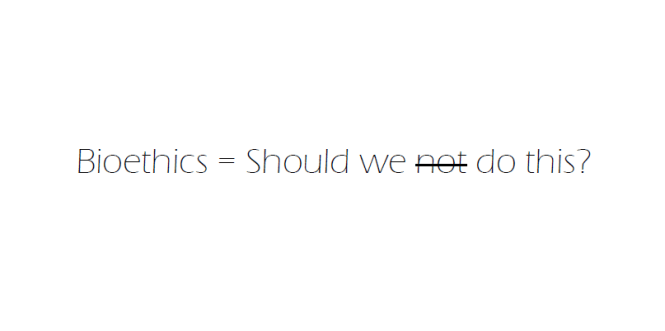
Discussions in bioethics largely revolve around the following two main questions:
- Should we do this? (That is: Would this be the right thing to do?)
- How should we do this? (That is: How can we do this as fairly, as equitable as possible?)
It’s about the avoidance of harm.
(A powerful example is the case of He Jian Kui and the deployment of the CRISPR technology. Not only did He Jian Kui spend three years in a Chinese prison after his illegal CRISPR experiments, in which he created gene-edited human babies, the shock effect of what he did also reverberated around the world and caused American policy to flip repeatedly in a short time period. Another example is the so-called Groningen protocol and the resistance against it around the world. The controversy surrounding deep-sea mining is an example too as is just about everything that happened with the context of Covid-19.)
In a sense, it is about balance, about the need to maintain an equilibrium.
The seeking of equilibrium is a dominating factor in the physical and natural sciences. It’s why a ball rolls downhill, not uphill. It’s why a radiator is able to heat up a room and doesn’t simply stay hot all by itself. It’s why winds blow. It’s why mountains develop and it’s also why they crumble. It’s why species can go extinct. It’s why ocean flows can change and why ice caps can melt and why climate change is taking place. It’s why chemical reactions occur and it’s how biological organisms function. It’s why you are able to have light when you flip that switch. It’s why birds die and crops fail when humans kill insects. It’s why dams in rivers are no longer seen as brilliant solutions.
So it’s about consequences.
(Exercise: Can you define what harm is? Can you give an example of justifiable harm? Can you come up with a good dividing line between justifiable harm and inexcusable harm? This is also how a lot of law comes about. It’s about avoiding causing harm or damages and about remedying incurred harm or damages. Intent plays a role as well as the degree to which it is possible to avoid harm or damages. It’s often about a duty to take care, by all parties involved, but within reason.)
Inequality is the result of otherization, which is the result of power imbalances but also of neuroscience. So, forms of deprivation such as food poverty and fuel poverty are also tied into bioethics. So is climate (in)justice.
Discussions in bioethics often sound highly esoteric, not only to lay people but also to people who work in the physical and natural sciences and in related technological fields. For them, ethics questions are usually about needing to comply with some kind of pesky regulation or ticking a number of boxes for some committee. It’s often a mere afterthought in a research proposal, often overlooked and rarely explored in some depth.
Sometimes, it crops up in spite of that reluctance of many scientists to consider ethics questions, for example, when they call a human-animal chimeric embryo a “thing”. This is a highly unscientific term, after all. It seems to reflect a desire to distance themselves from the “thing”. While these researchers are making sure that they are not letting the embryo develop into a full-grown organism, the fact that they refer to it as a thing hints at a level of discomfort. They may be worried about possible unintended consequences of their work, about upsetting the balance.
They are also asking themselves:
- “What does it mean to be human?” and
- “Is the distinction between us and non-human animals really that great?”
Bioethics is a very hard field for people who work in the natural and physical sciences, because it does not naturally need to follow the laws of physics or rigid definitions. It forces people to think very deeply and consider questions from many different angles. It also requires people to explore their own conscience and principles. It asks them to step out of their comfort zone.
It was Fritz Jahr who came up with the word “bioethics” in 1927 when he published the article: “Bio-Ethik: Eine Umschau über die ethischen Beziehungen des Menschen zu Tier und Pflanze” (Bioethics: A look at the ethical relationships of humans to animals and plants”).
Jahr also introduced what he would later call “the Bioethical Imperative”:
“All living beings are entitled to respect and should be treated not as means but as ends in themselves.”
So “bioethics sensu lato” is about accommodating human and animal diversity and allowing everyone enough space to breathe and flourish, according to their own wishes and without harming anyone.
This obviously means that we have to look after all species’ habitats as well as our own (earth) and it also entails that bioethics includes medical and legal aspects.
BIOETHICS-RELATED LINKS
- Hastings Center, US: https://www.thehastingscenter.org/
- Oxford Uehiro Centre for Practical Ethics, UK: https://www.practicalethics.ox.ac.uk/
- Centre for Global Science and Epistemic Justice at Kent University: https://research.kent.ac.uk/global-science-and-epistemic-justice/
- Petrie-Flom Center for Health Law Policy, Biotechnology, and Bioethics at Harvard Law School: https://petrieflom.law.harvard.edu/
- Center for Law and the Biosciences at Stanford Law School: https://law.stanford.edu/center-for-law-and-the-biosciences/
Also of importance:
- European Group on Ethics in Science and New Technologies (EGE): https://research-and-innovation.ec.europa.eu/strategy/support-policy-making/scientific-support-eu-policies/european-group-ethics_en
- The International Association for Promoting Geoethics (IAPG): https://www.geoethics.org/iapg-info
- Rathenau Institute: https://www.rathenau.nl/en
Bioethics sensu stricto is clinical or medical ethics. It’s called “zorgethiek” in Dutch. Care ethics.
It all often boils down to this:
To worship the Earth is not to deify her or believe she is any more sacred than ourselves. To worship the Earth is to love her, to take care of her, and to take refuge in her. When we suffer, the Earth embraces us, accepts us, and restores our energy, making us strong and stable again. The relief that we seek is right under our feet and all around us. Much of our suffering can be healed if we realize this. If we understand our deep connection and relationship with the Earth, we will have enough love, strength, and awakening so that we both can thrive.
– Thich Nhat Hanh
