Chapter 5 from my book “Is cruelty cool?”
Although most of us think the opposite, we are all capable of cruelty. All it takes is for someone or something to push us into it. Few of us feel joy when we bite off someone’s ear or stick a knife into someone’s stomach, though. Even those who think that they do may actually be wrong about that. I’ll come back to that.
Most of us will never even go there, fortunately.
The tolerance for cruelty in one’s environment plays a major role in how likely we are to engage in cruelty, however. Even talking about cruelty makes it easier to commit cruelty, neuroscientist Kathleen Taylor stated in her book about the topic. We are all capable of cruelty, but tend to assume that it takes a lot to get pushed into sadism. It’s a sliding scale, really. The difference between us and the “bad ones” probably is much smaller than we assume.
People who engage in cruelty usually don’t stop if you ask them kindly. One of the hardest and most dangerous things about cruelty, I have found, is that in order to make it stop, you sometimes have to say very ugly things. That’s a slippery slope and you have to remain very aware of it. It can not only make you cross the threshold into cruelty more easily, it also has the capacity to start eating away at your soul. When people otherize you, however, they feel that it is okay to violate your boundaries. If you allow other people to violate your boundaries over and over again, you start moving into trauma territory. It’s important to defend your boundaries, even if it makes you feel highly uncomfortable.
I have an example for you that will probably show you very well what I mean. When I was living in Portsmouth, I got really fed up with being hassled in the streets. This often came from guys and sometimes also women who were around forty years younger. England has a pretty misogynistic culture. (It is also shockingly gerontophobic.) One day, when another young guy started to hassle me, I asked him very politely if he wanted me to cut off his dick. I was not threatening to cut off his dick. I merely asked him if that is what he wanted me to do. I don’t think that I was showing any anger, but I wasn’t smiling either. I was certainly cold. I was fed up. My reaction was spontaneous and its effect stunningly powerful. This kind of response sadly is often the only thing that works when you are being otherized in an unacceptable manner. You have to cause the other party to start feeling fear and discomfort, enough to cause him to back off and leave you in peace.
As someone once said, it’s easier to raise happy, healthy children than to fix broken adults. Right now, the wars that are going on in the world, the extreme violence that Hamas imposed on the audience at a music festival in Israel, the retaliatory activities of the Israeli government, and the abduction and brainwashing of Ukrainian children that the Russian regime engages in, that’s where some of tomorrow’s sadists and terrorists are being created. Such people are also being moulded by the outrageous hate-mongering by people like Donald Trump, Geert Wilders and Rishi Sunak and also, when the mood grabs him, Nigel Farage.
Let’s go back to bullying to explain what I mean. Childhood bullying causes deeper and longer-lasting trauma than child sex abuse. That says a lot. Can childhood bullying turn child victims into sadistic adults? Perhaps. If we believe what Scottish serial killer Dennis Nilsen told forensic psychologist Kerry Daynes, as she described in one of her books, then bullied children can even develop into adult serial killers who seek to recreate victory over their bully over and over again.
I learned a lot about cruelty and sadism after I became the target of so-called sadistic stalking in combination with community abuse in England. Sadistic stalking is also called resentful stalking. In some cases, you can see how the resentful stalking behaviour was the outcome of many years of profound otherization and rejection. People’s anger and hurt begin to simmer. Eventually it all boils over and they start planning revenge. This has nothing to do with true joy, but sadism can start to play an increasingly larger role in these people’s actions.
What motivates someone to go into a woman’s home, take three or four birth control pills and deposit them into a cup at the woman’s place of work? It causes powerlessness and it messes with the target’s mind. As a victim, you can’t explain it. You can’t talk about it to others either because you’re going to sound crazy. It pushes you into a mental prison. This is one of the things that happened in a well-known case of sadistic stalking that began in Gosport, on the other side of Portsmouth Harbour. A ferry takes you from Portsmouth to Gosport in 15 minutes.
It concerns a man who was called Anthony Burstow until he legally changed his last name to that of one of the boyfriends of that particular woman he was stalking. It is very easy for English people to change their name. Unlike in other countries, you do not need a specific or serious enough reason, such as childhood sex abuse. You can simply do it and you can pick any name you like. I know a guy who changed his name to “DK”, for example.
Anthony Burstow was working at the Navy as a communications specialist. His victim was a newly married colleague who was called Mrs Tracey Sant at the time. Burstow went to prison for life after he tried to kill his next target, a woman whose first name is the same as that of the forensic psychologist who supported Tracey Morgan. Lorraine Sheridan.
I can’t help wondering if that is why he picked her. When he approached Mrs Tracey Sant-Morgan, he said that his wife’s name was Tracey too, after all. He claimed that his wife was stationed far away in Asia and that this is why he was very lonely. This next victim – Lorraine – had just discovered who her colleague and new friend really was because he had been featured in a TV program, under his old name, and she recognised him. Desperate, he started cutting into her wrist to hack off her hand. As far as I know, he had intended to kill himself after he killed her.
Before I forget to mention it, I should say that I suspect that cognitive deficits (or cognitive differences) played a role. This appears to show quite clearly in one of his statements made during his prosecution in the case of Ms Morgan. If I had not looked at a particular stalking case in Florida earlier, I would not have spotted it. A lifetime of otherization and rejection may have made him angry, resentful and desperate.
Specifically, there are similarities between Tracey Morgan’s case and the stalking that happened to Laurisa Anello in another city where I have previously lived, in Florida. It’s easy for me to see persistent profound otherization and rejection of the perpetrators as the cause in both cases.
Particularly in cases of stranger-stalking, stalking victims too become excessively otherized. The lack of support for these victims actually enables longer-term stalking. Mrs Sant was stalked so extensively and so persistently that even her husband left her, unable and unwilling to deal with it any longer. Apparently, he particularly couldn’t stand the idea that their bedroom had been bugged. Along with all other members of his extended family, he cut off all contact with Mrs Sant. She went back to being Tracey Morgan and moved in with her parents, in another county. Her job had gone up in smoke. Her stalker promptly followed her to the county in which her parents were living.
Sadistic stalking has a lot to do with control. It’s not necessarily control to attain something else, although it can be. It is often control for the sake of control, out of resentment. It is control in the sense of having the ability to tear the wings of a butterfly to destroy its ability to fly. (Is that because it can then no longer escape or because the perpetrator cruelly enjoys watching its struggle?) Control is not only a major factor in sadistic stalking; getting confirmation of the other person’s powerlessness, frustration and confusion can even serve as a trophy.
Most lay people and many police officers are often overly romantic in their assessment of stalking cases, but there can be a small seed of truth in it. These so-called sadistic stalkers often seem to be after a sense of connection, of belonging, but lost the ability to connect in any other manner a long time ago. Maybe they never even had it. Control can be a way to impose that sense of connection. Maybe it’s akin to how some men will rather tear something apart or rip it off a wall rather than seek a screwdriver to disassemble or remove something. It follows that such men are unlikely to be great builders or wonderful creators. Anyone can take a sledgehammer to a brick wall, but few can build one.
So in order to create a connection, some men resort to force (in the sense of controlling the other person). They don’t know how else to obtain what they want. This is all about what they want, however. The brakes – the controls – in such a person’s mind often don’t work properly. It’s like what you see in very young children who have not learned yet that others have needs and wishes too, as well as boundaries. They only care about what they want.
Some people mistakenly do believe that the infliction of cruelty brings them joy. I believe that this has to do with our biology. I learned this during my abuse in Portsmouth. I was constantly on edge for what would be next. Had they picked the locks again, gone into my home again? Had they carried out vandalism again, loosened another electrical wire, flipped a switch, caused a leak? What important postal mail had they stolen from me this time, requiring me to take instant urgent action, and likely leading to further havoc down the road? Which animal were they going to attack next? Were they going to kill it or merely maim it? That its only sin was that it served as a suitable tool to get to me to spite me left me with a terrible burden of guilt again and again.
In Portsmouth this kind of thing was considered normal.
While others were launching successful YouTube channels about their experiences with non-human animals, I became pretty much terrified of the idea of doing anything like that, because it would lead to attacks on animals if whoever was doing this to me recognised any of the animals in question. Particularly – but not only – mentioning online that I was doing or planning something or mentioning a particular animal or posting a particular photo that would often result in cruelty, whether it was an attack on an animal or sabotage of a work project. Sometimes, I would get some kind of warning, such as an odd, vaguely threatening DM about “my dog” on Twitter, asking me how my dog was getting along with my bird. I didn’t have a dog. It felt really creepy and, yes, it was followed up. The bird in question was interfered with in my home while I was out.
That’s sadism. Vicious targeted cruelty intended to make someone feel intense physical or emotional pain. It’s very hard to live with the realisation that someone hurt some innocent animal just to spite you. This happened multiple times.
My body had trouble handling this level of stress. I used to sign many petitions, including petitions related to animal abuse and cruelty and I noticed that my physiological response to cruelty began to change. I began to feel something that I initially mistook for joy. Although I fought it successfully, I hated having been confronted with this change in my response. It made me angry with the anonymous people or person around me who continued to expose me to so much cruelty that my body felt that it had no choice but to change its stress response to cruelty to preserve its health.
This is also what may have happened to many people in Nazi Germany.
Cruelty breeds cruelty.
Another thing that I noticed a few times back then was that when someone walking in front of me was using a crutch, I found myself thinking the horrifying thought “What if I kicked the crutch away?” (This is called an intrusive thought.) I hated that too. That kind of thought had never crossed my mind before. Fortunately, most of the time I wasn’t thinking anything like that at all.
Cruelty breeds cruelty. The more often you think cruel thoughts, the lower the threshold becomes towards acting on them, Kathleen Taylor explained in her book “Cruelty”. This will also happen if you are subjected to a lot of cruelty. It is very hard not to think of cruelty when you’re experiencing it.
By the way, this process may have been described by forensic psychologist Lorraine Sheridan as one of the goals (or at least a result) of sadistic stalking. Its aim can be to “spoil” someone, to take a happy, good and content person and “ruin” that person. That has to come from a terrible place of powerlessness within the perpetrator, hasn’t it? It’s like a toddler angrily destroying a favourite toy.
I suspect that inflicting senseless cruelty, perhaps particularly to animals, can also be like a loud cry of powerlessness, a screaming of “This much is how I hurt!” for people who have no other way to express their pain. They fling it away and inflict it on others so that they still get to share it with someone. Could it be related to self-harm phenomena such as cutting? Is it a symptom of extreme narcissism?
In my deplorably bleak and fairly typically English situation, there were very few sources of joy left. I am sure that this also had something to do with the change in my response to cruelty. I once used to socialise, but there was nobody left in my life to call, go have a cup of coffee or lunch with or share a pizza and watch a film with. I was trapped and alone, without support, often stuck in deep poverty with people around me pestering, mocking and ridiculing me, in a way that people around Ms Morris surely have done to her too.
Eventually, I realised that what I was feeling when I saw images of gore and cruelty was not joy at all. It was a physical sensation that I was associating with joy. It felt like the veins and arteries in my body relaxing instead of contracting, as they would do in fear (fight or flight). It was a solar plexus kind-of feeling. It was not associated with my thinking or intentions. It’s not joy. It’s despair.
Just like other physical phenomena such as an increased heartbeat can make some people think that they are scared and in danger when they aren’t, something like the reverse can occur too. I don’t know what happens during joy, physiologically speaking, but during stress, the veins contract and blood pressure goes up and whatnot.
Emotions often serve to tell us what we need to avoid or seek out. If it becomes impossible to avoid cruelty, as had been the case for me for at least a decade at that point, something may have to change after a while. The body may have to decide that cruelty is all your life is still about now and that you had better start enjoying it because you might die of a heart attack or suffer a stroke if you don’t. That’s a real possibility.
There’s been a sadistic stalking case in which the perpetrator dug up the bones of the target’s deceased husband and dumped them on her doorstep. The woman had a heart attack. Apparently, the intended message had been “What has he got that I don’t?” Not surprisingly, the woman’s mental health had also declined greatly during the course of the stalking; she had to spend some time at a clinic to regain her balance after her stalker went to prison.
By the way, the correct term for what I call joy here may be “excitement”.
Research has in fact shown that when we are physiologically stressed, we also tend to underestimate danger. The purpose of that is purely to keep this physiological stress response under control because it’s so damaging to our health. It does not happen consciously. It comes from the gut, so to speak. It comes from the endocrine system.
Is that why cruelty is considered so shockingly normal in England? Are people in England exposed to so much cruelty that many no longer see cruelty as wrong?
With all of this in mind, I can imagine what may be taking place in the bodies and developing brains of young children if they are relentlessly subjected to repeated cruelty and little else. I shudder to think of what that may result in and how powerless and helpless these children are. A two- or three-year-old does not know what I know, that what he is feeling is not joy or excitement but his body’s desperate attempt to stay whole. Thus he may learn that inflicting cruelty makes him feel better. Because it is all he knows. It is the only thing that still has the ability to make him feel better.
Maybe that is how you end up with adults, as malignant narcissist Sam Vaknin has put it, who have as much in common with neurotypicals as they have in common with long-necked giraffes. Sam Vaknin grew up in Israel and used to enjoy hurting people. If he knew that people had any suffering in their lives that was related to the Holocaust, he would target them with Nazi swastikas, for example.
That was the kind of abuse I was being targeted with, except it was also often merely about my perceived weaknesses and as such often just childish and annoying, besides frequently time-consuming and distracting. I still find its persistence, its obsessive nature, creepy and scary.
Inspired by what I read in Taylor’s book, I concluded that there was a high likelihood that the anonymous person in my life who committed the acts of animal cruelty to spite me uses the deployed rotary cutting tool on a daily basis. Perhaps he held some kind of job in construction. That alone would lower the threshold towards committing these cruelties, because of the force of habit involved in it. That makes sense. The action is semi-automatic. It could also be someone who slices into meat daily, such as a butcher, but I felt that the former option was more likely. I don’t know why I believed that. It was just a sense that I had.
How did I conclude that the cuts were made with some kind of rotary cutting tool? I noticed a pattern and I asked myself what could have made such a pattern. I’m a scientist. I can figure shit out.
Then one day, someone stood behind a van, near my home, and held a buzzing rotating tool up in the air when I walked by. It’s called an angle grinder.

The town in which I was living at the time – Portsmouth – has a reputation for cruelty and violence and is known as one of the hardest places in the UK. Some even call it the hardest, and that is “hard” as in “tough” and “callous”. Callous as in cruel. Was that where all the abuse was coming from? I don’t think so. I think there was some form of neurodiversity behind it or some kind of pathology, but I found it hard to tell. I didn’t know anyone locally. None of the locals ever admitted to knowing anyone else in town, let alone knowing anything about what was going on.
In 2019, after I came home to vandalism in my home again, I asked two professors in the Netherlands – people who I didn’t actually know but who I had been editing a paper for at the time – to contact the local city council leader on my behalf as I no longer had any standing in the town. I had already been asking for help for years, to no avail. Most people just shrugged. I was just another stupid foreigner to them or just another stupid old cow or just another whatever.
One of these professors made that call. I had sent him photos and I probably also sent those photos to the city council leader. I had an appointment with the city council leader about a month later, but meanwhile something else had happened and this guy didn’t want to discuss the problems that I was dealing with at all. This concerned a Liberal Democrat, by the way.
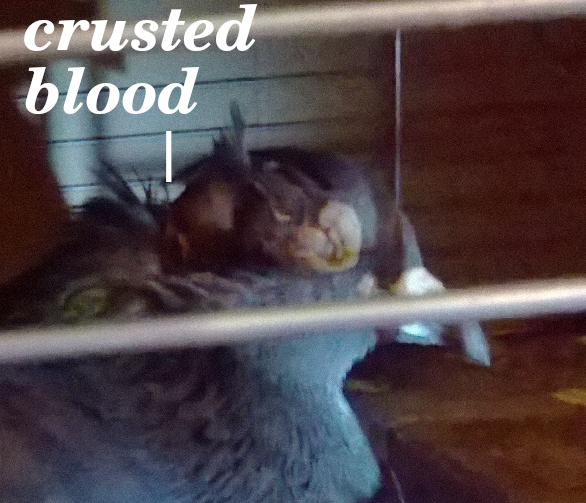
When I met with him, this also was not long after the attack on the bird in the following photo had occurred. I informed the city council leader of this, too. The poor animal was in terrible pain and came to me for help. Someone had cut into her with an angle grinder just to spite me. (It may have happened on the window sill under me, as I had heard some commotion. It woke me up. I later once overheard the guy who was living there take instructions over the phone. I also once caught this person leaning back against the wall to go through my postal mail at great leisure while I was tying a shoe lace a few stairs above him, unbeknownst to him.) Her previous mate had already been killed mercilessly, also merely to spite me. I’d received a warning about that, too. I’d received a warning about both events.
As I would often get very upset and scared when I talked about what was going on, I had typed up a few things and had printed that, along with a presentation given by an English forensic psychologist at the University of Leicester about sadistic stalking and an article in The Atlantic about psychopathy. The city council leader ignored it all.
He literally shrugged when I asked him again what we were going to do about this kind of stuff, in that moment ascribing it to the problematic local culture. We were standing in the elevator. I felt so powerless. I was like a rotting potato to him. Why?
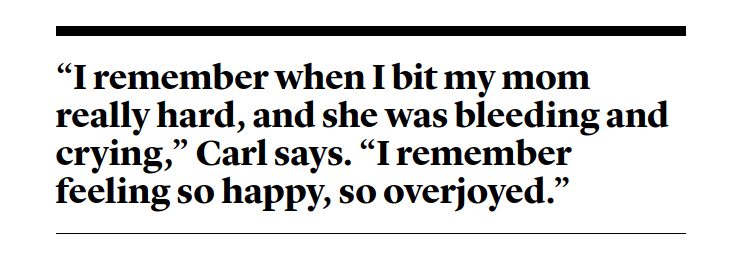
That text is a screenshot from the article in The Atlantic. You instantly realize that this statement doesn’t make any sense. Remember what I just said about this possibly having something to do with the endocrine system? This is the sort of sadism that I was exposed to. I was even also often called “mum”, among other things. Earlier, I had asked around and tried to find someone with a foreign partner who abandoned him or something along those lines because among other things, there seemed to be a lot of anger about me even visiting the websites of CNN and NOS.
Was it the two brothers whose Austrian mother had suffered badly during the Second World War? One of them is a hacker and the other one apparently also used to work in IT. Growing up, the two brothers apparently weren’t happy at home, complained about it and then became subjected to sexual abuse elsewhere. I don’t know whether that is true or whether this is something that they merely wanted me to believe, perhaps to generate compassion and make it more likely that I would put up with their abuse. They are masters at planting ideas.
I’ve been told that one or both have DID (dissociative identity disorder) but also that it may concern malignant NPD (narcissistic personality disorder) with psychopathy and in addition, it’s been hinted that they both have Asperger’s (or autism, more generally). How the hell should I know what is what when it concerns people who I don’t actually know and who nobody in the town that I was living in was willing to admit they knew or had heard of? While there can be overlap between these states of being, what’s what makes a big difference with regards to how you interact with people and for how you have to interpret their actions.
For about two years, they diligently tried to brainwash me into believing that I had been sexually abused as a child and had multiple personalities. If I hadn’t gotten a brief reprieve at the end of 2010, they’d have driven me around the bend. There’s been similar nonsense since. Most recently, they seem to have been trying to “prove” that I am severely autistic and have ADHD. When I am rigid with despair and powerlessness because they are still targeting me after all these years, which I find terrifying, do they misinterpret the stone-faced rigidity as “autism”? Or are they using it to be able to tell other people that I have autism as part of their game? A great deal of this really is just a smoke-and-mirrors game to the people who do this stuff.
My situation was dire. When I met with the city council leader, I had already made four escape attempts. I had included that information in my statement for him too. I could no longer support myself, could no longer remain functional in any kind of paid capacity. Twice, I had walked out of Portsmouth in the dark, with two wheeled suitcases. I was that desperate to get out. I wanted my life back.
This had begun years before. I couldn’t believe that it was still going on. What on earth was this? What on earth did the person who was doing this to me want from me? Why was he targeting me? Was it just because I was easy to target as a migrant who nobody knew and who didn’t know anyone, in an extremely insular town on a tiny island where he controlled the narrative and had already pitched people against me before I even moved to it?
Or was it really merely the crazy, extremely insular and often very hostile local culture that I was dealing with? The Pompey ‘ndrangheta?
At one point, I got the message that I was “actually a really nice woman”, and I thought to myself “No shit, Sherlock”. There’s been a lot of painting me black throughout all of this; a lot of people seemed to have been told that I am a horrible woman (besides that I am learning-disabled and whatnot). I know that I am not a horrible woman and I’ve always been pretty confident, so it didn’t hurt me but it did hamper me.
Things were really bad. In 2010, I lost a lot of weight, surviving on acorns and other things that I found. I didn’t know that my locks were already getting picked back then. It would take me until 2022 to figure that out. I had no idea. I knew that someone had been in my home and I did talk this over with the police and with someone else at the time, but I thought that it had been the estate agency. Later, I learned something that made clear that it couldn’t have been the estate agency and that it had happened several times. At my next address, the lock-picking became very frequent.
The sadism that I was subjected to was relentless and horrific and remained relentless for years. I often lived without electricity, hot water and heating, and frequently survived on food and coins that I picked up from the streets. Sometimes, food was left for me on the corner of the street. One time, a woman with some kind of mental health problem walked up to me and handed me half-frozen meal. (Another time, a young woman with Down syndrome was sent after me to mock me, whoever did it ruthlessly abusing her by getting her to smear lipstick all over her face.) People saw me rummage through garbage cans and I attended various food handouts. I had no choice. I had to survive.
At one of those occasions, one of the pastors played a little prank on me. The result was that I walked two hours through the pouring rain, not once but twice, for a non-existing food handout. When you’re hungry, that is the kind of thing that you do. In the homes of the poor, wet shoes and clothes takes days to dry. The food handout was “the body of Christ”. This prank was possibly suggested to the pastor by someone who has relatively little cognitive empathy, but on the part of the pastor, the prank was pure sadism.
What went on was unbelievably extensive, often very sadistic and utterly relentless. So massive, also geographically speaking. The latter makes it likely that there was 4chan involvement. There was a tremendous amount of hacking and the lock-picking meant that I couldn’t stop that either. The longest I’ve been able to keep “them” out was about a month.
Meanwhile, random people around me were often openly abusing me too, verbally and sometimes also physically as you’ll remember from the bucket incident. I had no social life whatsoever. I basically couldn’t go anywhere in that town without being pestered. (It also sometimes happened that people pretended that I wasn’t there.) Nobody knew me, but I knew that other women who were deemed too independent had also been pestered. It happened to Alice, for example. It had also happened to Audrey, who I hadn’t believed. I thought that she sounded crazy. Successful Scottish business owner Paul was driven out of town. He was treated to his personal version of Pizzagate; it got the attention of the national media and was referred to as a xenophobic campaign.
At a business workshop, someone said to me that I was being targeted because I was from Amsterdam as if this was a perfectly normal thing to do. I’ve also received the suggestion that I was being targeted because someone hadn’t liked the name of my business. I was self-employed. My money came from mostly clients outside of the UK, however, and I was spending it in the UK. I wasn’t taking anything away from the Brits. Why push me into deep poverty? Why turn my life into a nightmare?
All of this got me thinking a bit more about England and cruelty and joy. England is often such a joyless place. Could cruelty also somehow be related to things like the “stiff upper lip” phenomenon? I found some explanations for the really crazy place that England often is in Victorianism and I found a few more in utilitarianism.
Then I started to ponder the stiff upper lip. This came about in England as a result of a fascination with the stoics. It is the opposite of taking a Buddhist or Zen approach because that would acknowledge feelings without judgement whereas the stiff upper lip approach suppresses them completely. It’s been described as “unwholesome” and as “leading to stunting”. Might the stiff upper lip also in part explain for example the massacre at Amritsar? Wasn’t that, too, cruelty and perhaps even sadism? Wasn’t that like what happened in Nazi Germany?
If you repress all your emotions, which the English appear to believe all “proper” adults should do and which they probably still teach their children, cruelty can become seen as okay. That’s because you will eventually no longer have a good sense of what you’re doing. You lose touch with your emotions – those so important signals from your body that steer you towards or away from things – and they may eventually stop meaning anything to you.
Are empathy and compassion still possible if you don’t allow yourself to feel much? Cognitive empathy, yes, we all have that (perhaps not so much if you happen to be autistic but then you likely have oodles of emotional empathy) ), but what we usually call empathy is emotional empathy. Aren’t you in danger of behaving like a stereotypical psychopath while seeing nothing wrong with that if you suppress your emotions for far too long? After all, you’ll think it’s normal. You may even think that it is cool, that it means that you are super-tough now.
Could cruelty then become the only thing that can still evoke an emotional response in people and can make them feel alive? Is this why England can be so horrifyingly cruel?
And, again, if you grow up while not being allowed to feel anything good but are exposed to a heck of a lot of cruelty, might this teach the body (including the brain) that no longer getting stressed out over cruelty means that you are enjoying it? If you grow up, from baby to toddler to young child to teenager, with cruelty being the only constant factor in your life, how do you know that other things exist such as spontaneous bubbly laughter, hugs or tickles that bring genuine joy? If cruelty is the only thing that produces something in your body that feels like it might be joy – even if it has only developed to protect your health – how can you avoid not pursuing it as the only source of joy that you know?
I am getting into some really dark territory here.
I am also sure that I am upsetting a lot of English people with my lack of diplomacy, my refusal to ignore the elephant in the room. English culture is cruel. I’ve even called it hate-based, but it’s more appropriate to call it otherization-based, except that this otherization comes with contempt. I blame that archaic class system for it because it’s something that no other country has. Remember the apparent tradition of setting young low-level staff on fire in the automotive industry in England? I’ve not heard about anything like this happening in other countries. There was also a case of bullying at Landrover Jaguar in England. A subsequent tribunal agreed with the employee in question, a landmark decision. It ruled “constructive dismissal”.
If you look into for example the murder of Bijan Ebrahimi in Bristol, you have to conclude that his murder was a lynching. Saying that it happened because a rumour was spread that he was a paedophile is no more than a weak attempt to explain away a shocking level of hate and cruelty. The elephant is right in the room there with you.
Mr Ebrahimi was still quite young, pleasant-looking, kind and gentle. He had dreamed of getting an education but became physically disabled and loved looking after plants. He had a back problem. He was Iranian. So he wasn’t old and he wasn’t ugly, but enough about him was “different” to result in the community bullying that eventually caused his lynching.
His lynching – with the aid of the police – did not take place because people thought he was a paedophile. It took place because at that point people had already been hounding him for seven years. He’d even relocated within Bristol to get away from the abuse.
Saying that he was killed because people thought that he was a paedophile is just an excuse for looking away and doing nothing. I’m sure that they’d called him many other names too. To protect himself, he started using cameras. People then pestered him about that. They said that he was using cameras because he was a paedophile.
Two police officers went to prison over this. Upon his release, one of them still claimed that he had done nothing wrong. City council staff was found guilty by the court too. It’s just like the story of George Cheese except that Bijan Ebrahimi didn’t kill himself. If he had, no police officers would have gone to prison and no city council staff would have been found guilty. You can bet on that.
So I am saying hard things in this book about England and its stiff upper lip, the general glorification of cruelty and the tendency to look away when bad shit happens to other people. I cannot pretend that it isn’t there.
Part of me wants to remain silent. I always worry about the backlash. I’ve had enough of being terrorized. I have also had enough of being treated like trash because I must be deserving of abuse because, after all, why else would anyone be abused. I often used to be scared in Portsmouth, afraid of retaliation. I was supposed to keep my mouth shut. I was supposed to pretend that Portsmouth was like sweet Chichester-by-the-Sea.
Particularly also the callousness of people in the so-called Establishment in Portsmouth, people who could and should have supported me or at least should have treated me with normal human respect, has shocked me deeply. The way they treated me was so dehumanizing, so disempowering.
I wonder if these people have any idea what persistent nutritional deprivation does to you when you’re in your fifties or sixties. Because of the constant lock-picking and there having been meddling with the water supply as well, when I had a little money, I had a water analysis carried out to make sure that nothing had been added to my water supply that was making me ache all the time. No, it was a matter of far too often only eating rice with or without tomato paste and little else. I needed far more protein than I was usually getting. The stress, too, was killing me. I was basically forced to live in fear and deprivation for around fifteen years. Examples? In 2010, I lost a lot of weight and survived on acorns. In late 2011, I began to develop two painfully frozen shoulders that had me completely incapacitated by Easter 2012. In 2016, I survived on coins and food from the streets. In 2017, I had pneumonia. I often lived without heating, hot water and electricity. In 2021 going into 2022, I lived without electricity for about six months. In 2022, I had a little cardiac incident. I still have broken-off teeth, too. It know what I need to thrive. Portsmouth was the opposite. Portsmouth was killing me. I desperately had to get out. I had to make sure that I had nothing to go back to. You see, unlike Tracey Morgan, I had no parents who I could move in with. My only option was homelessness with no access to income. That’s scary.
In December 2023, while I was working on this version, I suddenly realized that this probably remains my biggest challenge. To be persistently treated like you’re no more than a rotting potato that fell out of a garbage bag ripped open by an urban fox, by the people who are supposed to be there for you, that is indescribably destructive and debilitating. I no longer trust a soul. I probably need to find a way to recalibrate my relationships with humans.
When the hacking followed me to the Netherlands, when there was new hacking there, that really did me in. I was absolutely totally completely gutted, creeped out and so so so terrified. You cannot function in any paid capacity with someone so incredibly intent on overpowering all your equipment, and able to delete or alter grant proposals and alter captions or add a letter-scrambling LaTeX virus to a file for a scientist who’s dyslexic – as well as tamper with e-mails, phone calls and text messages, dump tons of videos of women’s thighs on your computer and gaming videos on your mobile. Yes, there is 4chan involvement.
Yes, I know a little about IT. I’ve had some programming as part of my education, I have once programmed a modem so that I was able to use e-mail on a late model XT, I have created huge websites in Notepad – yes, Notepad – and I have built computers from scratch. The fucking despicable gerontophobia and misogyny that crops up every time I mention hacking is awful; most of the zombies who indulge in it have never even heard of 4chan.
It’s all brought me closer to a lot of people who are treated like this all their lives, however. It’s brought me closer to for example Jewish people who were seen as stinking rotting disease-causing potatoes too about a century ago because other people were whipping hate up against them. That realization makes me ache. How do people survive that without going bad? It also makes me realize that the world is currently dangerously close to another Holocaust. The level of hate that is being generated by various politicians around the world is damn scary.
About that local Establishment… In the course of all this, I stumbled upon a stinking cesspit of local corruption. In April 2023, a local builder and property developer – and self-appointed local ‘ndrangheta capo, who sees himself as a peer of Donald Trump before he became President and surrounds himself with people who “would never betray him” – suggested to me that he and that Lib Dem city council leader who I had that meeting with in 2019 had been behind my abuse. He literally said that they wanted me to leave Portsmouth.
“Gerald and I want you to leave Portsmouth.”
I had merely wanted to be allowed to live my life and support myself. I had been allowed to do that everywhere else where I’ve lived, even in Southampton, the bigger town to the west of Portsmouth, not exactly a very welcoming place. “Gerald” and I have a university in common, but he got to have a life whereas he felt that it was okay for me to be powerlessly stuck in poverty and abused relentlessly? Why? Was it because of medieval ideas about women that he and many others in that town still held high?
“Gerald” knew very well that I was dying to get out of the damn place! I wanted my life back! My 21st-century life.
It’s more complicated than that, however.
In 2010, when the Lib Dems had the overall majority at the local city council, they sponsored my participation in a successful national pilot for a NCFE-accredited course in community leadership within the Take Part (in democracy) initiative. I became one of only 11 graduates; austerity interfered with the roll-out in the rest of the country. Austerity also interfered with the graduation ceremony; the venue was changed from the Spinnaker Tower to the Aspex gallery.
During this course, it was emphasized that one shouldn’t go about upsetting any apple carts. When I was a member of an environmental forum that had been set up by the council, someone told me that that too basically was a cosmetic exercise.
Now these Tories in sheepskin wanted me to leave town? Hmm.
Might that for example have something to do with me advising tenants of their rights and telling them not to accept everything that was done to them meekly? (Might that have had something to do with some of the videos I posted on YouTube, even?)
Might it perhaps also have had something to do with me having taken a local estate agency to court, as a LIP (pro se), and a local so-called “traditional” solicitor likely having lost her business if I had not agreed to settle for over £10,000? Said solicitor paid half of that settlement. Towards the end of that lawsuit (case no. 2PO00972), I was only still talking with the lawyers for the estate agency’s insurance company and a lawyer for that solicitor’s insurance company. Said solicitor, just like Gerald and the property guy, is part of the local old-guard Establishment. I had started that lawsuit also for the sake of a local Navy woman, to whom I forwarded half of the settlement sum.
Yes, I guess I can understand why they had a problem with someone who stood up for tenants’ rights and so on (yes, also other people’s rights). That makes it so much harder to keep the plebs dumb and under the thumb. I think that the reason they wanted me gone was that I was upsetting the local apple carts of power too much. Why else? Anyone who is a bit of an activist will run into resistance at some point.
That property guy, whose right hand and legal advisor went to prison for three years and was no longer allowed to practice law, let alone be a judge, certainly had been up to all sorts of targeted harassment. He didn’t even try to hide it any longer in the end. He makes use of very young poor Albanian guys and such. I’d seen some ugly messing with people’s tenancy agreements, too, to cover up mistakes. More shockingly, although I have no physical proof of the act, I am pretty sure that the property guy’s tenants’ housing benefits used to get meddled with by the council if the property guy asked for it. (Maybe it’s a good thing that housing benefits are no longer paid by the councils these days. If “discretionary” stands for “corruption”, we’re all in trouble.)
I am now sure that “Gerald” at least suspected most of this. (Gerald’s full name is a long double double-barrelled one, by the way, a bit like Boris Johnson’s. It’s Robert Gerald Van Cortlandt Vernon-Jackson.) Gerald possibly even knew about it in detail. He probably thought that all the bizarre stuff that was going on in my life, including the relentless sadism, was that property guy’s doing. This must have been why he had not wanted to talk with me in 2019 about what was happening. Kerrist.
In hindsight, I can see that it initially was very hard for me to know what to make of this particular English politician. I misjudged him. He seemed a nice and friendly chap, but the friendliness was a mere facade. I had been active in various activities in town and I knew several Lib Dem city councillors from an environmental forum that I had been part of. They seemed regular okay people; they weren’t career politicians. In addition, I used to frequent a popular pub and music venue that was run by a guy who later also became a Lib Dem city councillor and then deputy city council leader. He wasn’t a career politician either at the time and he seemed an okay guy. Back then, he had integrity as far as I could tell.
By contrast, that particular city council leader had always been a politician, to my knowledge. I should have realized that. (His mother had been a politician, too.) It’s a totally different beast, isn’t it? A career politician?
I had voted for this guy. I had voted Lib Dem for years; it made me feel like such a fool later. The first time I voted Green, I felt that I was finally doing the right thing. What I had not counted on at all, is that many of these Lib Dem folks also adhere to these ridiculous outdated and dangerous class ideas. Tory ideas. Gerald once even publicly suggested that the local poor could be helped by giving them wealthier people’s discarded white goods. This idea displayed a stunning lack of insight into what causes poverty and what needs to be done to remedy it. Holy cow. I wonder what Oscar Wilde would have said about that.
I’d also encountered a young Lib Dem volunteer, however, who was profoundly unpleasant. She was abrasive and disrespectful, but at the same time not hampered by any knowledge about even such a basic concept like human rights, just hankering for political power.
The local Lib Dems seemed to have no interest at all in the many people in town whose nationality wasn’t British. After the Brexit referendum, the local Lib Dems sent out a newsletter in which they asked us how we had voted, completely ignoring that foreigners had not been allowed to. That was so hard to grasp. It struck me as very odd. Portsmouth had the UK’s largest number of foreigners and most were highly educated hence quite likely to vote. Although we were not allowed to vote nationally, we were and still are certainly allowed to vote locally. (This may change soon.) We foreigners, were we like aliens to them? Did they see us the way you may look at a four-year old who walks up to you at the mall?
I remember receiving the course certificate for that community leadership course from the mayor; she too was Lib Dem but I didn’t know her. It was a very strange experience. She was clearly very uncomfortable around foreigners. This sort of encounter always somehow feels personal, but it can be regular English social awkwardness. As this concerned a mayor, however, someone who surely was used to talking with strangers, it must have been a display of the focusing illusion. I’ve only just become aware of that concept and am intrigued by it because it explains so much. I want to find out how it comes about and how you can change it.
As a foreigner in England, you’re often not seen as a person but are like olives or moussaka or baklava or anchovies and artichokes. Retsina. Maybe you used to live in a mud hut with a straw roof. “Who knows, with these foreigners. Who can tell, really.” You’re not expected to have much command of the English language either. This view may be typical for the southeast, though. I didn’t only run into it in Portsmouth, but I didn’t encounter it in places like Bristol and Bournemouth.
Still, I find it very hard to imagine that Gerald and this property guy somehow had learned of my existence and decided that I was not welcome in their city. I can’t see them as having targeted me from that moment in 2009 when I collected the keys to my lovely garden flat in Southsea, around the corner from the Southsea Common. The Southsea Common is a grass expanse where I loved to go for my daily hop-skip-runs and attended many bandstand gigs. I loved it there. It borders the saline waters of the Solent, the water body between the Isle of Wight and Portsea Island and the rest of the south coast. I had been over the moon at the time. Over the moon! Literally everything in my life was looking up. A home in a dream location, all of a sudden. It was all too good to be true.
I really don’t think that it was the city council leader and his Trumpian real estate pal who had been picking my locks all the time and who’d been doing a lot of other strange things. Why on earth would they have been pestering me? For starters, the lock-picking and other unpleasantness was already happening before I had even heard of either of these two guys. In fact, the pestering began before I moved to Portsmouth. I thought that I was moving away from it. I had no idea that it was coming from within Portsmouth. I didn’t know anyone there.
Besides, I arrived in Portsmouth when Mike Hancock was still running the local Lib Dems. I can’t see Mike Hancock sneaking over to my house to write a slogan on a white wall with an arrow to my name and do other unpleasant things to me. The idea is preposterous. Why would he? In addition, some of the interference – the digital interference that had made it impossible for me to support myself in Portsmouth – followed me after I left Portsmouth again. Surely those two guys weren’t that obsessed and vengeful?!
Among other things, the location for my weather report on a computer that I purchased after I left Portsmouth was changed to “Shomron Regional Council, Netherlands”. The Shomron Regional Council, that’s the West Bank. Yes, that West Bank. Another example is that someone hacked into my tablet’s Google account early in June 2023. It was first accessed on 7 June 2023. At around the same time, I received six e-mails from a property guy I have mentioned. That property guy had also flooded me with phone calls in April. All spoofed and all somewhat sadistic.
Heck, who knows. Maybe this city council leader is a deranged nutcase. Maybe his property pal is a far greater nutcase than I already thought he was. Maybe they both have secret PhDs in advanced computer science.
The few fairly normal interactions that I’ve had with English strangers were with usually highly educated folks. I remember a London-based barrister, a woman who’d just given a workshop in London and who I talked with at a train station and another professional, also at a train station, who was on her way to Devon for a short break. She rode horses. Two folks who I met behind the scenes at the London Assembly (i.e. Greater London Authority) also seemed quite normal, as well as motivated and capable, just like many Dutch people and American folks.
Certainly not everyone in England has that bizarre paranoia towards strangers and that reticence of the stiff upper lip.
In Portsmouth, however, I once attended a court hearing concerning a man who had bitten off someone else’s ear after he saw his girlfriend flirting with the victim in a pub. (This incident did not take place in Portsmouth.) Biting off someone’s ear can certainly be considered the deliberate infliction of harm and therefore cruelty. That man went to prison for four years. Alcohol surely played a role. Had this man felt a brief moment of joy when he bit through the other person’s ear? Perhaps. But if so, was that really joy?
I see this incident as an example of the havoc that the stiff upper lip syndrome can wreak, that pathological suppression of swirling feelings which can explode like an underwater volcano when alcohol is added to the mix. There is a severely diminished capacity for dealing with emotions on the side of stiff-lipped perpetrators like this poor sod. When alcohol then removes the inhibitions that normally keep that suppression of feelings in check… Kapow! Kaboom! Kaput.
Cruelty rarely brings joy. When people think it does, they’re kidding themselves. What cruelty does do, however, is corrupt people’s souls and characters. Although we are all born with the capacity to be cruel, very few people are actually born cruel. Once we have made it safely to adulthood unscathed, cruelty becomes a personal choice. It’s a moral choice, an expression of your character and of your principles.
It’s been said that you can easily assess a person’s true character by studying how the person treats those who are helpless and powerless.
Cruelty is usually an expression form of mental, moral and spiritual poverty and sometimes of extreme inner turmoil or prolonged extensive suffering. True joy has nothing to do with it.
