Is peaceful protest grounds for deportation? No, rules tribunal judge in Marcus Decker case


Jailed climate activist wins appeal against deportation from UK
Marcus Decker was served with deportation order while in prison for unveiling Just Stop Oil banner over Dartford Crossing


Haroon Siddique Legal affairs correspondent
Mon 10 Nov 2025 18.48 CET


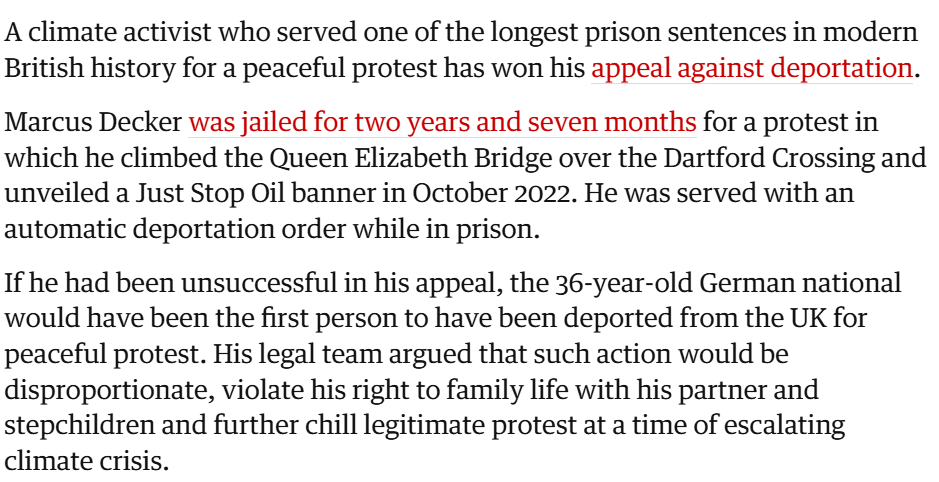
A climate activist who served one of the longest prison sentences in modern British history for a peaceful protest has won his appeal against deportation.
Marcus Decker was jailed for two years and seven months for a protest in which he climbed the Queen Elizabeth Bridge over the Dartford Crossing and unveiled a Just Stop Oil banner in October 2022. He was served with an automatic deportation order while in prison.

If he had been unsuccessful in his appeal, the 36-year-old German national would have been the first person to have been deported from the UK for peaceful protest.

https://www.theguardian.com/world/2025/nov/10/jailed-climate-activist-wins-appeal-against-deportation-from-uk

Asbestos class action (well, sort of) in the Netherlands against Eternit (may have affected my dad too)

My dad died of lung cancer in 2016, within a month of being diagnosed, I was told at the time.

There were photos – if memory serves me right – of people using a circular saw to cut up the sheets of Eternit cladding for my dad’s cooling facility. The year was 1970 or thereabouts. I was still in primary school, I think. I certainly remember the construction.

My dad was a milkman and grocer. We also had a facility for cleaning and rinsing glass bottles but that was being phased out and was later turned into my bedroom so that my sister’s could each have their own bedroom on the same floor.

I’m sure that my uncle Harrie assisted with this project. He too died of lung cancer.

Likely mere coincidences. Then again… who knows?

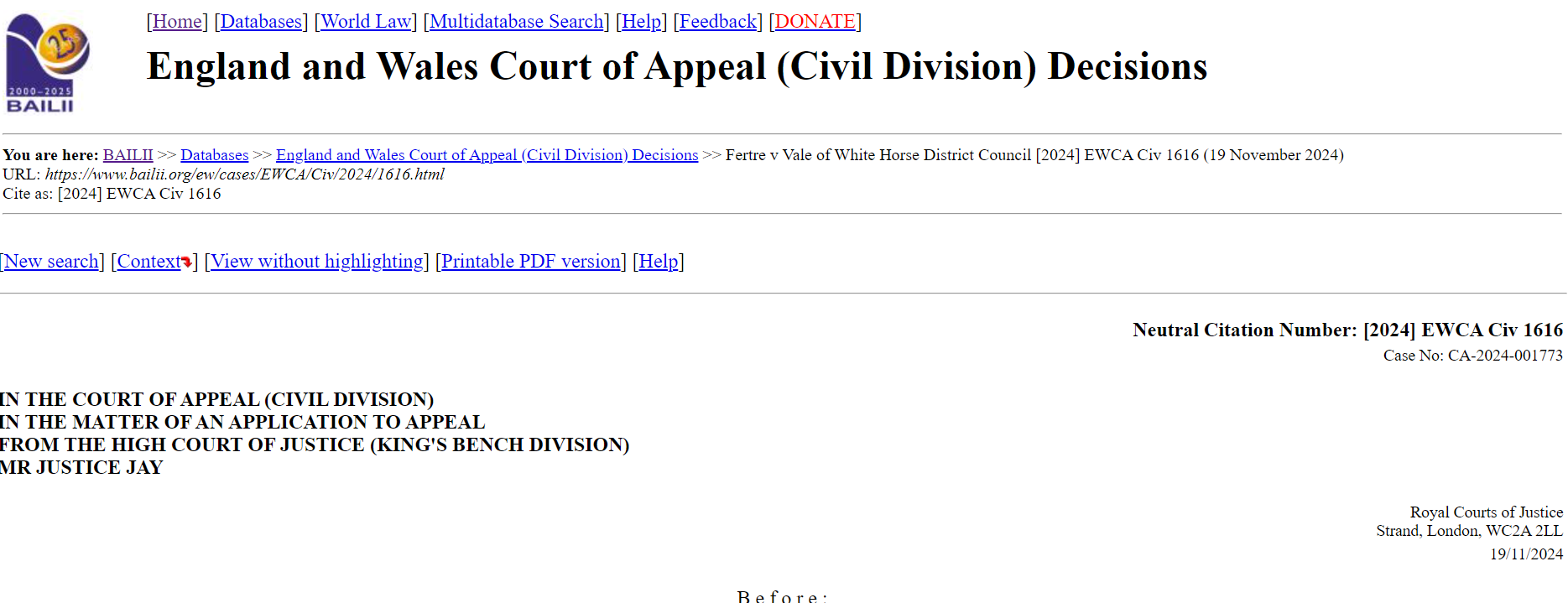
Immigration: The Sertre case, correction: Fertré

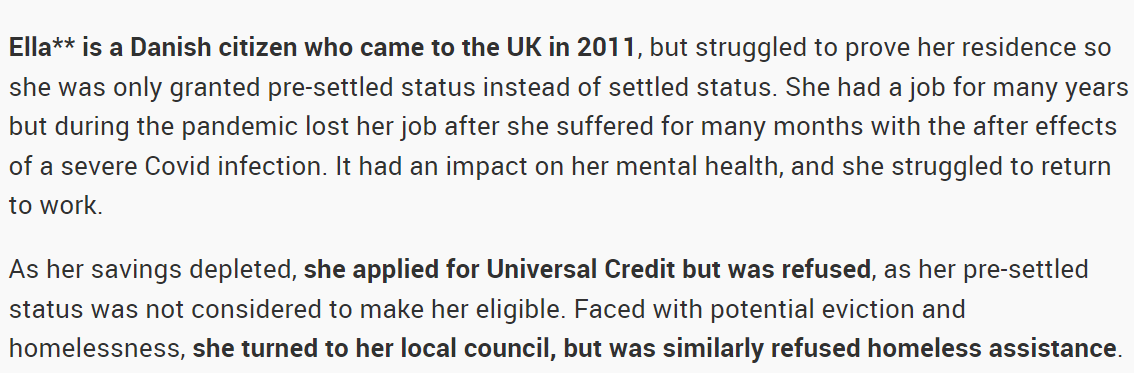
I almost get no emails these days because… Never mind. So I missed the Sertre Fertré case. Except, i just received a mail about the related crowdfunding. Ms Sertre Fertré is a French citizen with pre-settled status, which means that she has been in the UK for less than five years.

I have not read the recent judgement yet, but below is my instant response.

This is interesting, as Ms Fertré may not be eligible for support in her native country either as she is in the UK, after all!

In my native country the Netherlands, this type of support is tied to and determined by the municipality. 

Amsterdam, for example, doesn’t consider you as part of its citizens if you haven’t been living there for the 6 to 8 preceding years (depending on what regulations apply). Civil servants are instructed to do what they can to discourage people from asking for support and stop them from succeeding in getting that help. “Otherwise everyone will flock to Amsterdam”. 

My town in the Netherlands was Amsterdam, but Amsterdam doesn’t see me as having any ties to it. I worked at its tourist office among others, went to university there, graduated there, started my first business there but Amsterdam considers me a complete stranger.

You cannot even work at Schiphol airport if you have been away and haven’t been living here in the preceding 6 years. You’re seen as a security risk. So you’re seen as someone who’s loyalty lies elsewhere.

I’d say that all of this goes a long way towards arguing that the host country owes a duty of care. 

Otherwise these citizens are effectively stateless.

I don’t know for sure how France supports its citizens, though. Whether this would be similar.

It’s not osly a matter of countries trying to unburden themselves of their duty of care, within the Netherlands and not just within the Netherlands, municipalities try to shift their duty of care toward other municipalities too. There was a case of a woman who fled from domestic violence. You can only ask for help in your own municipality but of course, her ex found her and she was relocated to Amsterdam for her own safety.

When it was time for her to start rebuilding her life again, Amsterdam refused to support her as she had been living in a different municipality when she fled. Someone (some organization) took the case to court on her behalf and won.

LINKS

https://www.crowdjustice.com/case/eu-citizens-rights-to-dignity/

https://www.brickcourt.co.uk/news/detail/high-court-rules-on-equal-treatment-provisions-under-the-eu-uk-withdrawal-agreement: High Court rules on equal treatment provisions under the EU-UK Withdrawal Agreement, 10/07/24

https://the3million.org.uk/publication/2024031101: Note on the Withdrawal Agreement: Personal Scope (Art.10) and Equal Treatment (Art.23). as relied upon in C v Oldham (S 204 Housing Act 1996 appeal). Thanks go to Garden Court North, Landmark Chambers, Public Law Project and EU Rights and Brexit Hub. March 11th, 2024.

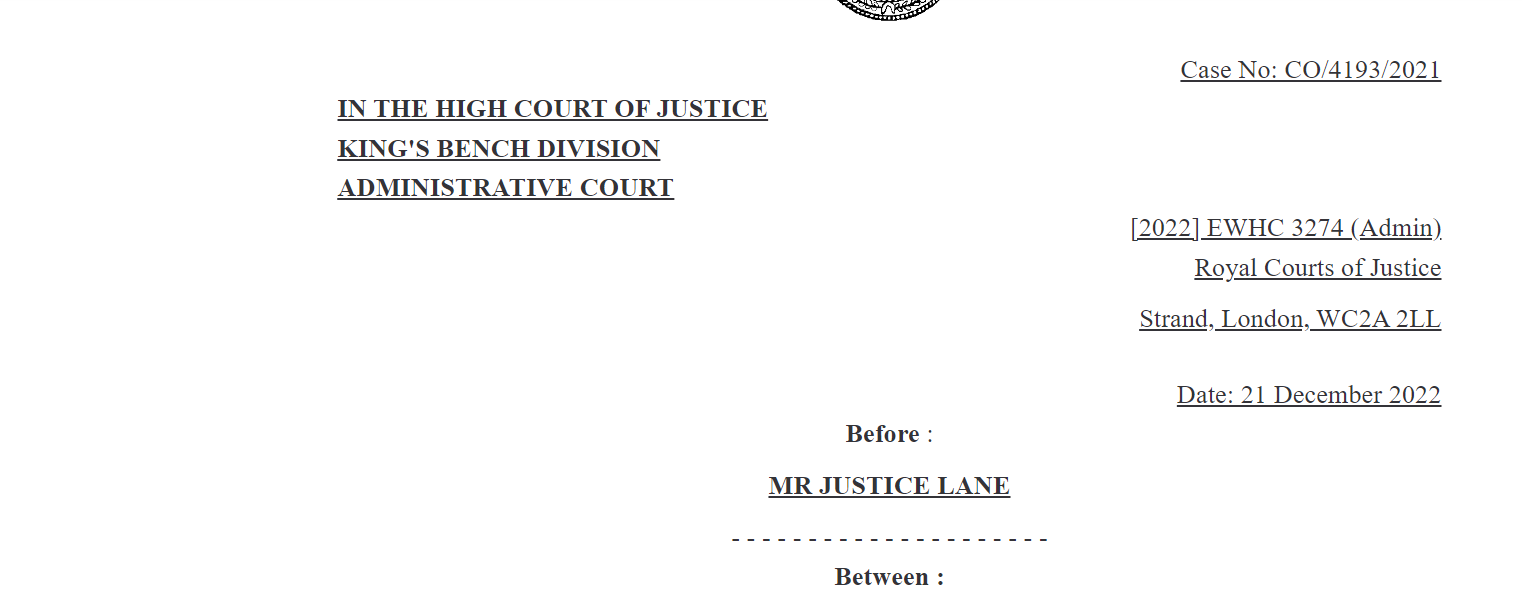
https://caselaw.nationalarchives.gov.uk/ewhc/admin/2022/327:

21 December 2022

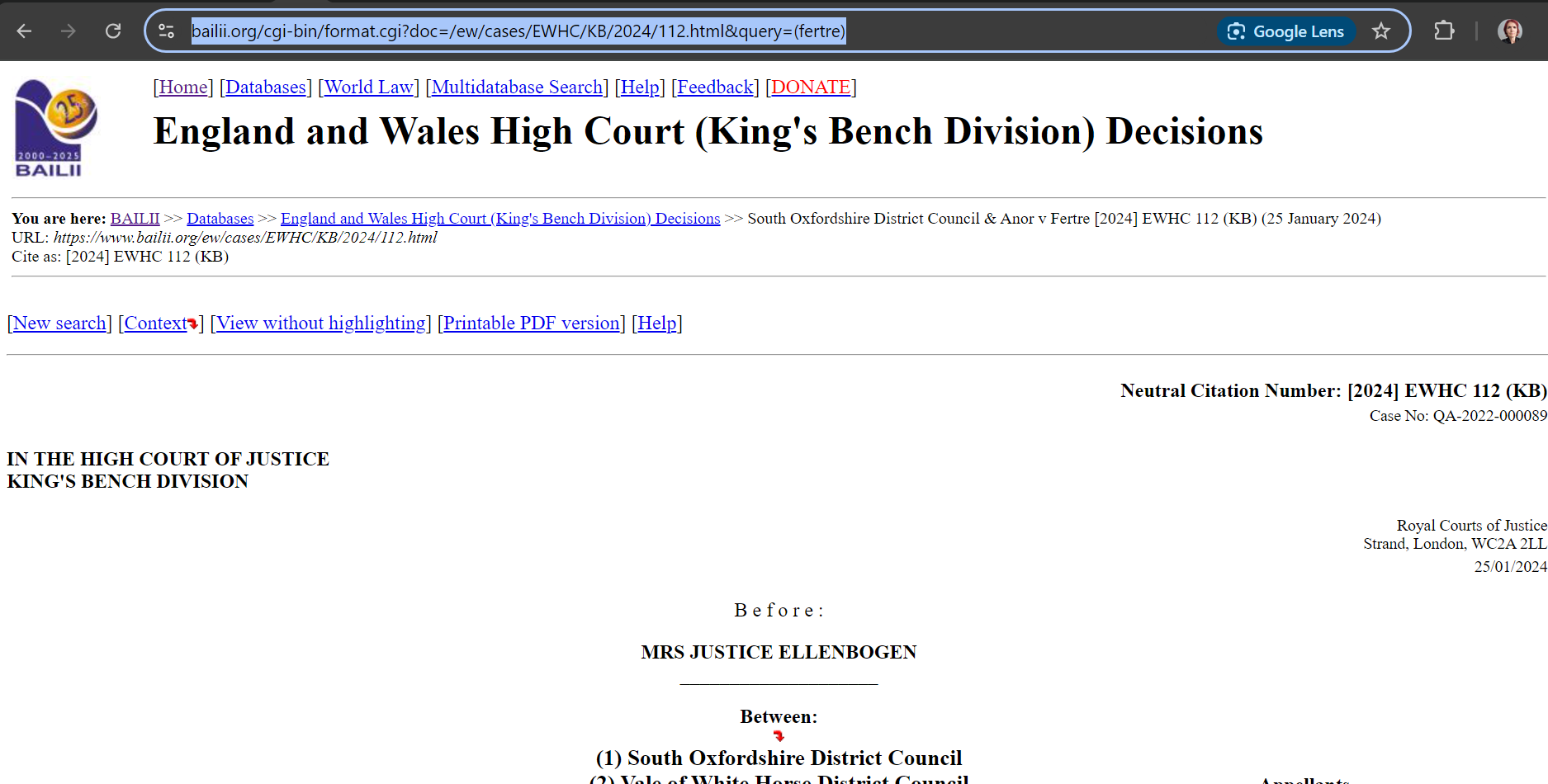
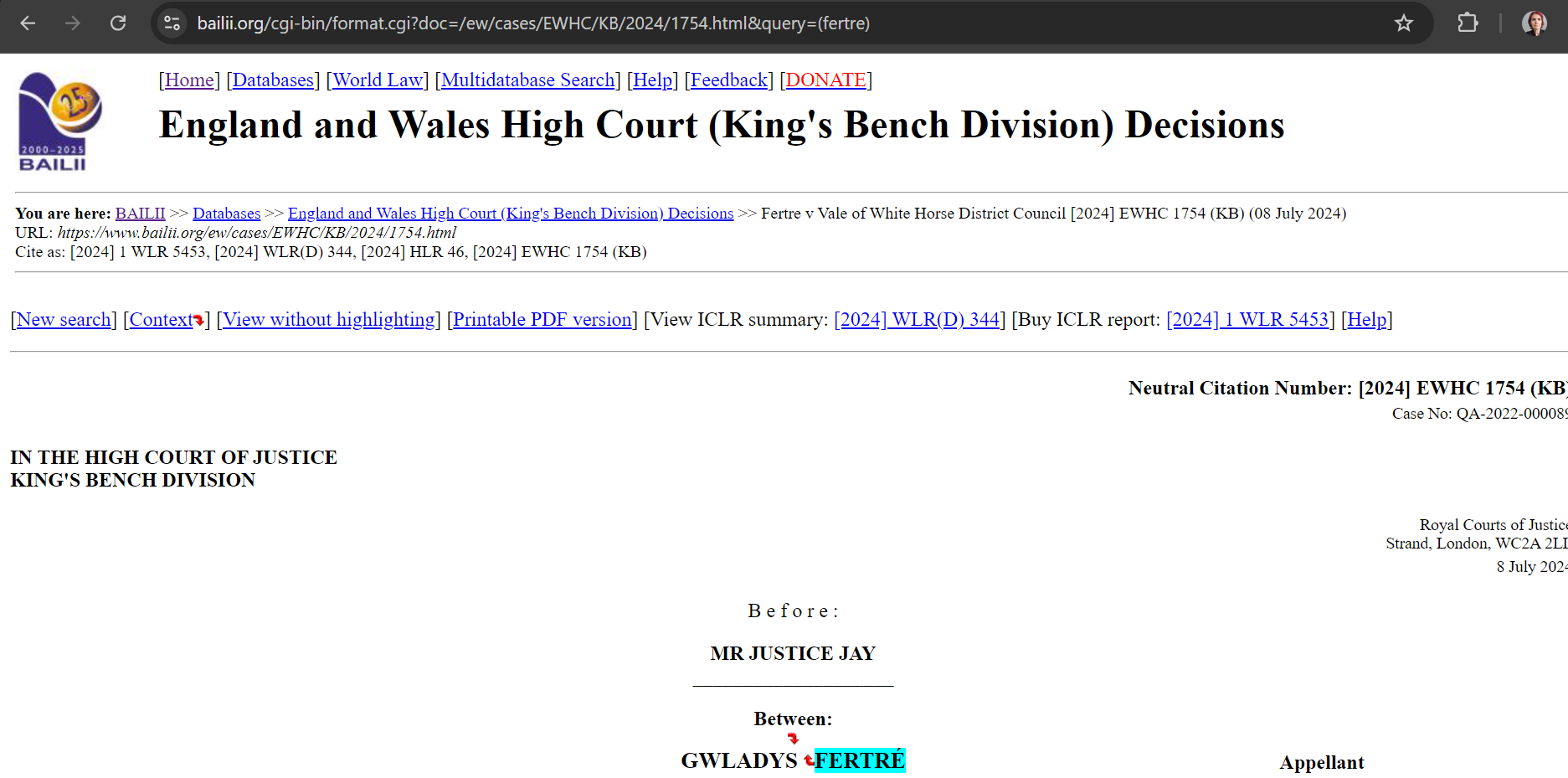
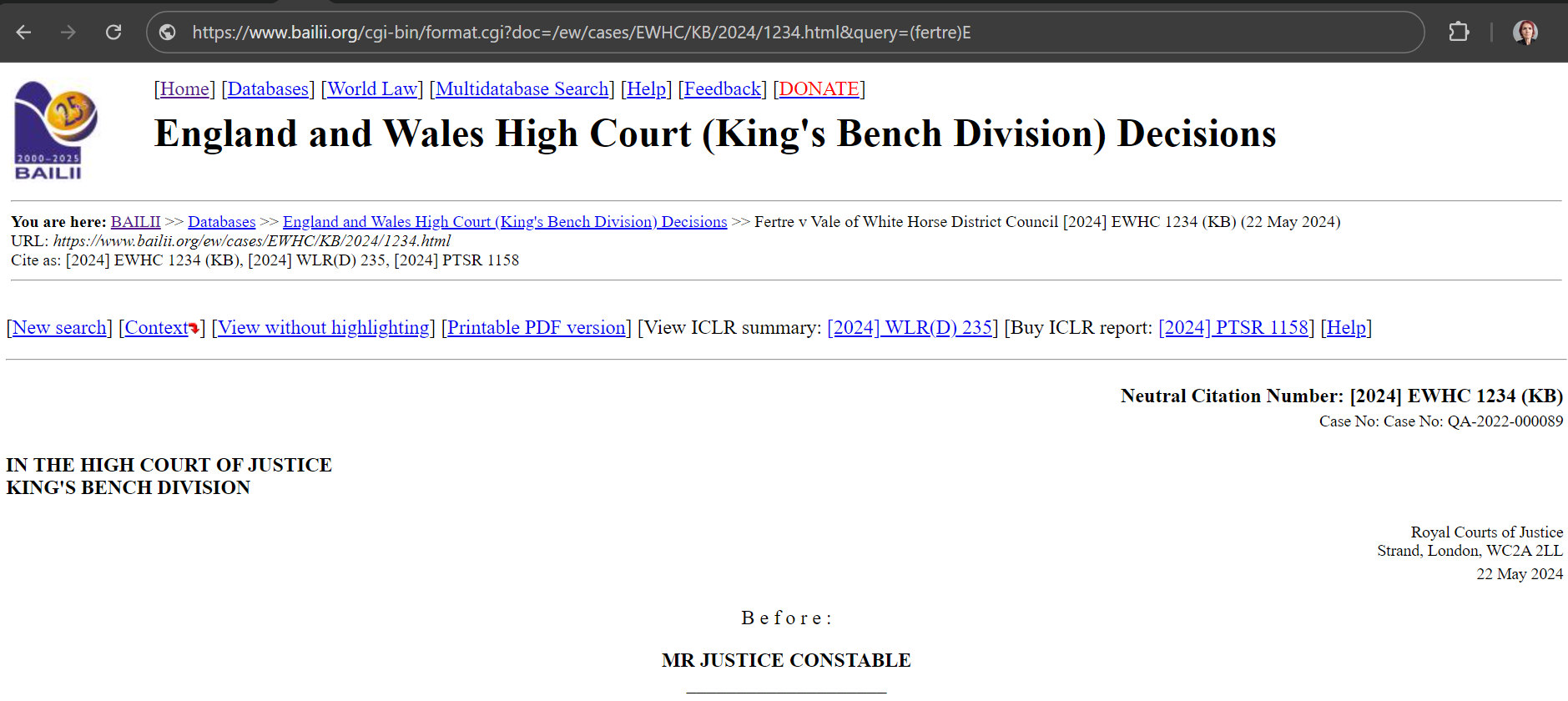
Here are links to court documents in the Sertre Fertré case:

25 January 2024
8 July 2024

22 May 2024

https://www.judiciary.uk/live-hearings/fertre-appellant-v-vale-of-white-horse-district-council-anr-respondents/: Fertre (appellant) v Vale of White Horse District Council & anr (respondents), May 16, 2025


https://www.theguardian.com/politics/article/2024/jul/25/uk-post-brexit-scheme-eu-citizens-courts: Courts place UK’s post-Brexit scheme for EU citizens at risk, experts warn. Lawyers criticise what they consider inconsistencies in the handling of individual foreign nationals’ cases.

Current issue of AMA Journal of Ethics is dedicated to sleep

Sleep Stewardship

Sleep hygiene, causes of sleep disruption, and sleep disorder interventions are recent, important topics of health and cultural awareness. The better one’s sleep quality over their lifespan, the better their health status and health outcomes, so who has reliable access to quality sleep is not just a clinical matter, but one for ethics and justice. This theme issue’s focus is broader than poor sleep pathologies and investigates how sleep is, perhaps, best conceived as a communal, natural resource. We all need clean air and water, shelter, nutritionally dense food, and sleep. Of course, we sleep as individuals, but our common human interest in quality sleep of sufficient duration generates collective obligations to respond equitably to chronic health conditions that exacerbate poor sleep patterns; to support conditions for feeling safe, peaceful, and calm enough to rest; and to mitigate noise and light pollution that compromise our and our neighbors’ sleep environments.

The above is some honestly stolen content from that issue. Most of the articles are about medical aspects including education, but one is titled “Sleep Is a Human Right, and Its Deprivation Is Torture“. I draw your attention to it.

Legalese: Commas matter

Years ago, when I was drafting documents for a lawsuit that I had started on my own and was carrying out on my own, I contacted a local lawyer to ask him about a term. (Well, technically, he was in Fareham, I think.) He didn’t understand why I was making such a fuss about one word.

Having worked at top law firm Clifford Chance (while also working at VU University and starting my small business and convening a conference session in Boston), where we drafted and printed and edited and printed and edited and printed and edited and edited and faxed and edited and edited agreements that were usually around one hundred pages, I knew that even a comma can make a crucial difference, and as I wasn’t dealing with small-time solicitors but with the lawyers for insurance companies (and a London-based barrister), I couldn’t afford to make a mistake that might accidentally undermine the point that I wanted to make. I wanted to avoid any ambivalence.

For those of you who think that I am exaggerating, read this article about how a single comma is deciding over the fate of so many humans:

https://www.theguardian.com/global/article/2024/may/29/how-a-single-comma-is-allowing-israel-to-question-icj-rafah-ruling

What the ICJ should have written is the following.

Instead of writing that Israel should

“Immediately halt its military offensive, and any other action in the Rafah governorate, which may inflict on the Palestinian group in Gaza conditions of life that could bring about its physical destruction in whole or in part.”

The ICJ should have written that Israel should

a) Immediately halt its military offensive; and
b) Immediately halt any other action in the Rafah governorate, which may inflict on the Palestinian group in Gaza conditions of life that could bring about its physical destruction in whole or in part.

Why didn’t it?

Time to look into that ruling: https://static01.nyt.com/newsgraphics/documenttools/95964284e55d5c79/b0c539e2-full.pdf

Okay. It was definitely meant in the latter sense is my first impression after having taken a look, so this was sloppy writing.

Continue reading

Reblogged: Holding a placard outside court isn’t illegal, judge rules: is that the best British democracy has to offer?

Holding a placard outside court isn’t illegal, judge rules – is that the best British democracy has to offer?

Steven Cammiss, University of Birmingham and Graeme Hayes, Aston University

The UK High Court recently dismissed the case against environmental activist Trudi Warner, who was referred for contempt of court in March 2023. Civil liberties campaigners hailed the decision as a “huge win for democracy”, but is it?

Warner had stood outside the Old Bailey, England’s most important criminal court in central London, with a sign that read “Jurors have an absolute right to acquit according to their conscience”. She did so at the start of a trial of climate activists who had been charged with public nuisance for obstructing traffic. Warner’s sign paraphrased the text on a plaque on display at the Old Bailey itself.

Known as jury equity, the legal principle evoked by this statement dates back to 1670 and is often cited, not least by leading legal figures and in the decisions of the higher courts, as a cornerstone of English democracy: juries can decide according to their conscience, and cannot be bullied into finding as the law dictates.

Indeed, many legal commentators saw the case against Warner as perverse. Since the threat of contempt proceedings was brought by the solicitor general (a government minister responsible for legal advice), Warner’s protest has been repeated outside courtrooms throughout the country at the instigation of campaign group Defend our Juries.

Why have juries became so important for protesters in the UK – and are they any more secure in their right to protest as a result of the High Court’s decision?

Jury equity and protest trials

Among recent protest prosecutions, Warner’s case is unique: as she saw it, her aim was to educate jurors on their rights.

For most non-violent disruptive protests being dealt with in English courts, defendants (like Warner) typically accept they did what they are alleged to have done, but argue they had a lawful basis for doing so. This is the case in many trials, from Extinction Rebellion to Palestine Action.

Over the last five years, this basis has been whittled away through government referrals to the Court of Appeal and decisions by that court which have removed the protection of lawful excuse and necessity defences in protest cases.

Meanwhile, new public order legislation has turned minor acts of disruption (such as occupying the highway) into serious acts of criminality punishable by prison sentences. The Court of Appeal endorsed long sentences for two non-violent activists who closed the Queen Elizabeth II bridge on the M25 in October 2022. Such is the parlous state of the court system following a decade of austerity that judges are under pressure to manage trials quickly.

Warner’s case brings each of these dynamics into sharp focus. Activists now regularly find themselves in court unable to present a defence in law for their actions, but remain committed to justifying them, because being publicly accountable is important to them. The only way they can avoid potentially severe punishments is by persuading juries not to convict them through the sincerity of their arguments and the public utility of their actions.

As such, jury equity is now often their only recourse. But judges, seeking to manage trials, regularly impose limits on what defendants can say in court, and for how long they can say it, particularly when they have no defence in law. In fact, Warner’s action stemmed from the widely publicised rulings of Judge Silas Reid in several Insulate Britain trials, who forbid defendants from addressing the jury on the climate emergency, and imprisoned two defendants for contempt for defying his order.

Restoring faith in British justice?

Does the High Court’s denial of permission to prosecute Warner indicate that the courts now seek to give greater protections to non-violent, disruptive protesters? Warner herself seems to think so, saying the decision “has restored my faith a little in British justice”.

The High Court ruled that Warner’s actions did not meet the threshold for contempt and that it would not be in the public interest to prosecute her. In fact, the court noted it would be “a disproportionate approach to this situation in a democratic society”. This can be read as affirming that protest is central to democratic life, rather than an irritant existing outside of it, and certainly gives some support to Warner’s faith.

But other elements of the court’s reasoning are less supportive. By noting that jurors swear an oath to make decisions according to the law, the court upheld a principle we have seen in numerous climate activist trials: defendants cannot invite a jury to apply the equity principle, nor even to inform them of it. This decision may allow people not involved in a case to do what Warner did, but in the courtroom itself, jury equity is to remain something of a dirty secret to be kept from jurors.

In deciding whether Warner’s actions were sufficient for contempt, the court also made much of her passivity in simply holding her sign; Warner did not attempt to engage with anyone entering the Old Bailey. She was, in both her own words and those of the judge, simply “a human billboard”.

Would the court have decided differently had Warner been more assertive? Where is the line between her permissible actions and those that would be deemed an unlawful hindrance of jurors entering the court?

A closer reading of the judgment suggests that, despite Warner’s victory, little has changed in the law’s view of protest. There is a good chance that Warner’s actions were tolerated for the very qualities that made her case so compelling: through her deliberate passivity, in the eyes of the law, she corresponded to the ideal of how protesters should behave. The court’s decision very much fits with a tolerance only of protest which is not disruptive (and, we might argue, not particularly effective).

It is unlikely then that the Warner outcome signals a return to a more liberal understanding of the role of protest as a democratic right. The court’s decision, if welcome, serves rather to underline how diminished the opportunities for real democratic agency are in Britain today.


Imagine weekly climate newsletter

Don’t have time to read about climate change as much as you’d like?
Get a weekly roundup in your inbox instead. Every Wednesday, The Conversation’s environment editor writes Imagine, a short email that goes a little deeper into just one climate issue. Join the 30,000+ readers who’ve subscribed so far.


Steven Cammiss, Associate Professor, Birmingham Law School, University of Birmingham and Graeme Hayes, Reader in Political Sociology, Aston University

This article is republished from The Conversation under a Creative Commons license. Read the original article.

Legal textbook case! (Titan missile silo fall)

An 18-year-old boy was injured when he fell 10 meters in a Titan missile silo in Colorado.

It is already having legal consequences for the injured adult in the group. The six minors have been passed on to their parents. Whether there will also be legal consequences for them and for the injured young man remains to be seen. That’s according to Dutch news (NOS) and one American source (KKTV).

USA Today, by contrast, reports that the 18-year-old injured person was charged with criminal trespass (3rd degree criminal mischief was how a third news source put it) and that seven minors were handed over into the custody of their parents, with possible charges pending.

When owners of a terrain do what they can to keep youngsters out to protect them against hazards that are present on the terrain, liability can shift. That’s the textbook case this may turn into. It has to do with whether it’s reasonable to hold a party liable for damages if that party has done enough to prevent the damages. These youngsters crossed a threshold.

(What’s more, these eight youngsters may have been on military territory. Doesn’t sound like it, though.)

Duty of care

I just realized that I have a legal duty of care to warn my not-too-clever lock-picker NOT TO TRY a mock-assembled piece of equipment, with for example the main weight-bearing bolt still missing.

(It is merely loosely held together, with even some parts still completely loose, not fastened at all because of missing bolts, nuts and screws.)

So I just printed a note that I stuck to the thing.

Does that feel nuts? Guess what.

There is case law on this.

I gave all my law books to to Advice Portsmouth a few years ago, but there is nothing wrong with my memory about some things that were in them.

Lock-picker be like… (hence partial duty of care)

Abundance. Immeasurable wealth. Human rights. Poverty.

This evening, I was suddenly reminded of what my life was like a long time ago, in the early 1980s, when I was working in tourism and hospitality in Amsterdam. I wasn’t making tons of money but I sure was making a lot more than what one third of England’s population needs to get by on, for whom life is mostly a cruel punishment for having been born. But that’s beside the point. Or is it? We’ll see.

I wore Cool Cat jogging pants from Fiorucci in the Kalverstraat and got to enjoy tons of music and dance performances as well as modern art exhibitions.

If you work in tourism and hospitality, you work shifts.

One of the best things in my life, one of my nicest memories, but I have plenty more, was to stop by at a particular “avondwinkel” on my way back home, often exhausted. It was really wonderful to stop by there on your last evening shift – get out of the tram or bus and then hop back on again or, hey, walk home if it was after midnight after I had moved from the “Gooi” to “De Pijp” – and take some goodies with you to enjoy when you got home. Utter bliss! That stuff was so good. It made you feel that it was really really GOOD to be ALIVE.

It was called Heuft, I think, just around the corner from the Vrijheidslaan. In the Rijnstraat.

They had the most delicious foods!

That kind of experience, that’s something that, I reckon, 90% of Brits have never had and will never have.

I can’t put this into words well enough so that you’d understand.

Heuft still exists, but I know it isn’t what it used to be. I know because I stopped by again, also quite a long time ago by now, and even then, it no longer was what it used to be. These days… it makes me weep… it seems to sell burgers and French fries. Okay, they’re home-made. But… oh man, you guys who go there now have no idea what the place used to be like, in spite of the fact that it still sells champagne.

If you’re from Portsmouth and want at least some idea of what I may be talking about, consider that little precious treasure we lost when Le Café Parisien (Lord Montgomery Way) closed. It served very different foods but what they served was delicious and the ambience superb. Le Café Parisien was one of the reasons why I moved to Portsmouth. There is nothing else like it, not in Portsmouth, not in Southampton. If you’re from Portsmouth, and you’ve never sat down there and ate some of its goodies, you’re poor.

The News called it “popular among students” when it closed, indicating that the journalist who wrote it was sadly clueless about the place or clueless about food or was living in poverty.

It was that place that gave Portsmouth its cosmopolitan allure.

Portsmouth University held its Café Jurist meetings there and it was also where people flocked to Café Scientifique meetings (both held after regular opening hours).

Here’s MIGRANT and human rights lawyer Conor Gearty (LSE), and yes, I attended that event and yes, he’s been one of my heroes ever since. That guy rocks. Boris Johnson? David Cameron? Theresa May? Priti Patel? Not so much…

Café Jurist – ‘In or Out in the European Convention on Human Rights?’ by Professor Conor Gearty from Strong Island Media on Vimeo.

Here is another one, one that I did not attend. (I was unwell, I think. A bit of flu or something.)

Café Jurist – ‘Social Inequality and Justice’ by Professor Jonathan Wolff from Strong Island Media on Vimeo.

Human rights under threat in the UK

Human rights are NOT about being allowed to watch porn in prison or only about people in third-world countries. Human rights are about things like the right to safety in your own home and the right to choose a profession, the right to own things, to have legal recourse and not to be discriminated against. Health is part of it too as is education.

(Do the universal human rights have a western values bias? Yes. Are they still slightly sexist? Yes.)

In The Guardian today.
Continue reading

The rights of nature

My computer froze at 12:12, requiring me to throw the power of it, has been hiccuping ever since,is hiccuping now too and at 13:09 I needed to throw power off the pc again to get it out of its hacking-induced freeze. The mysterious “he” has also disabled the control-key copy/paste function again. (Oh, that’s just press duration.) And my phone told me that I was in Devon this morning. Okay. (I’m also often in Scotland.) And I had an automatically forwarded e-mail from an e-mail address that I no longer own. (And it looks like my older computer has suddenly folded again, lol.)

(14:44: I am now in the West Midlands? Location is “on” and I am not in the West Midlands, just like I was not in Devon this morning either.)

Anyway…

Last night, Hank Greely tweeted this article:

https://www.newyorker.com/science/elements/is-mars-ours

It made me remember a discussion on LinkedIn; the Dutch were contemplating giving the Wadden Sea legal status. Here is a related article. Food for thought.

https://www.openaccessgovernment.org/protect-biodiversity/102506/

If you consider the question whether humans own parts of earth or other species, you also have to ask whether other species have “priority rights” so to speak and whether other species might have claims on or against us, in view of the fact that most have been on the planet much longer than the species Homo, let alone modern humans.

(We are supposed to be the smart ones. Are we?)

Sex without consent about to become “rape” in the Netherlands (and 11% of female students at Dutch universities raped)

https://nos.nl/artikel/2384251-een-op-negen-studentes-verkracht-tijdens-studententijd

Sex without consent = rape = insertion of body parts or objects

It will carry a custodial sentence of 4 to 9 years.

(Amnesty International has been campaigning in favour of sex on the basis of equality, consent and free will for over a year in the Netherlands.)

It’s not clear to me from which date the new legislation will apply.

DEFRA consultation on regulation of genetic technologies (closes 17 March)

DEFRA currently has a consultation called “the regulation of genetic technologies”. Post-Brexit adaptations or not? Will we drop the phrase “even if their genetic change(s) could have been produced through traditional breeding” or not?

Post-Brexit, animal welfare protections are being abandoned. We can’t let that continue unbridled. This consultation is not just about animals, however. It is also about agriculture, bacteria and foodstuffs.

If you want to weigh in, you have up to 17 March, 1 minute before midnight. It will take you some time and you’d better have a bunch of references and links to data ready. 
consult.defra.gov.uk/agri-food-chai

It consists of two parts, that is, the actual consultation is Part 1. You can come back to Part 2 later after you’ve completed Part 1. I have been working on Part 1 so far. 

When I downloaded the 14-page document that goes with this gene editing consultation, I spotted several problems. There is a pretence of an emphasis on science and there is at least one or one half paragraph that has nothing to do with genetic technologies (obfuscation).

The document starts as follows:
“Building back greener is integral to creating a healthier, more resilient world for future generations and the Prime Minister has highlighted the need to take a more scientifically credible approach to regulation to help us meet some of the biggest challenges we face.”

This is the document’s fourth paragraph:
While GE is unlikely to be able to address all these complex challenges, a whole range of innovative approaches could help us make progress over time. These could include increasing agro-ecological approaches for land management, the use of robotics and artificial intelligence, vertical farming, and the development of undervalued protein sources.

The part in blue has nothing to do with gene editing. So why throw it in? The first sentence seems to suggest that there may not even be a need for gene editing. What is the purpose of this paragraph? To obfuscate? 

On page 5 it says:
“Our position follows the science, which says that the safety of an organism is dependent on its characteristics and use rather than on how it was produced.” 

That, with all due respect, sounds like pretentious nonsense. No references are given, no scientists are mentioned, no agencies or universities are named.

Anyone wishing to take part in this consultation, however, is supposed to provide evidence and literature references and the consultation is clearly not intended to draw the public’s opinion.

Also on page 5 of the consultation document, DEFRA mentions that Japan, Brazil, Australia and Argentina take a different position than the EU and there is the suggestion that the EU’s view is flawed. 

“Now the transition period has ended, retained EU law requires that all GE organisms are classified as GMOs irrespective of whether they could be produced by traditional breeding methods. This was confirmed by a Court of Justice of the European Union (CJEU) judgment in 20181. This is not consistent with the position taken by most countries who have reviewed their respective regulations like Argentina, Australia, Brazil and Japan, which have concluded that certain GEOs should not be regulated as GMOs.”

There is also a 2-page Gene Editing Explainer, which tells the public what to think, again without providing any literature references or links.

(Only Rothamsted Research in Hertfordshire is mentioned in it. Wikipedia says:
“previously known as the Rothamsted Experimental Station and then the Institute of Arable Crops Research” “one of the oldest agricultural research institutions in the world, having been founded in 1843”. It is located on the campus of “Rothamsted Enterprises”. I assume that it is comparable to some of the departments of Wageningen University and Research. I am unfamiliar with it, had never heard of it before.)

I am a little disgusted with the approach taken by DEFRA here. I have taken part in DEFRA consultations before, when that particular PM mentioned at the start of the document was not PM yet. I may not often agree with DEFRA, but DEFRA’s consultations did not use to annoy me. This one does.

It is a political document, isn’t it?

I may be way off, but I hear the PM’s voice in the background and I sense the assumption that the public at large does not have the capability to understand the science and/or that the public is not well informed enough to be able to contribute to this consultation.

(Note that research in Germany showed that providing more information did not make the public more accepting of the use of genetic technologies; link below. These kinds of studies are not my field of expertise and there may be plenty of studies that found the opposite. But if that were the case, then why did DEFRA provide so little information?) 

Below are my two cents, so far. Also biased, namely skewed toward caution, and written off the cuff.

In my opinion, organisms developed using genetic technologies such as gene editing (GE) must continue to be regulated as genetically modified organisms (GMOs) even if their genetic change(s) could have been produced through traditional breeding.

  1. Genetic technologies can have side effects that are not necessarily instantly clear. An example could be that the changes that Dr He introduced in a pair of human twins in China to make them immune to HIV could also have resulted in “off-target” changes and scientists are largely still in the dark about this. (Natural breeding does not have the potential for unintended changes that CRISPR still has.)
  2. The application of genetic technologies may also impact animal welfare differently than when their genetic change(s) are produced through traditional breeding. 

Regarding the question as to the risk associated with the application, the problem is that we cannot predict what we don’t know yet.

If you look back into history, you can see that in the past, we’ve often hailed as great progress what we later ended up banning.

  • We gave a Nobel Prize in medicine for the development of DDT. It almost eradicated the American bald eagle and that is only one aspect of its many side effects. DDT causes nerve damage and affects the hormone-producing systems of many animals, among other things lowering their fertility. In the United States, it was the environmentalist and marine biologist Rachel Carson’s work that eventually led to a ban on DDT and other pesticides.
  • We didn’t even foresee the blatantly obvious consequences of insecticides, namely that their use would affect pollination as well as bird populations.
  • Should I mention thalidomide? DES? That ibuprofen may affect male fertility?
  • Many people are pushing to have other harmful pesticides banned, such as glyphosate and chlorpyrifos. That isn’t because they’re afraid of progress. It’s because these substances are not as harmless as we thought.
  • When I was still based in the Netherlands and a board member of the Environmental Chemistry (and Toxicology) Section of the Royal Netherlands Chemical Society, our section organised a symposium on brominated flame retardants. They were already being found in tissues of animals in the Arctic. Did we see any of that coming? No, we did not. Subsequently, there was a push to phase them out in favour of others that turned out to have similar problems.
  • Did we expect to do damage to the ozone layer when we introduced CFCs?
  • Should I mention PFAS? (You may want to look into the situation in the Netherlands, where PFAS in soil have caused major upheaval because the Dutch want very little of it in their soils and the stuff is everywhere. When permitted levels were lowered, construction ground to a halt all over the country.) But we all thought that non-stick coatings (also called Teflon, PTFE, polytetrafluorethylene etc) were the greatest thing since sliced bread. People with pet birds started noticing disastrous effects. Perfluorooctanoic acid (PFAO), also known as C8, dissolves well in water and does not decay. It is now globally present in the air and in seawater. In the Netherlands, discharges by the Chemours plant in Dordrecht led to increased PFOA concentrations in the Merwede river and in the groundwater along its banks. In the U.S., a former DuPont plant in West Virginia released more than 1.7 million pounds of C8 into the region’s water, soil and air between 1951 and 2003. C8 was phased out after a class-action lawsuit that alleged that it causes cancer. Chemours now makes a new compound called GenX instead, for which safety thresholds have yet to be established. Regular water treatment methods don’t remove it from drinking water. GenX may be safer than C8, but it is also alleged to have caused tumours and reproductive problems in lab animals.

None of what I just wrote has anything to do with the use of genetic technologies. My point is that we never know with 100% certainty that all forms of progress are safe and we have missed the blatantly obvious in the past. This uncertainty also goes for genetic technologies. 

I also think that dropping “even if their genetic change(s) could have been produced through traditional breeding” would likely make the regulation harder to apply. It would have companies trying to find all sorts of shortcuts (to “prove” that the effect of the technology they used could also have been produced through natural breeding). It might lead to frustrating discussions and costly legal proceedings. It might even lead to more campaigning, protests, etc.

(I did not look into how Japan, Brazil, Argentina and the United States handle these matters.)

There might well be effects on trade as well. German consumers for example traditionally have put great emphasis on ensuring that their food is as “clean” as possible.

https://www.loc.gov/law/help/restrictions-on-gmos/germany.php

https://www.researchgate.net/publication/326462738_Does_information_change_German_consumers’_attitudes_about_genetically_modified_food
From the abstract:

“The consumers who are more accepting of genetic modifications are younger, less educated and less concerned about their nutrition. The average effect of our provided information is negligible. However, the initially less opposed become slightly more opposed. Our results thus do not support the view that a lack of information drives consumer attitudes. Instead, attitudes seem to mostly reflect fundamental preferences.”

Many of the questions and the choices for answers in the DEFRA consultation survey are blatantly biased and it is quite clear that DEFRA would like to see the phrase “even if their genetic change(s) could have been produced through traditional breeding” dropped.

Am I being too critical? I don’t think so.

See also for example these two articles:

https://angelinasouren.com/2018/12/11/an-opinion/ by Cecile Janssens, professor at Emory University. A quote: “Most DNA mutations do nothing else other than cause the disease, but DNA variations may play a role in many diseases and traits. Take variations in the MC1R “red hair” gene, which not only increases the chance that your child will have red hair, but also increases their risk of skin cancer. Or variations in the OCA2 and HERC2 “eye color” genes that are also associated with the risk of various cancers, Parkinson’s and Alzheimer’s disease. To be sure, these are statistical associations, reported in the scientific literature, some may be confirmed; others may not. But the message is clear: Editing DNA variations for “desirable” traits may have adverse consequences, including many that scientists don’t know about yet.


https://www.nature.com/articles/d41586-019-02087-5
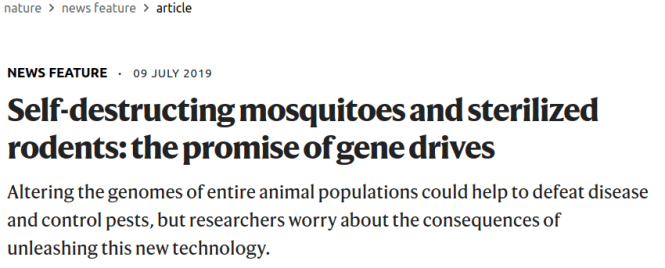
 

So, what exactly is the science that DEFRA claims to be following? It is not this kind of science.
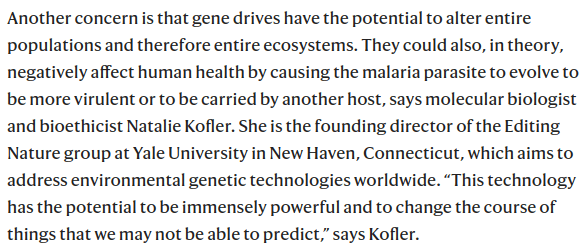


It is too soon to abandon caution. 
 

12 March 2021
Here is the PDF with my response: 

DEFRA-my_response

I expected Part 2 to take as long as Part 1 – I imagine that the start of Part 2 is the point at which many give up – but it did not. And in essence, it was a repeat of Part 1.

Homeless? You may soon no longer be breaking the law

Secretary of State for Housing, Communities and Local Government, Robert Jenrick MP, has told the House of Commons that the Vagrancy Act should be “consigned to history”.

Oh, that’s good of him, isn’t it?

At the same time, the UK government has quietly eroded the corona virus eviction protection – which was much less extensive than the one in the US to begin with – Lime Legal informed me this morning. It pointed me towards this article:

https://www.theguardian.com/society/2021/feb/28/eviction-orders-being-issued-despite-uk-government-covid-pledge

A reminder. How is workplace bullying affecting your business? Do you know?

(image from the NY Post)

Since the start of the first lockdown, the number of internet searches for “workplace bullying” went down. As of about July, the number began to increase again. This indicates that now is a good time to ensure that such practices do not flare up again once the bulk of the pandemic is behind us.

Because workplace bullying is costing businesses a lot of money and not just that, business owners are expected to deal with it. They must look after their employees.

I am aware of two cases in England in which employees were set on fire at work and Landrover / Jaguar has just experienced a landmark case of constructive dismissal to do with workplace bullying.

In the UK, the incidence of workplace bullying is around 30% (2015, Trades Union Congress), with 71% of disabled women reporting some form of abuse and 91% of workers stating that bullying in the workplace wasn’t being dealt with appropriately.

The Chartered Institute of Personnel and Development (HR professionals) found a percentage of 15 for the years 2017, 2018 and 2019 yet added that more than half did not report bullying.

  • Most bullying at work in the UK appears to take place in London and the southeast.
  • Most bullying is carried out by someone higher in the hierarchy.

In a study by Kew Law (employment law), 71% of the employees at 131 companies in the UK stated that they had either been bullied or witnessed bullying.

Are you sticking your head in the sand over it, ostrich-style?

Workplace bullying. Don’t pretend it isn’t happening when you know it is.


How is workplace bullying affecting your business?

(image from the NY Post)

Do you know?

In the UK, the incidence of workplace bullying is around 30% (2015, Trades Union Congress), with 71% of disabled women reporting some form of abuse and 91% of workers stating that bullying in the workplace wasn’t being dealt with appropriately.

The Chartered Institute of Personnel and Development (HR professionals) found a percentage of 15 for the years 2017, 2018 and 2019 yet added that more than half did not report bullying.

In a study by Kew Law (employment law), 71% of the employees at 131 companies in the UK stated that they had either been bullied or witnessed bullying.

Workplace bullying is very costly. Are you sticking your head in the sand over it, conveniently closing your eyes? Well then, with most staff still working from home, NOW may be the perfect time to wake up and address it. Workplace bullying. Don’t pretend it isn’t happening.


Excellent COVID-19 resource for decisionmakers at various levels

I started attending various webinars some time ago, like lots of people, and like lots of people, I also got a little webinar fatigue at times.

A great series continues to be organised by the National Academy of Medicine and the American Public Health Association in the US, looking into many topics such as the science of the virus, finding vaccines, health inequalities and so on.

Today’s session, on mitigating direct and indirect impacts in the coming months, was excellent for decisionmakers at all levels – also in the UK! – because it addressed a lot of practical aspects and many angles of the pandemic.

It mentioned the need to provide free wifi, talked about telehealth (telemedicine) and developments expected to take a decade suddenly being realised in a mere three weeks, about the complications food deserts pose, about the politicizing of the pandemic, about how to cope with emergencies such as hurricanes and related evacuations, how to remedy the impact the pandemic is having on non-Covid-related healthcare (such as people with heart attacks not seeking help out of fear of catching the virus), the healthcare clinics getting into financial difficulties as a result (as, I think, we saw earlier with those two doctors in California who owned a small chain of facilities and saw their turnover drop so dramatically that they resorted to unorthodox action), the challenge and need to communicate well and perhaps have ambassadors explain the purpose and reasoning behind social distancing, the massive impact social distancing has on the infection rate and the risk of people that people will no longer observe distancing when lockdowns are relaxed and developing a false sense of safety, and so on and so forth.

Here is a link for a model (simulator) that people can play with to explore the effects of lifting lockdowns: https://budgetmodel.wharton.upenn.edu/

The video recording of the webinar will be online soon, at covid19conversations.org:
https://covid19conversations.org/webinars/summer.

The slides have already been uploaded, but not all presenters used slides and the Q&A of course is not online yet either. I’ll post the unedited transcript below.

Continue reading

Non-human rights: Update on Happy’s case

This is straight from the e-mail I received:

Today, Justice Alison Y. Tuitt of the Bronx Supreme Court today issued a decision in the Nonhuman Rights Project’s New York elephant rights case that is powerfully supportive of our legal arguments to free Happy from the Bronx Zoo to a sanctuary.

While Justice Tuitt “regretfully” denied the habeas corpus relief the NhRP had demanded because she felt bound by prior appellate court decisions in the NhRP’s chimpanzee rights cases, she essentially vindicated the legal arguments and factual claims about the nature of nonhuman animals such as Happy that the NhRP has been making during the first six years of our rights litigation.

Deeply encouraged by Justice Tuitt’s embrace of the merits of the NhRP’s case following 13 hours of oral argument over three days, we already begun working on our appeal.

In her analysis and conclusion, Justice Tuitt agreed with New York Court of Appeals Justice Eugene M. Fahey’s conclusion that an elephant, like a chimpanzee, is not merely a “thing.” Instead, Happy “is an intelligent, autonomous being who should be treated with respect and dignity, and who may be entitled to liberty.” Further, Justice Tuitt rejected the Bronx Zoo’s claim that its continued imprisonment of Happy is good for her, stating that “the arguments advanced by the NhRP are extremely persuasive for transferring Happy from her solitary, lonely one-acre exhibit at the Bronx Zoo” to The Elephant Sanctuary in Tennessee.

In late 2018, Happy—currently held alone in an industrial cement structure lined with windowless, barred cages (the zoo’s “elephant barn”) while the elephant exhibit is closed for the winter—became the first elephant in the world to win a habeas corpus hearing intended to determine the lawfulness of her imprisonment after the NhRP filed a petition for a writ of habeas corpus on Happy’s behalf. Such world-renowned elephant experts as Dr. Joyce Poole and Dr. Cynthia Moss supported Happy’s rights case while making clear that the Bronx Zoo cannot meet the needs of Happy or any elephant.

While we lament Happy’s continued imprisonment, we thank Justice Tuitt for breaking ground on the long road to securing liberty and justice for Happy and other autonomous nonhuman animals. Happy’s freedom matters as much to her as ours does to us, and we won’t stop fighting in and out of court until she has it.

Anyone who’s become curious should look into the story of Guida, who’d become so severely mentally ill in her confinement that there were serious doubts about the potential for recovery.

Upon release to the Global Elephant Sanctuary in Brazil (sister of that in Tennessee), Guida bounced back remarkably. When having the choice of taking an easy path toward food or picking a difficult one, she was often observed selecting the more challenging path, which required her to climb up an edge (a small straight cliff), which took some effort.

She rejoiced in having the choice and in being able to conquer the cliff.

(I have seen something similar in a pigeon, to my utter astonishment, the animal setting herself a goal, a challenge. Also, pigeons are able to recognize individual human faces, whereas humans generally have a very hard time recognizing individual pigeons.)

Sadly, Guida is no longer with us, but at least she lived the last part of her life in friendship with another elephant and doing the kinds of things that she enjoyed doing.

Moratoria no longer enough

Moratoria are sometimes seen as “knee jerk” responses.

But this is what Jennifer Doudna, one of the “inventors” of CRISPR, says:

https://platform.twitter.com/widgets.js

WhatsApp flaw “puts words in your mouth”

https://www.bbc.co.uk/news/technology-49273606

This sort of thing has been possible since at least 2010.

Back in 2010, I knew it was happening on my equipment, but I couldn’t prove it and when you say something like that out loud, everyone assumes that you’re delusional. After all, accepting that I might be correct is a scary thought.

Too scary for most people. 

So when I finally got the proof, when I was able to compare a tweet on my phone with the same tweet on a friend’s computer, I could see that there were words in the tweet on my phone that were not present in the tweet on my friend’s computer… I didn’t show it to anyone. There was no point. Nobody was going to be interested.

The original tweet came from Portsmouth-based Maricar Jagger, but she had nothing to do with the digital mischief (other than that she was connected through her social circles).

I also knew about phone hacking via the invisible text message method before it became news – because I saw it happen on my own phone. (Same thing. Delusional cow who has difficulty grasping technology was the usual response.)


PS
And OUT goes a big chunk of police “evidence”, of course.


(See also this page.)

Landlords…

Never had any problems with landlords in the Netherlands. Never.

Had three in Florida. The first and the third were fine, but the second one was not and his attorney was rumoured to have mafia ties, I kid you not. But I heard that later. I think it was actually a legal aid lawyer who told me that who I talked with later, long after I’d moved out and his lawyer started pestering me. I’ll spare you the details.

My third landlord was the husband of the person I volunteered with on Saturdays and sometimes Sundays. (He was a builder, built huge places, the way they are in Florida. Nice guy. I think he was in the US Army for a while, and they lived in places like Morocco. ) She stopped by one day – to bring me two birds – and was appalled and suggested I move in to one of their places. They owned a small apartment building that was mostly used by snowbirds (people from for example Canada who take winter vacations in Florida).

Some time later, I moved to Britain.

In Southampton, I knew several landlords. (Only one of them was mine.)

One said that only educated people were decent human beings, and I was too shocked to respond. He called tenants who rang him because the washing machine or heating wasn’t working (properly) “bad tenants”. This was not my own landlord, but someone I met within a business context and was friendly with for a while. Wasn’t actually a bad guy at all, strangely enough.

I also knew one who proudly told me how he had tricked an elderly woman with beginning Alzheimer’s out of her flat, I kid you not.

On another occasion, the same guy was talking with me about a new building he was constructing and then added that it did not have to be very good “as it is only for tenants”.

In Portsmouth, I’ve met two who dump rubbish on other people’s front courts and patios. I caught one red-handed and the other one admitted it.

I have principles.

If I can help make things better for people who come after me who are less strong in some way – okay, except physically as I am getting old and I am feeling it – I will try to do that. And that baffles the hell out of (most) Brits. But that is not my problem.

Highly interesting legal case!

Was this whistleblower’s sacking discrimination?

On paper, whistleblowers are often legally protected, but in practice, well, that’s a different story. Whistleblowers usually end up ruined. It takes guts to take a stand and also often sacrifice.

So a different approach is taken in this case. I shall be following this (to the extent that I can).

Sacked vegan claims discrimination:

https://www.bbc.co.uk/news/uk-46385597

Something you may want to watch

It may also shatter your illusions, however, if you still believe that police are the good ones, the ones (that you pay for through your council tax, in Britain) to help keep you safe and secure and protect your basic rights.

This morning, this caught my eye:

(Scottish) Police Pause Rollout Of Device That Hacks Into Phones After Fears ‘It Is Unlawful’

I suspect that police in England and Wales already are using these “kiosks” that hack into people’s phones and laptops, overriding passwords.

I am sure it can be great fun for some officers to play with these “kiosks”. You can almost hear them talk. “I knew it! She’s a lesbian!” and “Does he really think he stands a chance with that woman?” and “Oh my god! Trying to lose weight? Fat chance!”

Yep, very useful.</end of sarcasm>

We need an alternative to police. Because going to or contacting the police has become one of the worst things to do in almost any situation. (Unless your insurance company wants a copy of a report after a burglary or theft, but leave it at that and do not ask police to do anything else other than give you a copy of the report.) How it got to this point? It’s immaterial. It’s what we have in the here and the now.

As Michael Doherty (a former aircraft engineer who made the mistake of reporting something to police and expecting police to follow up on it) says in the video below, you do have the right to investigate on your own, to try to detect and stop crime on your own. If your investigation is successful, you can also prosecute on your own. (I am talking about England and Wales.)

But before you choose this path, as I have stated several times before, look into the Protection from Harassment Act 1997 because police and others can use this against you, assuming that you are unaware of 1(3)(a), which most people probably are. That means that, before you know it, you can already have confessed to a crime that you didn’t actually commit. To prevent this, you need to know what the law says.

I repeat and highlight:

(3) Subsection (1) [F4 or (1A)] does not apply to a course of conduct if the person who pursued it shows—

(a) that it was pursued for the purpose of preventing or detecting crime,

(b) that it was pursued under any enactment or rule of law or to comply with any condition or requirement imposed by any person under any enactment, or

(c) that in the particular circumstances the pursuit of the course of conduct was reasonable.

(Whether it says “and” or “or” makes a difference. It means that each of these conditions on its own applies, that they do not have to apply all at once.)

The video below dates back to 2015, is rather academic and particularly in the beginning lacks a logical thread, in my opinion, but does contain useful information.

You may want to read this as well:
The Human Rights Act Can Transform Lives Without Going To Court

(Also, if you want to protect yourself from police with a camera, you need to have one that does not have wifi or bluetooth.)

It is possible to resolve many situations or at least make them somewhat liveable without going to police, and much more successfully and/or peacefully. If you try this after you’ve been to police, however, police officers are likely to hold it against you. (This is mean because most people who contacted the police in the past decade will have been told that police wouldn’t investigate and would do nothing with what they told the police owing to a lack of resources and/or will have been referred to their GP and the local civic offices.)

Unfortunately, most of us learn these things the hard way – and you can’t undo having contacted the police.