I have several courses on Thinkific and on Udemy They are largely diversity-oriented.
See my Udemy instructor profile for more information.
I retired my first course years ago when it became out of date. It was a highly practical course called “social media for visual artists”, inspired by having worked with a number of visual artists and their managers over the years. It taught me a lot about the process of making an online course. It was well-received in spite of the fact that I didn’t quite have the proper equipment for editing videos at the time; the computer I had at the time was not really up to the task. I really enjoyed making that course.
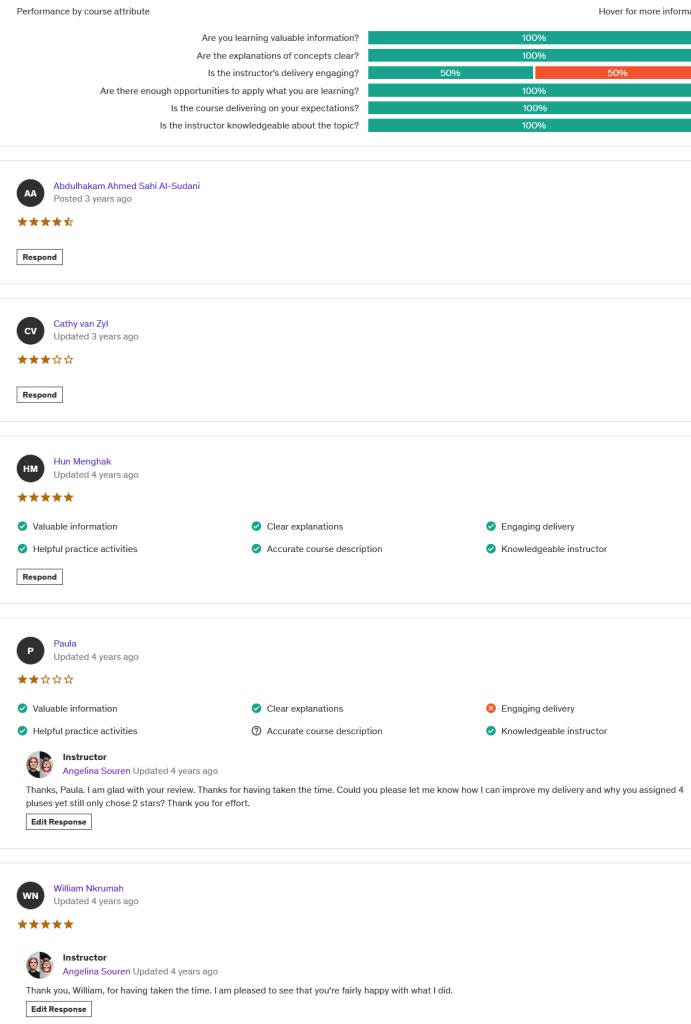
See the reviews below for an impression of feedback.
It may be telling – and I find it somewhat disappointing – that various organizations that I gave the opportunity to give their staff access at no charge whatsoever didn’t even want to look at this course. Individual people are interested in this course, for example, because they work in the field or are students. Organizations still see dealing with diversity as a burden for example because they associate it with a lot of paperwork. There is often no true willingness to be inclusive. Instead, it is merely seen as a matter of pesky obligations imposed by governments. I’ve seen this tendency in the UK and also in the Netherlands.
“Bioethics – the ethics of everyday life”

Bioethics… You can’t open a newspaper or go to any news site without seeing at least one news item that has to do with bioethics. Bioethics is much more than merely medical ethics or clinical ethics. Bioethics is not only about looking after ourselves within a medical context or from a diversity perspective. It includes our duty to care for the planet, i.e. our habitat, and to be mindful of the other species who share that habitat with us.
It was Fritz Jahr who came up with the word “bioethics” in 1927 when he published the article: “Bio-Ethik: Eine Umschau über die ethischen Beziehungen des Menschen zu Tier und Pflanze” (Bioethics: A look at the ethical relationships of humans to animals and plants”).
Jahr introduced what he would later call “the Bioethical Imperative”:
“All living beings are entitled to respect and should be treated not as means but as ends in themselves.”
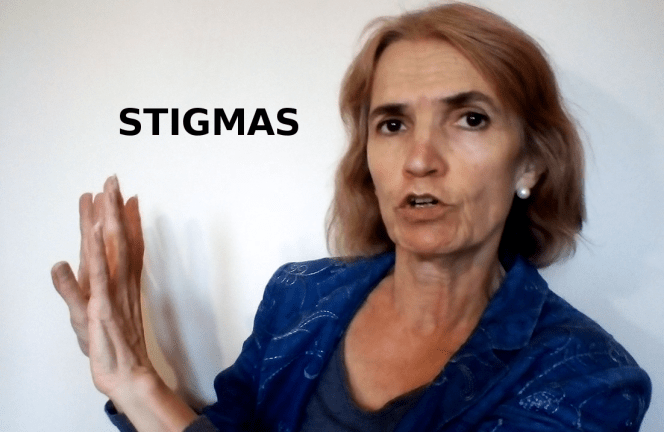
So bioethics is about accommodating human and animal diversity and allowing everyone enough space to breathe and flourish, according to their own wishes and without harming anyone. This includes medical aspects. To a large degree, it is about respect. That is why one of the course images portrays me in the middle of explaining stigmas in one of the videos for this course.
Bioethics is a fascinating and challenging combination of law, philosophy, science, politics, technology, futurism, policy, medicine.
That course was built up like a wave, starting with common topics and simple materials and then progressing toward more complicated ideas such as defining what a life not worth living is. It tapered off with issues like climate change and our surprising inability to foresee all effects of past advances in science and technology. I provided a lot resources such as links to news items and videos, and downloads of scientific papers.
Reviewers said that I am a knowledgeable instructor who provides valuable information and helpful practical activities as well as clear explanations.
What’s in it for you?
- You will gain a greater awareness of innovative views in areas of diversity and inclusivity.
- You will be more skillful in formulating and supporting your own views during meetings and negotiations.
- You will build up more knowledge to support so-called green choices.
- You will be able to add much more variety and strength to your written communications.
- You will become more flexible in countering traditional arguments during meetings and negotiations.
- You’ll get lifelong access to the course on Udemy, and that includes any materials that I will add to the course later.
- If you complete the course successfully on Udemy, I think you’ll automatically receive a certificate.
CURRICULUM
The bioethics course currently contains 25 video lectures and many assignments and quizzes and lots of resources, in 7 sections, as follows.
SECTION 1: INTRODUCTION
This section sets out what this course is about. Surprise surprise.
- Lecture 1. Introduction
This lecture gives you the outline and other information for this course.
SECTION 2: WHAT DOES IT MEAN TO BE HUMAN
This is a question many philosophers ponder. Have you found a good answer yet?
- Lecture 2. What does it mean to be human?
In this lecture, we discuss a definition a particular philosopher came up with. - Lecture 3. But what about animals?
Definitions we come up for what it means to be human may also apply to other species. - Lecture 4. Should we respect other species more?
Other species are not as different from us as we used to think. Shouldn’t that have consequences for how we treat them? - Lecture 5. The new eugenics.
This lecture contains a brief introduction to the new eugenics and the questions this development raises.
SECTION 3: DISABILITIES AND DIVERSITY
Human diversity is much more varied than most of us assume. Isn’t time we accept that?
- Lecture 6. Are people with disabilities expensive?
An often-made argument for removing certain variations of humans from future populations is that they cost more. Is that true? - Lecture 7. Many so-called impairments are created by society.
In this lecture, we’ll take a look at how we make the lives of some people much more difficult than they need to be. - Lecture 8. Why we may need diversity.
Many disabilities are natural variations of the human species and come with special abilities and characteristics. - Lecture 9. Discrimination: how stigmas work.
Stigmas debilitate. Stigmas render people powerless. Stigmas are mostly figments of other people’s imagination. - Lecture 10. Mental health versus physical health.
It is time to start seeing mental health conditions in a new light. - Lecture 11. Gender is a dial!
Gender is not an either/or switch. So does it even make sense that some people travel to foreign countries because they want a male baby? - Lecture 12. Skin tone is not black and white!
Just like gender, skin tone is not exactly an either/or switch either. - Lecture 13. Trends of emancipation give hope.
Will we have a world, one day, in which everyone is equally accepted?
SECTION 4: HUMANS’ RIGHTS
Humans have rights, right? But your rights can only be upheld if other people respect them. That’s your duty too, toward others. So what are we doing with the rights of humans, in practice? Let’s take a look.
- Lecture 14. Where do they come from?
In this lecture, we talk about universally accepted and locally adapted human rights. - Lecture 15. Should prisoners be allowed to vote?
In Britain and in some American states, (many) prisoners are not allowed to vote. - Lecture 16. Should we ban tasers?
Tasers are disproportionately used on people with mental health issues and disabilities. That is not the whole story.
SECTION 5: THE NEW EUGENICS
New technologies are making more and more possible when it comes to selecting the properties of our offspring. Some say that we will never have designer babies. To some degree, however, we have already been making them for a while. It’s just that we’re gearing up rapidly now as a result of the various new technologies.
- Lecture 17. Should we “erase” certain people?
Would we be saving them from pain and suffering? Or is that merely an excuse or the result of myths such as that all disabled people lead miserable lives? - Lecture 18. What is a life not worth living?
A useful concept within this context is the so-called life not worth living. Defining it is hard and getting such a definition universally accepted even harder. - Lecture 19. Are tall people better than short people?
Proponents of the new eugenics often discuss the notion that tall people are more successful. - Lecture 20. It’s the fashion, stupid!
Many of the properties that the new eugenics may enable people to select in their offspring are merely dictated by fashion trends. We’ve seen it before. - Lecture 21. The new eugenics, revisited.
Knowing what you know now, do you feel the same way about what you said in Lecture 5?
SECTION 6: WHAT IS PROGRESS?
I love technological progress, but not all “progress” is good, even though the word sounds so positive. We should keep an open mind, both ways, and not get trapped in discussions of science versus nature, as that isn’t what the issues are really about. It is about science and nature.
- Lecture 22. Climate change and climate change deniers.
A hot topic, with lots of myths and mud-throwing…
Not all so-called climate change deniers are actually like people who keep insisting that the earth is flat, but the term “climate change denier” suggests that they are. Always keep an open mind. - Lecture 23. Why didn’t we foresee this?
Looking back into history, we can see choices that we made that now look incredibly dumb. Technological progress is not always progress, even though a lot of it is. - Lecture 24. Geo-ethics.
Humans are becoming more conscious of what they are doing to their habitat and the other species in it. This is leading to the development of new disciplines.
SECTION 7: CONCLUSIONS
- Lecture 25. How to move forward?
In this lecture, I will also give you tips for how to move forward in your own life and work regarding what we’ve talked about.
I’ve occasionally added more content to it on the basis of developments in the world.
About your instructor
- I am a knowledgeable instructor who provides you with valuable information and helpful practical activities as well as clear explanations according to the reviews.
- I hold a teaching certificate from VU University Amsterdam and have taught graduate students at VU University Amsterdam and the University of Twente, both in the Netherlands. I’ve also supported individual foreign students in the US and in the Netherlands.
- This was my second course on Udemy. I’d earlier created a course for visual artists that was well received and enabled me to familiarize myself with the process and challenges of creating a video-based course. Getting lighting and sound right and tackling video editing can take up a lot of time.
- I have often been told that I am a surprisingly patient teacher, notably when I was helping people with computer issues and with setting up websites. In one instance, this came from an Englishwoman who used to be a teacher in her home country but then moved to Amsterdam. So that was a real compliment.
