Here is the most recent information in Dutch that you MUST READ (echt een inkopper voor wie het nog steeds niet snapt): https://nos.nl/artikel/2605848-ruim-honderd-daklozen-naar-de-rechter-gestapt-voor-opvangplek
In Amsterdam, 11,065 people are without fixed address. This includes 1,446 kinderen. Over 1,300 people are street-homeless in Amsterdam, but the ones not considered street-homeless may be dwelling in a bicycle storage area or garage under a building. Source: https://www.nhnieuws.nl/nieuws/353102/11000-amsterdammers-dak-thuisloos-1500-kinderen
This comes at a time (Feb 2026) when research has also just revealed that most people in the Netherlands have way too much living space. This does not only concern older adults. Older adults in the Netherlands often refrain from moving in with each other because of the extremely complicated legislation and potential severe financial consequences such as cuts to state pension payments. An example of the Dutch regulatory mess: They can live with two siblings without financial penalties, but if one of the siblings dies, the two remaining siblings will see their pensions cut.
Do you still believe in the myth of Amsterdam’s “opvang” or “nachtopvang” upon hearing that? These places are called shelters abroad.
Amsterdam has almost none of that. Between 1 December and 1 April, 250 beds or mattresses are available to those willing to make the long trek to JvG 323b and pretend that they aren’t really capable humans but are mentally deficient creatures who need others to think for them and who meet a bazillion of other conditions such as long-lasting uninterrupted ties to Amsterdam. They can stay there for 1 night. They used to have to pay a fee for this and I assume that this is still the case, but there is no mention of it on the page below (source).
The city of Amsterdam is investing 62 million euros into “homelessness” but it can’t even arrange access to toilets for homeless people. What on earth is it doing with those 62 million euros?
Source: https://www.amsterdam.nl/nieuws/nieuwsoverzicht/winteropvang-en-winterkouderegeling/
Below, you will find links to news articles, research and other people’s opinions as well as as my own views.
But before I continue to lament and criticise, let me offer you a solution for tomorrow… It’s inspired by Japanese capsule hotels and Japanese internet cafes (where people live as well, yes). Don’t get me wrong, I am well aware that Japanese culture is very different from English, American or Dutch, but where there is a will, there is a way. Put one or more persons in charge in return for living there. Include a laundry room. Install vending machines (just like in Japan).
Here is a Dutch example of what I have in mind: https://www.diamondcapsulehotel.com/en
If I’m not mistaken, this is a former office building, possibly where I may have delivered the FD for a while in the 1980s AND where the film “De lift” was shot. I used to live around the corner from this location.
Frans Herberighs, of Stienstra Mercurius, why not start a consortium to convert empty office buildings into cheap and tiny but affordable housing? It would go toward corporate responsibility and help toward improving the awful image of the real estate sector.
As of 13 June 2025, homeless people in Amsterdam are no longer fined for being homeless. That’s in theory. Have the regulations meanwhile really been updated or was this, too, meaningless waffling? https://www.dedaklozenvakbond.nl/2025/06/13/geen-boetes-meer/
Apparently, it’s mere cosmetics: https://decorrespondent.nl/16264/buiten-moeten-slapen-dat-is-geen-overtreding-maar-een-onrecht/7774e412-2a4a-0572-05fd-b77458dbf41f (article published in July 2025, in Dutch, about the myriad of other fines that can be imposed on homeless people)
I do sense that there is increasing willingness to abandon “medieval” ideas about “the homeless” and what they need but there’s a long road ahead.
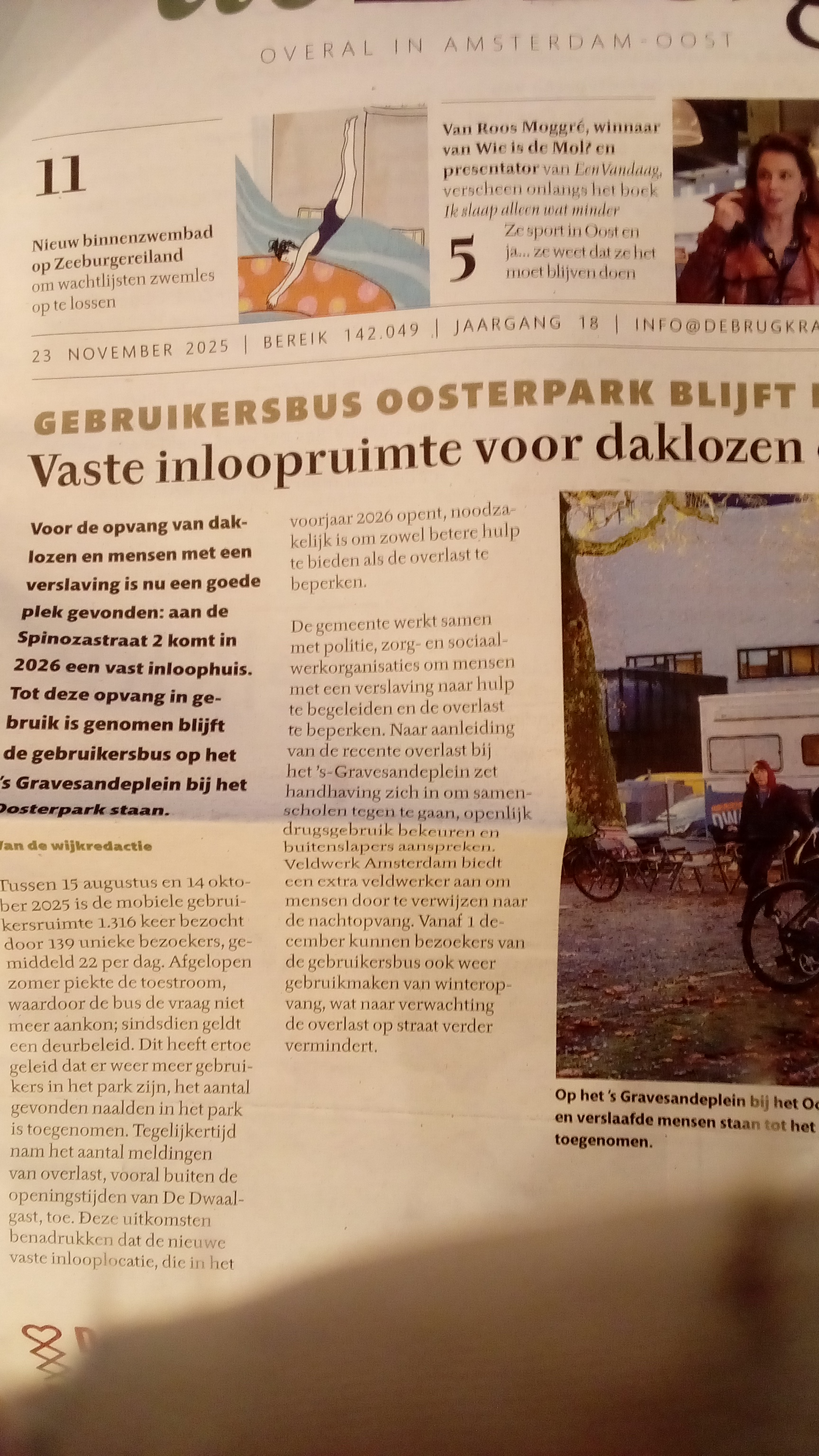
That became clear in November 2025, when I spotted an article above the fold on the front page of a well-distributed newspaper for Amsterdam’s east that suggests very strongly that all homeless people are drug-addicted troublemakers. I contacted the newspaper in question as well as the Netherlands’ Press Council about this article because it expresses an almost medieval view of what homelessness is. It’s highly stigmatising and thereby also highly embarrassing. (I’ve demanded that they publish an apology.)
Oddly enough, when I went to the newspaper’s website, the first thing I encountered above the article in question was an advertorial asking people to help others and make a bit of money in the process because of the humongous housing shortage in Amsterdam. That’s a little hypocritical, isn’t it?
I am seeing a striking difference between the views expressed by London’s Mayor Sadiq Khan and his staff on the one hand and the approach taken by Amsterdam’s Mayor Femke Halsema and her staff on the other side. The former embraces and expresses responsibility and care. The latter demonises and expresses rejection and disapproval.
I’ve been wondering whether the offensive stigmatising article might have actually been provided by Amsterdam’s city council. This might be the reason why the newspaper still hasn’t responded.
Here’s some research done at the University of Amsterdam. Among other things, it states that the majority of homeless people in Amsterdam receive no “social support” and it talks about the effect of having foreign roots on the probability of receiving support. It was published in 2024; It’s a chapter in The Routledge Handbook of Global Perspectives on Homelessness, Law & Policy (pp. 175-187).
https://doi.org/10.4324/9781003274056-12
https://pure.uva.nl/ws/files/180146235/10.4324_9781003274056-12_chapterpdf.pdf
And here is awful and flabbergasting news for those of you who read Dutch or are willing to ask ChatGPT to translate it:
- https://nos.nl/artikel/2583909-gemeente-amsterdam-koopt-haventerrein-terug-voor-165-miljoen-euro
- https://nos.nl/artikel/2584376-vragen-in-amsterdam-over-spookhotel-met-33-verdiepingen-en-600-kamers
Can we call this incompetence on the part of the City of Amsterdam? And do we have yet another example of the abusive or offensive and wasteful and narcissistic reign of Dutch civil servants in one of those stories?
There is something that I want you to realize.
Homelessness, household debt and poverty in general, those are money-making business models. They generate billions in turnover and create many jobs. That is why there is often no real motivation to prevent or remedy any of this.
There is a big circus of consultancies and government departments and other undertakings that surround these isssues. Few of them are genuinely focused on remedying the issues at stake. If these issues would disappear, all those businesses and organizations and departments would go out of business.
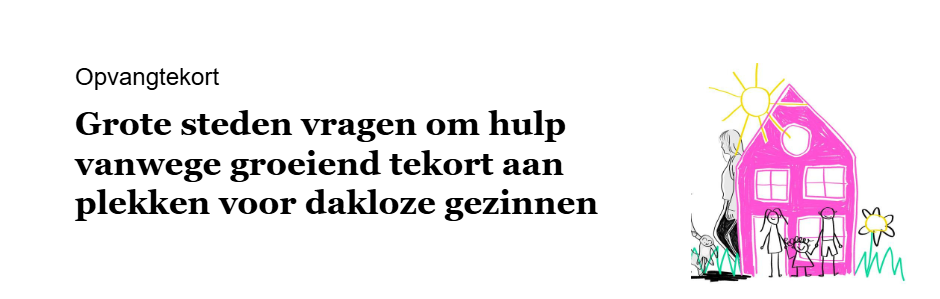
10 September 2025
The cities of The Hague, Rotterdam, Utrecht and Amsterdam are sounding the alarm. In 2024, 2000 homeless families asked for help there. These cities are only able to help 1000. There is support, but it is not intended for people who simply lack money. The existing support includes intensive counselling and check-ups. It’s intended for people with drug and alcohol problems and major mental health issues.
Kids simply need places to sleep safely, be at ease and do their homework. They need good nutrition. They don’t need drug addiction support and neither do their parents. Housing is available, but only for those with very deep pockets. Housing too is a business model nowadays. To be housed is no longer a right. It’s become a privilege.
I’ll ramble on below. The issue is complicated, but I am highly critical of everything that I have seen and heard about the existing – or rather non-existing – support so far. As you will see, I am not the only one who feels that way.
In June or July 2025, I overheard snippets of a conversation among random, housed people in which someone said that some but not all Salvation Army employees (Leger des Heils) are civil servants employed by the city of Amsterdam. That’s probably correct because hearing that made pieces of a puzzle suddenly fall into place.
- I had found it very odd, for example, that the Salvation Army only refers people to the City of Amsterdam’s central intake counter at Jan van Galenstraat, and ignores other doors that may be open for many people who need help. It does not even mention that the Salvation Army hands out coffee and sometimes food from one or more vans. (The way I found out about the latter is by running into such a van.)
- The attitude of some of the Salvation Army staff is very similar to that of civil servants at the gemeente. Dismissive and even a little punitive at times and working as if off scripts. You may get told that the IND will house you and repatriate you if you’re a Dutch citizen who’s been living abroad. This ignores that you’d likely to get deported back right away and end up in the same position, namely homeless without any entitlements to support in Amsterdam.
- I’ve also noticed that there is a tendency to hint openly or subtly – among police, Salvation Army and civic offices staff – that people who say that they were told that they have no entitlement to any form of support (usually because they have not been officially living in Amsterdam for the preceding six or eight years) have been REFUSED ACCESS, suggesting that they are disruptive troublemakers.
It is estimated that there are over 17,000 homeless people in Amsterdam (source: https://www.deregenboog.org/nl/nieuws/de-regenboog-groep-schat-17000-dak-en-thuisloze-mensen-amsterdam, published on 10 October 2023) although the City of Amsterdam speaks of 14,000 homeless people in Amsterdam.
Some of those are not homeless in my view, namely those who are living on a very fancy houseboat or in a very fancy vacation home. The latter is related to one’s legal status in the Netherlands, however.
These are the categories of homeless people in Amsterdam.
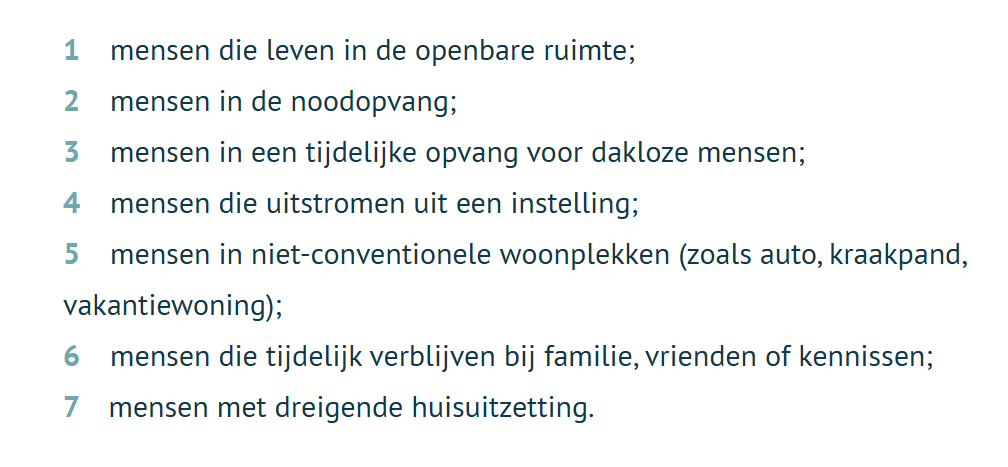
Category 2 are people in emergency shelters, which are only available in the winter and have very limited space. They’re usually not free.
Category 3 are in temporary housing for homeless people. The Netherlands does not have for example the system that the UK uses, which it also often uses for refugees but there is a new system called “Onder de pannen” in which you can rent a room from someone and get matched. It requires sufficients income, among other things. Other options are available as well but hard to get into (such as requiring having lived in Amsterdam for 6 or 8 years plus sufficient funds) and they also sound very limited in scale. None of them are free. It frequently pushes people into a system that was designed for alcoholics and drug addicts or people with debilitating mental health issues.
Category 4 are people about to be released from a prison or hospital.
Category 5 includes people living in a car or a luxury RV or someone’s garage or well-equipped high-end vacation home or as squatters or who are staying at tourist hostels etc.
Category 6 are sofa surfers.
Category 7 are people who are in danger of being evicted.
The number for Category 3 is the only known number for Amsterdam; the other numbers are estimates and extrapolations. The ETHOS project (in which homeless people supposedly are literally counted once a year, which I haven’t witnessed) has been in existence for about two decades. Somehow, cities in the Netherlands weren’t part of it until very recently.
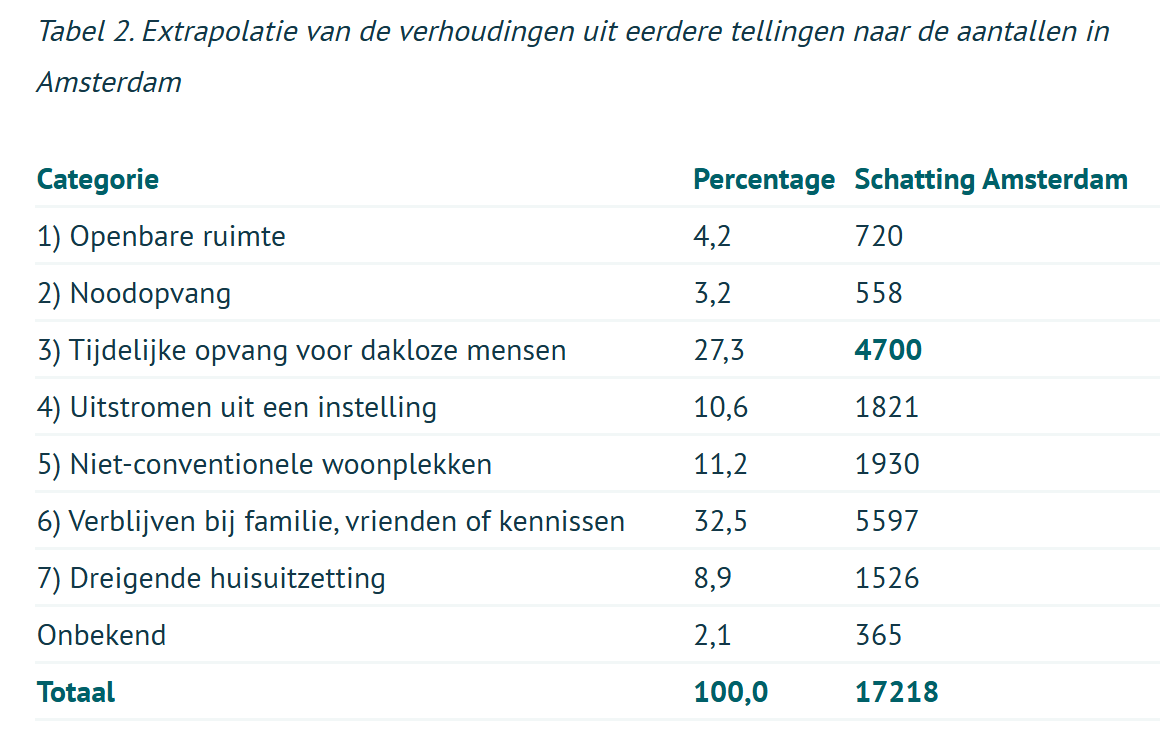
The municipality of Amsterdam counted 933,680 individuals in June 2024 (see data at Netherlands Statistics https://opendata.cbs.nl/#/CBS/nl/dataset/70072ned/table?ts=1755339241585).
If I subtract categories 4 and 7, I end up with a number of 13,871 for Amsterdam. This must be how the city of Amsterdam arrived at the total of 14,000.
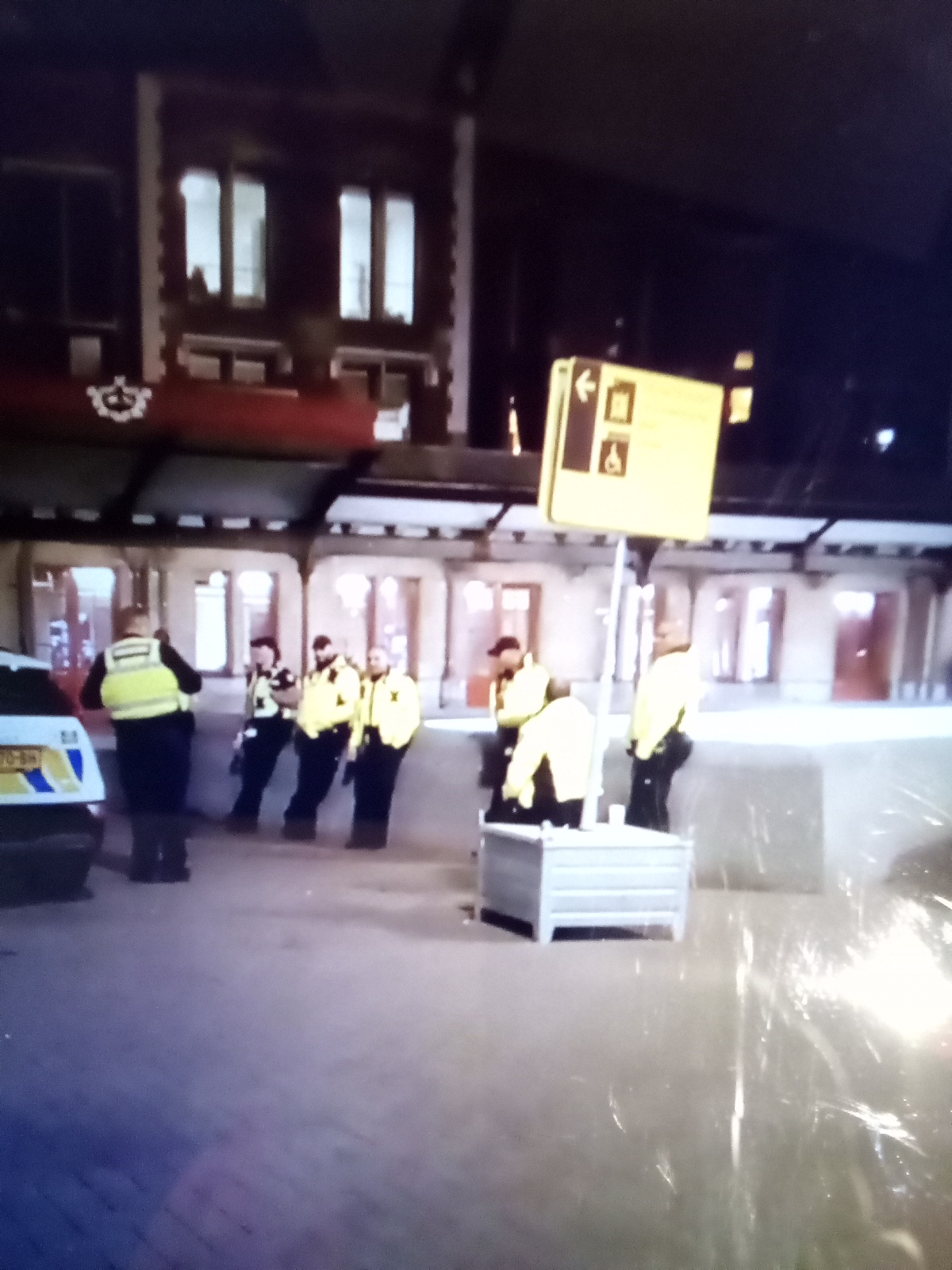
Ready to target homeless people seeking shelter at Amsterdam’s central train station?
Note that it makes sense that organizations who receive their income on the basis of the number of homeless people come up with high numbers and that politicians and city administrations come up with low numbers.
Amsterdam tends to reject claims from homeless EU citizens who are entitled to support; they often have to go to court if they want support. The city of Amsterdam recently spent a lot of money to discover that most homeless EU citizens are actually entitled to support and to develop a convoluted tool that must be used to determine if a homeless EU citizen is entitled to support in Amsterdam.
The Netherlands is a system of boxes and labels. If you flee from domestic violence in the Netherlands, you can only go to a women’s shelter in your own town. If you are relocated to a different municipality for your own safety, you may have to go to court if you want basic social security benefits in that new location once the shelter releases you. That’s because many – or all? – Dutch municipalities have rules that if you haven’t been living there for the preceding 6 to 8 years without interruption, you won’t get any support whatsoever. Is it legally allowed? No.
Some municipalities have complicated agreements with some of the surrounding municipalities. You may be eligible for support as a homeless person in Amsterdam – including a registered address and a basic monthly benefits payment – if you sleep in a tent in Amstelveen, but not if you sleep in a tent in Purmerend or sleep on a sofa in Amstelveen.
Side note: Did you know that as a Dutch person, you are not allowed to work at Schiphol Airport if you’ve been out of the country for longer than 6 or 8 years? It makes you a security risk…
Tips for anyone who’s (about to be) homeless in Amsterdam
- Ask ChatGPT for tips first. It may surprise you pleasantly. Just keep asking it questions and tell it what you like and don’t like and need and don’t need. Be persistent. It can search the web much better and faster than you can and can come up with places to stay and ways to make money (such as through Temper) that nobody else will tell you about and it does not have to adhere to rules and policies imposed by the city council. Many options you are told about may not actually be available to you, however (due to their small capacity and other restrictions or, if you need to walk, because they are are a great physical distance).
- Did you know that you no longer need a deposit to rent anything through WoningNet? It does often take 15 to 20 years, however, before you will get access to this type of housing because of the huge housing shortage. A WoningNet registration costs only about 10 euros per year. WoningNet (which has several versions, one of which is for housing in Amsterdam and some of the surrounding towns) is the official allocation system for relatively affordable housing and comes with rules and requirements. If you have a few spare millions, housing is not a problem, of course.
- The organizations that claim to be there for homeless people are often mostly in the process of receiving funds and shifting monies around. Sometimes, they’ll refer you to a connected organization but they won’t tell about other initiatives and options that might be much more suitable for you (possibly because they see those as competition). There are also many people involved who enjoy looking down on you because they are secretly painfully insecure and “helping the homeless” makes them feel better. A few of those rotten apples can really ruin the harvest, so to speak
- The lack of true commitment is reflected in the fact that many of these organizations don’t even bother to publish accurate information about their own locations (addresses) and opening hours and of associated organizations.
- There is also a tendency to see you as severely mentally ill and potentially dangerous or as having an addiction problem and needing rehab and counselling, whereas you’ll mostly need MONEY. You are likely not at all “broken” or “defective”, like a washing machine or car (but you are probably stressed and tired and that’s only to be expected and normal). You also see this reflected in the November 2025 article I posted above. It suggests that all homeless people in Amsterdam are drug addicts.
- Once you make the mistake of contacting organizations for help, your anger and frustration about the way they may talk down to you or about the useless information they give you may simmer for a while – and that’s not helpful.
- Be resourceful. Be strong. YOU’VE GOT THIS. There are worse things than being homeless. Yes, really. Many people will treat you as if you have terminal cancer, but homelessness is not an incurable disease and it’s not infectious either. YOU’VE GOT THIS. One day, this will all be in the past again. You can do this! Of course you can. Don’t be a proverbial meek, weak sheep inside. Inside, be like an eagle or a pigeon or a lion or Stafforshire terrier or anything else that doesn’t go with being meek and weak, like you are expected to. Take the lead. This is YOUR life, and YOUR struggle. You are not a leaf in a strong headwind, even though you may feel like this at times.
- Make a list of priorities and make sure that they are truly your priorities and not the ideas of people who oh so helpfully may be talking you into a corner.
- Don’t listen to all the negative folks. They are simply feeling insecure because the idea of homelessness makes them panic. They are not rejecting YOU; they are rejecting their own insecurity and helplessness.

https://nos.nl/nieuwsuur/artikel/2569689-in-heel-nederland-wonen-kinderen-in-auto-s-en-garageboxen
Homelessness is increasingly common in the Netherlands, as you can also read in Michelle van Tongerloo’s book and articles. She is a general physician based in Rotterdam.
Homelessness can happen to anyone. Perfectly fine people are increasingly often being pushed into homelessness without support.
All over the world – but perhaps notably in Australia – this increasingly often concerns 50+ women. In the Netherlands, there is a view that older adults should apply for euthanasia anyway, as their lives are seen as devoid of value and their wishes and ambitions as silly. This does not help.
Here are some links for people who read Dutch:
• 17-12-2024: Physician Michelle van Tongerloo in LINDA, about how things REALLY work in the Netherlands
• 19-07-2024: Physician Michelle van Tongerloo in LINDA, about the same
• 3 January 2025: Article in Dutch about the Dutch explosion epidemic as a new cause of homelessness
Unlike in the US, there generally are no homeless shelters in the Netherlands such as in The Pursuit of Happyness. That inspiring film is based on the experiences of a real person: https://en.wikipedia.org/wiki/Chris_Gardner
In reality, homeless people often have to fend for themselves in the Netherlands, particularly if they are educated and capable. Friends and family or (ex-) colleagues are expected to step up. People whose home was attacked in the crazy Dutch explosives epidemic can also end up on the streets, without support, yet can still be expected to continue to pay rent, if the mayor shuts down their residence. (Link below)
What I didn’t expect to find is that homelessness is a moneymaking business model for many people and organizations, just like debts constitute a major industry. People get into debt because too many other people make a living off those debts. Businesses, various organizations and also government at all levels make money off people’s debts. The annual amount spent in the Netherlands on helping people resolve their debts is currently EUR 17 billion, whereas the total amount of debts is only about EUR 3.5 billion per year. That industry therefore generates an annual revenue of way over 13.5 billion euro per year. The fees, fines and interest for example alone add up to a hefty total. And that is not included in this turnover.
Similarly, there is an industry around homelessness.
De daklozenvakbond, that is Vest Advies: https://www.vestadvies.nl/carolien-de-jong/
Here is another party that really benefits: https://www.movisie.nl/tools/zelfredzaamheid-matrix-zrm
There are many consultants and consultancies involved in this industry.
This includes the harsh response to the manifestations of homeless people’s utter physical exhaustion and resulting crankiness (also known as irritability).
I find it so disgusting.
Human rights, universal declaration
https://www.un.org/en/about-us/universal-declaration-of-human-rights
Article 12:
“No one shall be subjected to arbitrary interference with his privacy, family, home or correspondence, nor to attacks upon his honour and reputation. Everyone has the right to the protection of the law against such interference or attacks.”
Article 13:
1. “Everyone has the right to freedom of movement and residence within the borders of each state.”
2. “Everyone has the right to leave any country, including his own, and to return to his country.”
Article 25, paragraph 1:
1. “Everyone has the right to a standard of living adequate for the health and well-being of himself and of his family, including food, clothing, housing and medical care and necessary social services, and the right to security in the event of unemployment, sickness, disability, widowhood, old age or other lack of livelihood in circumstances beyond his control.”
Article 7:
“All are equal before the law and are entitled without any discrimination to equal protection of the law. All are entitled to equal protection against any discrimination in violation of this Declaration and against any incitement to such discrimination.”
Olivier de Schutter, human rights expert and United Nations Special Rapporteur for Extreme Poverty and Human Rights since May 2020 has stated that povertyism should be made as illegal as discrimination on the basis of race or any other illegal form of discrimination of a random characteristic of a person. He concluded “Discrimination is part of the daily experience of people in poverty.”
Links:
www.ohchr.org/en/documents/thematic-reports/a77157-banning-discrimination-grounds-socioeconomic-disadvantage
www.unicef.org/thailand/press-releases/people-living-poverty-face-three-times-more-discrimination-any-other-groups
www.ohchr.org/en/press-releases/2022/10/ban-povertyism-same-way-racism-and-sexism-un-expert
The remainder of the page contains a lot of Dutch, with added comments or translations in English. You’ll also see links that clearly lead to English-language pages.
I am quite disappointed by the current mayor of Amsterdam, Femke Halsema. In the area of homelessness, her comments and policies are either rather right-wing or mere political cosmetics and, therefore, occasionally even in direct contradiction to each other (condemning fining homelessness but also threatening to issue homelessness fines).
Wonen en mensenrechten
De Verenigde Naties spraken in 2021 specifiek hun zorgen uit over een situatie in Rotterdam. De Speciale VN-Rapporteur voor het Recht op Huisvesting, Balakrishnan Rajagopal, en de Speciale Rapporteurs voor onder meer Armoede en de Rechten van Migranten en Minderheden brachten een formele verklaring uit.
Link:
spcommreports.ohchr.org/TMResultsBase/DownLoadPublicCommunicationFile?gId=26359
De context is de spanning tussen het doelbewust veroorzaken van dakloosheid onder vooral mensen met een niet-Nederlandse achtergrond versus de commerciële belangen van onroerend-goed-bezitters. Het Nederlandse ambtelijke apparaat lapt de belangen van inwoners wel vaker gemakkelijk aan de laars ten faveure van wat o.g.-giganten willen. Dat weet ik intussen ook uit eigen ervaringen.
Ter illustratie geef ik deze twee gedeeltes uit de VN-verklaring met betrekking tot de situatie in Rotterdam:
• “Rendering homeless those people who previously enjoyed adequate housing by demolishing their homes, would violate the principle of nonretrogressive measures in international human rights law.”
• “Targeting in particular Rotterdam South, where a significant proportion of the residents are migrants or have a minority and immigrant background, may have the effect of discriminatory distinction, which impairs the exercise of the right to adequate housing.”
Een jaar geleden kwam Rajagopal al voor Nederland met 65 aanbevelingen om het recht op adequate huisvesting beter te beschermen en verwerkelijken.
Link:
www.woonbond.nl/nieuws/zo-kan-nederland-het-recht-op-huisvesting-waarmaken/
In december 2023 meldde hij namelijk al dat Nederland het internationale mensenrecht op adequate huisvesting beter in de Grondwet en in de nationale wetgeving moest verankeren.
Links:
www.woonbond.nl/nieuws/nederland-recht-op-huisvesting/
www.rijksoverheid.nl/actueel/nieuws/2024/05/31/kabinetsreactie-op-vn-rapport-over-adequate-huisvesting
Daklozen en mensenrechten in Amsterdam
Gewone burgers kunnen bij de gemeente gewoon naar binnen lopen, maar daklozen niet. Die moeten in de Jan van Galenstraat (op nummer 323b) al hun spullen in een kluisje zetten en mogen alleen met bundeltjes papier naar binnen. Na hun afspraak worden de bezoekers snel het gebouw uitgewerkt; hun papieren moeten ze desnoods maar in de nabijgelegen KFC ordenen. Er staat ook een metaaldetector.
Die bejegening van daklozen op het adres Jan van Galenstraat 323B is naar mijn mening een haast onbetwistbare uiting van povertyism. Dit zal voor velen niet meteen duidelijk zijn. Dat komt door mythes en misverstanden rond dakloosheid. Dakloosheid heeft zeker tegenwoordig vooral veel met armoede te maken. Armoede is puur de combinatie van relatief weinig inkomsten hebben en daar zelfs de basisbehoeften niet van kunnen betalen. Daarom stel ik dat de behandeling van daklozen door de gemeente Amsterdam een uiting van povertyism is.
Ambtenaren halen soms heel flauwe spelletjes met daklozen uit en zetten hen bijvoorbeeld bewust wekenlang op het verkeerde been om hen zo de toegang tot enige ondersteuning te kunnen ontzeggen op grond van regels die Amsterdam hanteert. Dat is zoiets als zes of acht jaar lang onafgebroken in Amsterdam hebben gewoond of gewerkt onmiddellijk voorafgaand aan de dakloosheid, al betreft dit mogelijk vooral het recht op een bijstandsuitkering, niet zozeer de toegang tot de opvang. Die opvang stelt overigens toch al geen fluit voor. Er kunnen een aantal mensen een deel van het jaar terecht, maar alleen ‘s nachts en meestal slechts voor 1 nacht en alleen als je zegt dat je achterlijk bent en anderen voor je wil laten denken en besluiten. Slapen doe je in dat soort faciliteiten doorgaans slecht, maar je vriest er niet dood wat een PR probleem voor anderen zou kunnen veroorzaken maar voor de dakloze in kwestie de ellende oplost. Je vriest niet dood door de kou. Je vriest dood omdat je in de steek bent gelaten en de hoop hebt opgegeven. Regen is een veel groter probleem en een van de redenen waarom mensen het Centraal Station opzoeken.
Derden kunnen later ten onrechte concluderen dat de persoon in kwestie een toegang tot opvang kreeg omdat deze probleemgedrag vertoont, bijvoorbeeld vaak agressief is, en dat de toegang tot de opvang op grond daarvan was ontzegd. Nee. De Gemeente Amsterdam heeft een bewust ontmoedigings/weigeringsbeleid en er is bijna geen capaciteit.
Er is behalve de opvang van de gemeente een wirwar van initiatievenen organisaties met vage beschrijvingen van wat ze doen en wie bij hen terecht kan. Ze overlappen vaak onderling en lijken meestal gebaseerd te zijn op de aanname dat daklozen verslaafd zijn of hoe dan ook “defect”. Er zijn mensen bij betrokken die helemaal niets met de materie te maken hebben, maar er geld aan verdienen.
In de praktijk lijken dakloze mensen vaak alleen richting Bijlmer een tentje onder de metrobanen te mogen opzetten en anders misschien in het Flevopark. Ook kunnen ze tips krijgen voor hoe ze zich zo goed mogelijk verborgen kunnen houden. Want voor anderen moeten daklozen uiteraard zo onzichtbaar mogelijk blijven. Gezien worden, dat geeft overlast en aanstoot. Wegmoffelen moet je die daklozen.
Amsterdam heeft er veel. Daar zijn heel wat ambtenaren mee bezig, dus als die daklozen er niet meer zouden zijn, zouden veel van die ambtenaren hun baan kwijtraken.
Mythes en misverstanden
Deze met opzet anoniem gehouden meneer op Bluesky begrijpt er duidelijk de ballen van, zou je zeggen.
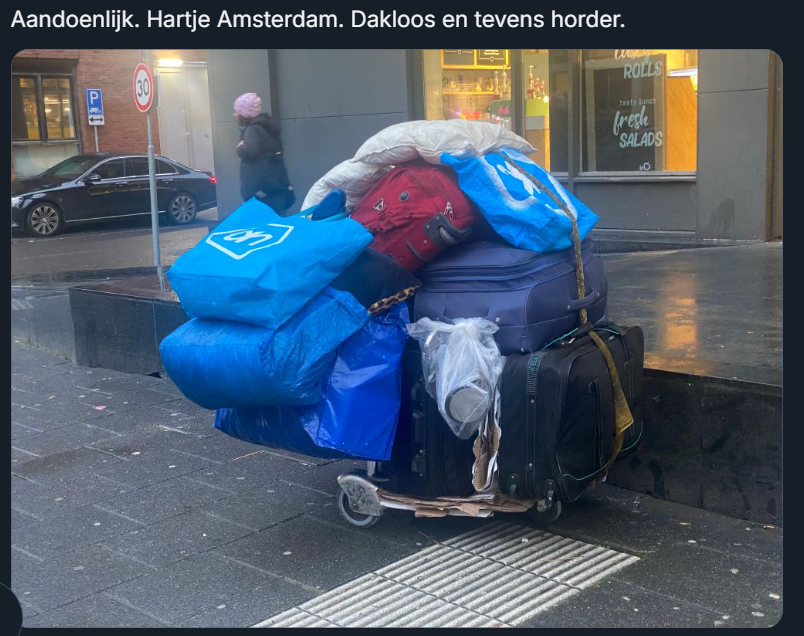
Dat weet de meneer die deze foto deelde ook wel, maar hij is zo onzeker dat hij dat niet wil erkennen. Dat ervaart hij als veel te bedreigend. Het doet mij me afvragen of hij wellicht ook in scheiding ligt of moeite heeft met het betalen van zijn hypotheek en hij zich wil distantiëren van zijn eigen mogelijke toekomst als dakloze in Amsterdam. Het zou ook kunnen dat zijn bedrijf wordt gewurgd door coronabelastingschulden; hij is architect en misschien wel eigen baas.
Het is in Nederland nog steeds een standaardaanname dat dakloosheid wordt veroorzaakt door drugsverslaving, alcoholmisbruik en hersenaandoeningen zoals schizofrenie. Af en toe zit er misschien iemand bij die niet of niet meer kan tellen of lezen en schrijven, geen formulieren kan invullen en niet begrijpt dat hij de huur moet betalen.
U denkt dus wellicht dat ambtenaren zoals op het adres Jan van Galenstraat 323b daarom tegen daklozen moeten worden beschermd omdat daklozen per definitie potentieel gevaarlijk zouden zijn. Waar komt dat idee vandaan?
Om dat te achterhalen, sleur ik er nu even een ander “mensenrecht” bij. Het onthouden van dat recht staat internationaal erkend als een wrede martelmethode en is dan ook niet toegestaan. “Sleep Is a Human Right, and Its Deprivation Is Torture” luidt de titel van een artikel in de oktober 2024 editie van het AMA Journal of Ethics.
Link:
journalofethics.ama-assn.org/article/sleep-human-right-and-its-deprivation-torture/2024-10
Doordat extreem slaapgebrek hooguit wordt geassocieerd met illegale martelpraktijken van de CIA is er is veel te weinig bekendheid met de effecten van ernstig slaapgebrek en het feit dat dit zeker in het begin als je op straat helemaal niet durft te slapen een hoofdcomponent van dakloosheid is. Dat is overigens niet alleen zo voor buitenslapers, maar is ook vaak het geval bij mensen die bij vrienden en collega’s op de bank slapen, zij het in mindere mate.
Hoe langer je dakloos bent, hoe beter je leert te zorgen voor wat je nodig hebt, maar vooral in het begin ben je permanent BEKAF. En toch verwacht men dat je dagelijks tien tot twintig kilometer kunt lopen, al dan niet met je hele hebben en houden, van loket tot loket.
De aandacht ligt bij daklozenopvang jammer genoeg behalve dat het grotendeels politieke cosmetica lijkt te zijn vooral op het beschermen tegen de invloeden van guur winters weer. Slaapgebrek leidt echter al snel niet alleen eerst naar een niveau van functioneren dat op dronkenschap lijkt, maar kan daarna onder meer in hallucinaties en psychotische symptomen resulteren.
Chronisch slaapgebrek leidt ook tot een aftakeling van het uiterlijk. Mensen gaan er puur door slaapgebrek al snel “verwilderd” uit zien. Als je er vrieskou bij doet en gure wind, dan zien ze er misschien zelfs ronduit “gevaarlijk” uit. Je ogen raken hun normale aantrekkelijkheid kwijt. Daar komen de effecten van armoede nog bovenop. Denk aan een slechte kwaliteit voeding, niet meer naar de kapper kunnen en ook, wellicht vooral voor wat oudere personen, niet meer dagelijks verzorgende producten kunnen gebruiken. Uiteraard laat het uiterlijk van de mens ook de impact van stress zien. Daar komt ook nog enige uitdroging bij omdat je wilt voorkomen dat je ‘s nachts naar de wc moet en dus probeert niet al te veel vocht te consumeren.
Er is geen wc waar je naartoe kunt als je ‘s ochtends wakker wordt als je dakloos bent. Als je mazzel hebt, kun je al vroeg bij een McDonald’s terecht.
Dakloos zijn is slopend. Je raakt bek- en bekaf. Op straat leven kan overigens wel een stuk rustiger zijn dan bij iemand op de bank “mogen” slapen.
Bovendien leef je dus net als de wilde dieren en is iedere onbekende mens een potentieel gevaar. Je schrikt ‘s nachts nogal eens wakker als je ergens op wat stoeptegels ligt. Je kunt niet douchen, je kunt je haar niet wassen of kleuren, je kunt de was niet meer doen, de huidschilfers stapelen zich op en je veroudert met de dag (hoewel sommigen zich in het toilet bij McDonald’s een beetje weten te wassen), je kleding wordt vuil, je leeft ‘s nachts vaak bij temperaturen rond het vriespunt, terwijl je overdag met je 2, 3 of 5 lagen kleding aan rondloopt in warm weer. Je zweet je te pletter, je loopt UTIs op omdat je vaak niet naar de WC kunt, je kleding gaat stinken en jij gaat ook vast stinken. Mensen doen in het begin vaak super aardig en komen met koffie en croissantjes aanzetten maar hoe langer je dakloos bent, hoe meer mensen superbot en irritant gaan doen. Waar bemoeien ze zich in hemelsnaam mee? Als je iemand niet kunt helpen – en dat doe je met geld of door iemand bij jou thuis te laten douchen of naar de toilet te laten gaan en de was te laten doen – val mensen dan niet lastig.
De mythen over dakloosheid moeten de wereld uit want die helpen dakloosheid in stand houden. Er wordt bij de aanpak vaak onbewust van uit gegaan dat de oorzaak van de dakloosheid zo problematisch is dat dakloosheid niet te vermijden is. Het ondersteunen van iemand’s dakloosheid wordt dan hoofdtaak. Daarmee bedoel ik dat de daklozen zelf niet worden ondersteund; ze worden vooral geholpen om dakloos te blijven.
De opvang is in Amsterdam niet alleen erg beperkt qua capaciteit, zoals bij velen bekend is, maar is ook slechts tijdelijk (winterperiode), meestal voor slechts 1 nacht. Die is ook niet altijd gratis. Bovendien is toegang krijgen erg moeilijk. Ik heb begrepen dat dit een bewuste tactiek is om te voorkomen dat anders bij wijze van spreken half Nederland naar Amsterdam zou komen om toegang te krijgen tot de daklozenopvang. Ik denk niet dat dat een realistische aanname is.
In 2019 werd daarom voorgesteld om daklozen in tentjes in het Vondelpark te laten slapen. Volgens de Volkskrant dreigde burgemeester Halsema daarop met fikse boetes.
Links:
www.volkskrant.nl/nieuws-achtergrond/dan-maar-in-het-vondelpark-kamperen-want-wij-als-daklozen-kunnen-s-nachts-niet-verdampen~bbb48c0d/
www.parool.nl/amsterdam/dak-en-thuisloze-in-amsterdam-steeds-vaker-zonder-hap-eten-en-een-warme-douche-weer-de-kou-in~be2a45d8/
Ik hoop dat Femke Halsema zich achteraf GROEN heeft geschaamd over hoe afgrijselijk RECHTS haar reactie destijds was.
Links:
www.parool.nl/nederland/minder-toegang-en-meer-beveiliging-s-nachts-op-amsterdam-centraal-station~ba6b76b2/
youtu.be/INr4Kw6JnHk?si=G3HNCPJ4CtsoW2va
Je kunt je afvragen wat de nieuwe aanpak bij het Centraal Station op de achtergrond écht bereikt. Ik vermoed dat die de problemen in werkelijkheid vergroot. Het probleem – als er al een probleem was, trouwens – is namelijk ongetwijfeld verplaatst. Dat kan haast niet anders. Je geeft mensen niet de broodnodige rust door ze als ratten op te jagen.
Links:
www.parool.nl/amsterdam/waarom-krijgen-buiten-slapende-daklozen-nog-steeds-boetes-halsema-wil-beleid-tegen-licht-houden-daklozen-beschermen-en-overlast-tegengaan~b6af637f/
www.at5.nl/nieuws/206600/halsema-vindt-beboeten-van-slapende-daklozen-beschamend
In 2021 zei Halsema dat ze de boetes beschamend vond. (In 2019 dreigde ze volgens De Volkskrant zelf met boetes.) Nu, in maart 2025, wil Femke Halsema het boetebeleid opnieuw bekijken. Kortom: er lijkt niets te zijn veranderd.
www.binnenlandsbestuur.nl/sociaal/meer-dan-300000-euro-aan-daklozenboetes-opgelegd-130-gemeenten
Hier is nog meer gerelateerde achtergrond voor wie de realiteit in Nederland nog niet goed kent:
www.youtube.com/watch?v=fG3mbA4kJg0 (Zembla, hoe medische faciliteiten in Nederland de mensenrechten schenden door zorg te weigeren aan onverzekerden, met Michelle van Tongerloo, Rotterdam).
www.youtube.com/watch?v=phh9jXqABiQ (Zembla, over hoe onroerendgoedbelangen mensen gewoon op straat gooien, redelijk vergelijkbaar met hoe dat in Rotterdam gebeurde in de kwestie waar de VN zich over uitsprak, al gaat het in dit geval over een camping en onder meer een Nederlandse leerkracht)
eenvandaag.avrotros.nl/item/oost-europese-daklozen-krijgen-vaak-geen-hulp-maar-hebben-daar-wel-recht-op-ernstig-dat-eu-burgers-als-tweederangsburger-behandeld-worden/ (EenVandaag: Oost-Europese daklozen krijgen vaak geen hulp, maar hebben daar wel recht op: ‘Ernstig dat EU-burgers als tweederangsburger behandeld worden’)
Over het beleid heb ik een paar keer contact opgenomen met Halsema – omdat ik dacht dat ik haar op grond van mijn eigen ervaringen kon bijstaan – en naar aanleiding daarvan een telefoongesprek van een half uur gehad met een projectleider van de gemeente. Ik kreeg veel gebakken lucht te horen en veel uitvluchten voor waarom er zo goed als niets lijkt te worden gedaan aan het oplossen en voorkomen van dakloosheid. Erg teleurstellend vond ik dat beleid van de gemeente leek te worden afgewimpeld op ambtenaren aan de Jan van Galenstraat. Op de situatie bij het CS werd niet ingegaan.
ChatGPT translation, adapted:
“I contacted Halsema a few times to talk about her homelessness policy (because I naively thought that I might be able to contribute) and, as a result, had a half-hour phone conversation with a project manager from the municipality. I heard a lot of hot air and many excuses as to why next to nothing seems to be done to solve or prevent homelessness. I found it very disappointing that the municipality’s policy was brushed off onto individual civil servants at Jan van Galenstraat. The situation at Central Station was not discussed.”
Ik kom tot min of meer dezelfde conclusies als JOOP van BNNVARA: https://www.bnnvara.nl/joop/artikelen/daklozen-mogen-blijkbaar-meedoen-maatschappij
If you look at the post category “law” or “housing”, you will find a few English Supreme Court cases that I’ve discussed that concern housing and homelessness in England. There too, vulnerable people get government support rather than resilient people. Different in the Netherlands is that the country with its long tradition of egalitarianism doesn’t know what to do with its increasing inequality and tends to view poverty in the same light as staunch Tories do in England.
This article discusses that capable homeless people receive no support in the Netherlands, which dooms them to perpetual homelessness without income. Part of the reason is what I often refer to as the Dutch address nonsense, a peculiar thing that requires you to be officially registered, permit and all, at a particular Dutch address, without which you can’t do a thing. Unfortunately, not being able to do a thing aso means that you can’t get an official registered address.
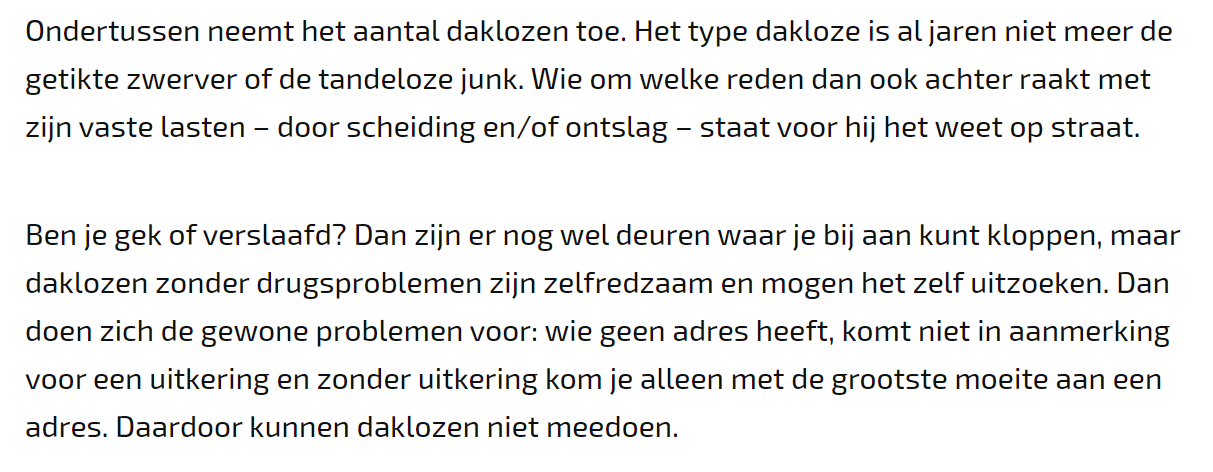
ChatGPT translation, adapted: |
“Meanwhile, the number of homeless people continues to rise. The typical homeless person is no longer the stereotypical mad vagrant or toothless junkie. Anyone who, for whatever reason, falls behind on their fixed expenses—due to divorce and/or losing their job—can find themselves on the streets before they know it.”
“Are you mentally ill or addicted? Then there are still some doors you can knock on. But homeless people without drug problems are considered self-reliant and are expected to sort things out on their own. That’s when the ordinary problems arise: if you don’t have an address, you’re not eligible for welfare, and without welfare, it’s nearly impossible to get an address. As a result, homeless people are blocked from participating in society.”
“Dinsdagavond portretteerde Nieuwsuur een schrijnend geval, een typisch slachtoffer van de crisis. Meneer kwam in scheiding terecht en verloor zijn baan. Bank verkoopt huis. Je blijft met een restschuld op straat achter. Hij was er in vijf jaar niet in geslaagd zijn leven op de rails te zetten omdat hij door zijn dakloosheid en al dat Kafkaeske gelazerstraal zijn leven niet op orde kan krijgen.”
ChatGPT translation, adapted: “On Tuesday evening, the TV program Nieuwsuur portrayed a harrowing case — a typical victim of the crisis. The man went through a divorce and lost his job. The bank sold his house. He was left on the streets with a remaining debt. In the course of five years, he still hadn’t managed to get his life back on track because, due to his homelessness and all the Kafkaesque hocuspocus, he simply couldn’t get his life in order.”
The article also mentions the involvement of consultancies: “De Zelfredzaamheidsmonitor is een product van het bureau Movisie te Utrecht waarvan de 140 medewerkers tegen een marktconform salaris bezig zijn met het verzinnen van manieren om anderen te vertellen hoe ze zelfredzaam moeten zijn. “
ChatGPT translation, adapted: “The Self-Reliance Monitor is a product of the agency Movisie in Utrecht, whose 140 employees, earning market-rate salaries, occupy themselves with devising ways to tell others how to be self-reliant.”
- Er wordt vreselijk veel gepraat, vergaderd, gelezen, en onderzoek gedaan.
- Er worden, vaak door derden, checklists en tools ontwikkeld en rapporten geschreven.
- Soms maakt men reisjes: https://hvoquerido.nl/meedoen-volgens-de-finnen/
- Soms legt men ludiek ergens bij de receptie matrassen neer waar daklozen op mogen liggen.
- Projecten komen niet van de grond wegens krapte op de arbeidsmarkt of omdat er een situatie wordt gecreëerd die niet brandveilig is.
- Er wordt nog veel meer gepraat en gelezen en vergaderd. Er zijn heel veel mensen continu mee bezig en de projectleider houdt zich ook al haar hele leven lang met daklozen bezig.
- Dit jaar in april worden daklozen geteld, vertelde de projectleider me met trots. Dat bleek om een onderzoeksproject te gaan dat al 20 jaar bestaat.
- Daklozen hebben allemaal intensieve begeleiding nodig, volgens haar, en ook dat is een struikelblok. Daarbij speelt die krapte op de arbeidsmarkt.