(Chapter 1 from my book “Is cruelty cool?”, available as Kindle ebook and as hardcover.)
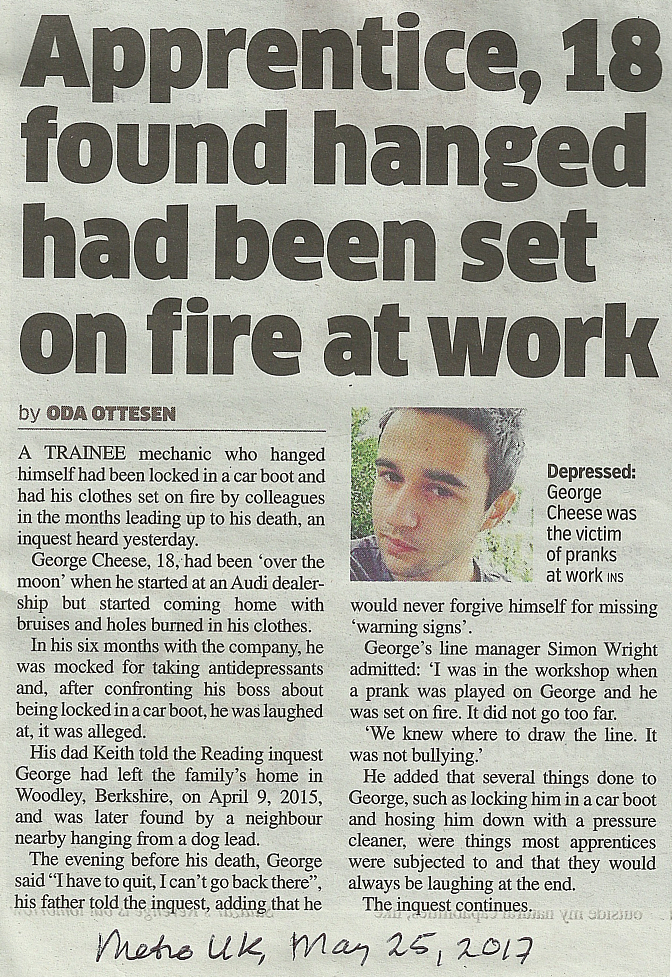
On 25 May 2017, I ran into an article in Metro UK about a young man who had killed himself because of extensive bullying at his place of work in Reading. Bullying is a highly deliberate public form of inflicting cruelty. Bullying is tied to a location or environment. Workplace bullying is related to work, bullying at school is related to being a student or pupil, and internet or cyber bullying is related to the internet and all electronic means of communication.
Handsome George Cheese often came home with holes in his clothes and bruises on his body, cracks in his soul and tears in his sense of safety. The holes in his clothes were the result of his colleagues having set him on fire. He was mocked after he stood up for himself after he had been locked into a car boot (trunk). He was prescribed antidepressants. He was held down and punched. He was ridiculed.
Here, we see a glimpse of a problem that I initially had no answers for. Why does it sometimes have the opposite effect than what you’d expect when you stand up for yourself? Where does it come from that people then ridicule the victim even more? From the victim’s point of view, the behaviour of the others, the ones who are misbehaving towards you, is shameful and seeing those who misbehave becoming glorified can be infuriating and baffling. Are victims of bullying supposed to crawl into a corner and quietly lick their wounds, pretend nothing is going on?
I have had similar experiences in England (which I will come back to from time to time in this book) and I couldn’t have been more baffled. I wasn’t able to explain what was going on to friends and colleagues abroad either and eventually, some of them must have started to wonder if I might be suffering from early-onset Alzheimer’s or some other early-onset form of dementia. I can’t blame them. Because what I told them made absolutely no sense.
In a way, this actually pointed to the heart of the problem, but I didn’t realise it back then and I was not aware that I was trying very hard to distance myself from the bullying. I was not only baffled by it, I was probably also ashamed of it, without realising it. Other people get bullied. Weak people get bullied. Silly people get bullied. Children get bullied. But how does an adult self-employed professional woman become bullied out of the blue? That made absolutely no sense.
I now know that whether you are perceived as a suitable target for bullying has to do with whether you are seen as one of us – part of the in-group – or as a member of some other group. Not one of us. You don’t even have to be part of a different group. Merely being perceived as such is enough. Not one of us.
Back to the story now.
Utterly flummoxing was the statement that Simon Wright, the immediate superior of Mr Cheese, apparently gave to Metro UK.
“I was in the workshop when a prank was played on George and he was set on fire. It did not go too far.”
“We knew where to draw the line. It was not bullying.”
After some contemplation, I realised that these statements seemed mostly about the risk that he, his bosses and colleagues thought they ran. To understand what I mean by that, consider the following.
“I was in the workshop when a prank was played on George and George was stabbed with a knife. It did not go too far.”
“We knew where to draw the line. It was not bullying.”
A relatively small cut may not get the perpetrators in trouble. It will be the perpetrators’ word against the victim’s word and a small cut can be explained away by a thousand things. An incident that directly lands the employee in hospital and possibly in dire straits, however, is quite another matter.
It reminds me of how utilitarian reasoning can be applied to justify such incidents. The damage and discomfort on the side of the victim are seen as negligible next to the joy experienced by the perpetrators and any passive witnesses. “It was just a prank. We all laughed about it.” This happened at the expense of someone else, who was not laughing at all.
It’s like eating the weakest member of the crew in a lifeboat after a ship wreck in the middle of the ocean and hunger taking over when the food runs out. It was a necessity. We all filled our bellies. At the expense of someone else.
There is a clear difference between those two situations, however. (Pause now. Identify the difference.)
The coroner conducting the inquest ruled that the employer, an Audi car dealership, was not to blame. Audi UK posted a tweet with a link to a statement on its site. That statement had meanwhile disappeared, but the critical responses on Twitter, one calling the statement “the weakest I have ever seen” and others using words like “poor”, “unacceptable” and “hypocritical” had not. Not a single response was in support of Audi’s statement. I asked Audi UK for a copy of that statement, both on Twitter and via e-mail, and to its credit, it dug up the statement for me and sent it to me.
This is what this 26 May 2017 statement said.
“At Audi UK, we remain deeply saddened by the news of the tragic death of George Cheese in 2015 and wish to reiterate our heartfelt condolences to his family and friends.
The inquest heard very personal and painful accounts of events leading to George’s death encompassing all aspects of his life, including his time working for Sytner at its dealership in Reading. We are very sorry for the huge loss felt by all those so tragically affected.
The inquest concluded that a number of factors contributed to George’s death. However, we want to make it clear that both Audi UK and Sytner absolutely condemn any behaviour which is detrimental to the well-being of employees in any of our franchises.”
That sounds appropriate to me, certainly in view of what the coroner had ruled. (That the coroner may have erred is another matter.) Caring, carefully phrased, clear and at the same time diplomatic in the sense of not pointing fingers at specific individuals.
It is my understanding that some kind of training has since taken place at the dealership in question; this likely was up to that dealership, not Audi UK. I asked these good folks how they have been faring. I didn’t hear back from the dealership, however.
George Cheese, to me you are still very much alive.
I too have had a colleague who committed suicide, not very long after I went to a garden centre with him to pick out a gift. If I remember correctly, his birthday was a few days before mine and he and his wife had just moved into a new home. That suicide had nothing to do with bullying. I think I had just left the company in question – this was shortly before I emigrated to the US – and the company informed me about the suicide, which I highly appreciated. We were all in shock.
So I imagine that (some of) the employees at the dealership where Mr Cheese worked may have needed counselling in view of what had happened. I sure hope that they’ve seen the error of their ways with regards to the pretty vicious bullying that went on there. Because folks, that is what it was.
It appears that the coroner put more emphasis on the declined mental health of Mr Cheese than on the crimes committed by the colleagues and employers of Mr Cheese. On page 51 of Kathleen Taylor’s book “Cruelty. Human evil and the human brain”, in the first and also second paragraph under the heading “Liking and bias”, you can read more about how that can play out in real life.
The coroner also sent a report to Mr Cheese’s GP practice, among others mentioning the prescription that Mr Cheese had received after he started working at the car dealership, more or less suggesting that if Mr Cheese had not hanged himself, he might have swallowed all of his pills. Was the coroner suggesting that the medical practice was at least partly responsible for what went on at Mr Cheese’s place of work, then? Apparently, one of the people at his place of work had actually told him that he should hang himself. That’s what he did.
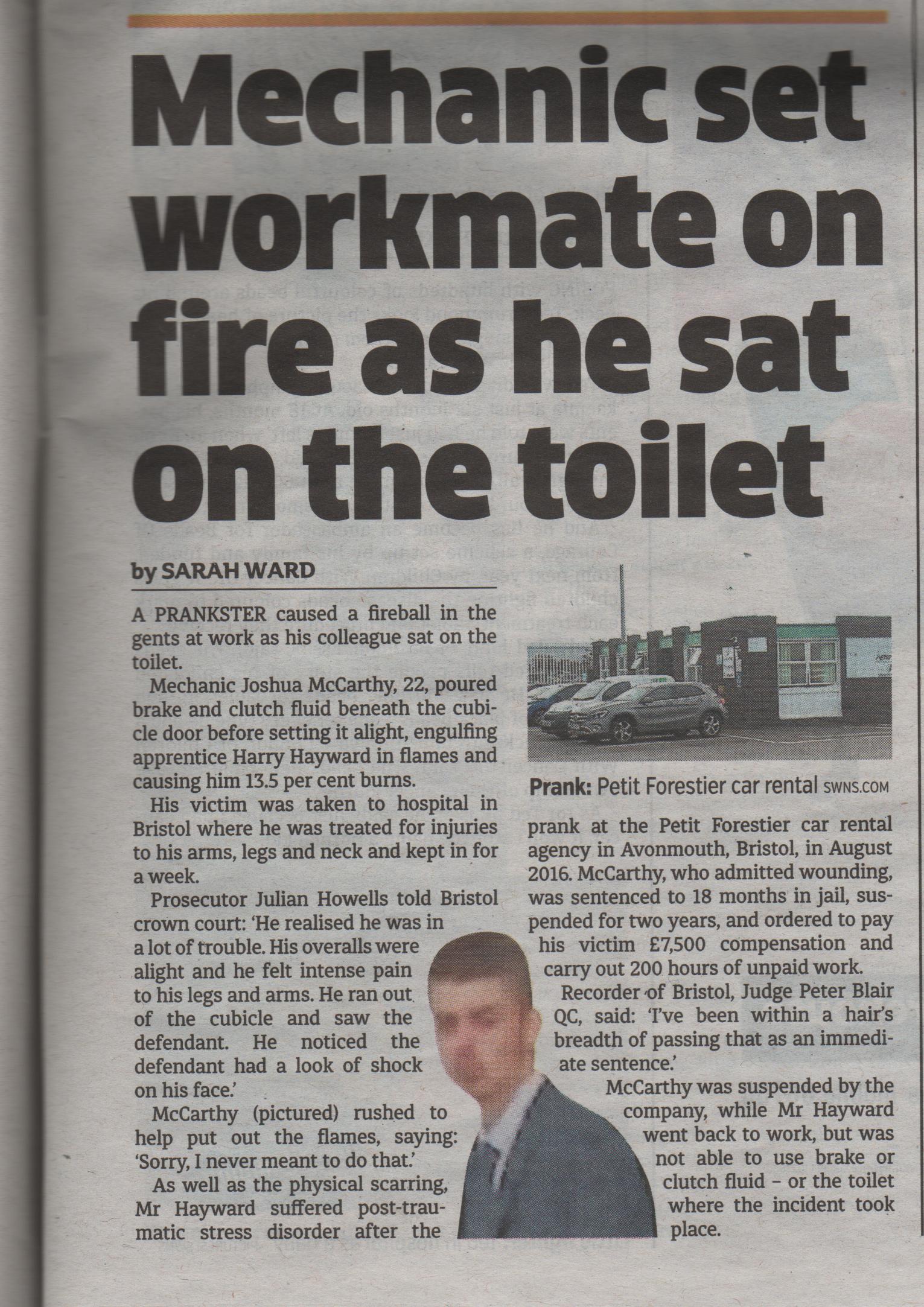
A year later, a similar story caught my eye. Someone set a colleague on fire at work in Bristol. The victim, Harry Hayward, was in hospital for a week because of injuries to neck, arms and legs (13.5% burns). In addition, Mr Hayward contracted PTSD. His colleague was sentenced to 18 months in jail, suspended for two years, as well as ordered to pay £7,500 compensation and carry out 200 hours of unpaid work. Apparently, the judge who gave the suspended sentence came very close to making it an immediate one. Prison time.
In this case, the intention supposedly had not been to set Mr Hayward on fire, but to alight fluid that had been poured into a toilet cubicle while Mr Hayward was using the toilet. That almost sounds too good to be true. We’ve all watched scenes in TV series and films in which this method is used to set fire to a house or factory. How on earth can you expect someone whose trousers are on his ankles not be set on fire when he is surrounded by flames coming from the floor all around him?
Particularly the first case – the bullying of Mr Cheese – was about the enjoyment of cruelty, pure and simple, however. It was sadistic. The second case – the bullying of Mr Hayward – sounds more like sheer stupidity.
Mr Cheese was doused in brake fluid and then his clothes were set on fire. Mr Hayward’s burns were caused by brake and clutch fluid that had been set on fire. Mr Hayward got burned and contracted PTSD. Mr Cheese got burned and became depressed. The main difference may have been that Mr Cheese seems to have suffered more – or rather a different kind of – mental health damage and Mr Hayward suffered greater physical damage.
Wait a minute. Mr Cheese is dead, while Mr Hayward is still alive.
In Mr Hayward’s case, the judicial process assigned blame to the specific colleague who caused Mr Hayward’s injuries. His place of work went scot-free. His place of work, however, had a tradition that explained how the injuries came about. They normally turned spray cans into flamethrowers, just for fun. This time, they had run out of spray cans. Unless you happen to be sitting on a toilet, the flame coming from a spray can may be easier to dodge. You can jump out of the way.
In Mr Hayward’s case, there had been no intent to harm him while there was a clear intent to harm in Mr Cheese’s case. In fact, he had been pushed onto the floor and punched on at least one occasion, leaving him with bruises. People had locked him in the boot of a car and had deliberately set him – the clothes that he was wearing – on fire.
Do you see the difference? There is nothing to jump out of the way from when you are locked into the trunk of a car or if your clothes are on fire. That makes it the deliberate infliction of harm. It wasn’t “horseplay”. Horseplay requires all parties to be willing participants.
What appears to have happened was that even after his death, Mr Cheese continued to be seen as “not one of us” and that this was considered a good enough reason to do to him what was done to him. He was no longer there to defend himself.
Why didn’t Mr Cheese quit his job? I can’t help but wonder if the following played a role besides a possible scarcity of jobs. (He was reportedly over the moon when he got hired by this Audi dealership.) When we experience physiological stress, which Mr Cheese most certainly did, we tend to underestimate real danger. This is a mechanism of the endocrine system to protect our health as long-term serious physiological stress is usually very harmful to the body.
As a result, Mr Cheese may have kept telling himself that things weren’t really that bad, that he could handle it and he may have blamed himself more than he blamed his work environment. “I am being bullied at work so something has to be wrong with me. Please, fix me so that they will stop bullying me.”
All it may take to remedy such a situation is one person who says “Quit the damn job! Quit! There is nothing wrong with you, it’s those jerks that have a problem.”
It appears that he had been trying to get into the army, though. I deduce that from the report that the coroner sent to Mr Cheese’s GP practice.
A while after that, I came across a case of community bullying in which a family with several autistic family members was being targeted relentlessly. I think this was somewhere in Somerset. Bristol, perhaps. The local council then – supposedly accidentally – sent a confidential file on the targeted family to the bullying party. This could only have been an accident if the family that was being targeted received papers intended for the bullies. It is very hard to imagine how highly specific postal mail intended for me somehow accidentally ends up being addressed to people who live two doors or one street away from me unless both parties receive each other’s mail from the same sender, so that it clearly was accidentally put into the wrong envelope. I have been living in England long enough to know how these things are often played out in practice. It was the family that was being bullied that was forced to move. It’s never the bullies.
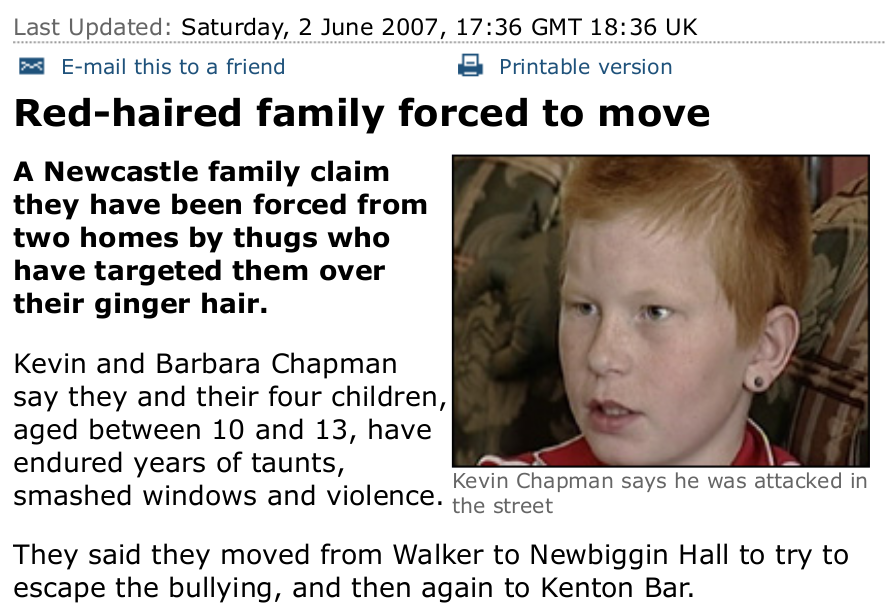
Next, I read a 2007 article about an older case, in Newcastle. A family was being bullied in a similar way as the family in which several people are autistic. Different about them is that they have red hair. That small difference alone seems to have been enough to trigger massive community bullying. They too were forced to move repeatedly as the bullying included smashed windows and graffiti. You can live with graffiti, but you can’t live with smashed windows.