No, I am not a psychologist or life coach or anything. I learned a lot of stuff the hard way and am sharing some of it because it might be of benefit to someone. Many psychologists and other professionals in the mental health area do not understand NPD well or what so-called narcissistic abuse is and how it can affect people (including them seeming to be narcissistic themselves, while they aren’t).
- People with NPD may be drawn to empaths because intuitively empaths pick up on their inner feelings and try to nurture and reparent them. People with NPD often have a split between what they show on the surface and the inner core with all the vulnerability and insecurity. When there is no connection between the two in their thinking – that is, they don’t see how vulnerable and insecure they feel inside and what it makes them do – you end up with problematic NPD.
- People with NPD who are aware that they have this inner drive to be even more than perfect and super human all the time – and if they trust you they may tell you about it – those are the ones who have insight and are often genuinely likeable.
- Autistic people can be drawn to people with NPD because they see the exterior and realize that some of the shine of the narcissist may rub off on them and may even protect them. They may also believe that they may be able to learn things from them and they aren’t wrong.
- I think that you can see someone with NPD but without insight as akin to having DID with two alters that aren’t aware of each other’s existence.
The following may be helpful.
These abbrevations can be confusing.
- ASD = autism spectrum disorder
- ASPD = antisocial personality disorder (sociopathy, psychopathy)
When I was still in primary school (aka grade school, not to confuse with graduate school), I decided that people who were often verbally aggressive or loud or who seemed overly confident were often merely trying to hide their insecurity.
I don’t remember where I got this idea from, but I think that it merely came from observing some of the kids in my classes. Some seemed to have a greater need to be popular and draw attention to themselves. I also saw that the attention they got was often of a low quality. I don’t know how else to put it. It made me decide that I didn’t want to be popular. I’m perfectly happy just quietly doing my thing as long as I make enough money to support myself. I don’t need a lot of money to be happy, but I do need to have my deficiency needs met. Good nutrition, shelter from rain and wind, high-quality sleep and a certain degree of physical safety.
Based on something that I had heard as a teenager – probably the story of Narcissus – I used to think that narcissism had to do with some people being vain and spending a lot of time in front of mirrors.
Then one day, a long-time friend in the US emailed me that an English guy who she didn’t know and who I had only met a few times a few years before and didn’t know anything about had a malignant narcissistic personality disorder. This email may have been spoofed but that’s not the point. I started looking into NPD and found a lot of fear-mongering online, also from clinical psychologists.
I learned a lot more from my interactions with two people who have NPD. That eventually also made it easier to recognize NPD when I ran into new people and keep my distance if I didn’t like the person. People with NPD can be genuinely likeable and have lots of good qualities, but there are also people with NPD who are best avoided. People who have NPD and some insight into how they tick are probably mostly the former.
There are different types of NPD, namely “grandiose” which is the well-known stereotypical form and “vulnerable” or “covert”, which can be harder to detect.
They say that people with NPD have no or little emotional empathy; their brains lack the ability. They do understand what certain things may make another person feel (humiliation or general powerlessness, for example). That’s cognitive empathy. Brain scans confirm this. They are not faking it. They did not create themselves. They cannot repair themselves at will. Their brain structure is different.
APSD can also occur without NPD. Most people with ASPD function fine.
Below are some video about a woman with NPD and sociopathy. Sociopathy is no longer used in most clinical settings, but that does not really matter.
Fragment:
The entire episode:
When should you consider that someone might have NPD?
- If the person very often makes remarks like “what goes around, comes around” and “you scratch my back, I’ll scratch yours”.
- When they make you feel immensely powerless by accusing you of something that never even happened or blaming you for something that was beyond your control – which they well know – such as the fact that you have no brother because your brother died of appendicitis at age 4.
- When they oddly enough (rather childishly) keep harping on (in the sense of blaming or accusing you or using it to “prove” what a “bad” or “useless” person you are) about something that happened decades ago and that no longer matters at all (it reflects that they’d likely still be sensitive about it if they were you).
- When you notice that what they tell you and/or how they behave around you clashes with what they tell others and/or with how they behave around others. You may catch them in lies or half-truths, may find that they tell different people different things about themselves, such as what their family life is like (lots of fighting versus idyllic) or where they grew up.
- When they try to control you and/or try to make you feel powerless or inferior.
- When they seem to be doing things to upset you or undermine you or violate your boundaries, also literally, by using for example a spare key to invade your space to throw you off-balance or for example even go through your trash.
- They like rendering you powerless.
- They may also try to brainwash you into thinking that they are the only ones looking out for you.
- Some may engage in excessive pranking.
- You may notice that they observe you very carefully, including how you respond to certain things, such as the person lighting a cigarette when you’ve previously told them that cigarette smoke irritates your respiratory system. They may probe your boundaries and even watch for example your hand movements.
You may notice that you feel nervous around someone for no instantly discernible reason. You need to observe what is happening, then think about it. Where does the nervousness come from? What causes it?
TWO EXAMPLES
In 2023, I encountered a man who developed NPD the same way as the above woman (in the video); she explains it in program. He was very severely ill as a child and learned to manipulate this to counter his powerlessness. He now has a physical disability, but he is a puppeteer, goes around calling people and talking with people to cause upset or in a campaign to discredit someone.
Having read up on NPD before and thought about it a lot, I was very fortunate that I recognized it. I saw that he was trying to manipulate me – which started with him very deliberately mispronouncing my name – and undermine and unsettle me while pretending to be helpful at the same time. When I drew the line, which I had to, he threw a hissyfit and wanted nothing more to do with me. He had expected me to be easy to manipulate.
All I’ve done with it is that I said to him that he was being manipulative, the last time I had to be around him. He didn’t reply. He didn’t say a word, he didn’t utter a sound. I never shared my conclusions and observations with any of the people around him; it would have served no purpose.
I’ve since encountered someone else with (covert) NPD. I noticed that this person was observing me me almost like a snake or a cat about to pounce on a mouse (and not saying much). I had seen this before. Sure enough, shortly after, this person started a series of games intended to make me feel low and humiliated. I simply stopped responding, ignored the person from then on. I went grey rock. The person used at least one other person to try to lure me back but when they mentioned the person’s name, I simply did not respond at all.
People with NPD can be very hard to be around, let alone live with, but unfortunately, there is also a movement that you can almost call a cult, in which people with NPD are relentlessly vilified. I understand where all the hurt and anger come from. Oh yes. However, some “regular” people don’t know very well how they tick, emotionally, and that makes it very easy for people with NPD to push their buttons.
A little zen can go a long way.
I don’t think that it is wrong to accept someone with NPD just the way they are and try to keep them happy. If you do this consciously, deliberately and with good intentions, you will also help avoid psychological effects on yourself or even harm. It’s not wrong either to stand on someone’s “good” side when a person is deaf in the other ear. For the sake of comparison, nobody would say that you’re encouraging the person’s deafness in that ear by standing on the other side when talking with them. It just makes plain good sense to do that.
In my opinion, all people have pluses and minuses, and when a person has many pluses that you personally value highly, such as great intelligence and a fantastic sense of humor, then that can make it much easier to accept minuses. This goes for people with NPD too.
The one thing you shouldn’t do is expect to be able to heal them. It can be very obvious to everyone around them that the person is hurting. It can be very tempting to want to take that hurt away, and try to. Don’t. Accept the status quo. See the little boy inside the grown person. If you look at someone like Donald Trump and see the little boy who is probably still desperately trying to prove to his dad that he is worthy (of life), without him realizing it, it becomes harder to be angry and easier to have compassion. That is not the same as condoning harmful things that someone is doing.
People with NPD have different brain structures, as I just mentioned. They cannot change their brains at will. I am hoping that in some cases people with NPD may be able to start rewiring their brains with the aid of neurofeedback.
How this works? Neurological pathways that get used a lot become strengthened, at the expense of other pathways. Neurofeedback is not expensive and self-reinforcing because it is (self) rewarding.
Something that I didn’t initially realize is possible is that people can be both autistic and narcissistic. It’s meanwile dawned on me that diversity is a huge multidimensional space in which we all take up a unique spot with the set of characteristics and abilities that we have.
More information?
I do not recommend watching videos by some of the more famous experts, but I am not going to name any names. I also probably should warn you that if you start looking into NPD, at some point you may wonder if you have it yourself, particularly if you are around someone with grandiose NPD who is constantly flooding you with negative messages about yourself. Having a little bit of narcissism can be very healthy.
Anyone who wants to learn more about narcissistic personality disorder (NPD) should probably look into “Sam Vaknin“. There was a time in his life when he deliberately focused on hurting others. He would find out what they likely felt vulnerable about (such as a Holocaust background in the family) and then he targeted those perceived vulnerabilities, with the aim of pressing these people’s emotional buttons, such as by bombarding them with swastikas.
Watch this video in which he explains how he became a narcissist and what it feels like. Note that the true self is definitely there… but he fears it more than anything else. It is not the false self that feels attacked, the false self defends the true self, but he’s completely lost touch with it, emotionally. It’s become, how shall I put it, disconnected. It’s no longer online.
One aspect of NPD that strangely enough points at something similar as the events that can lead to the development of NPD is that when victims of people like Sam Vaknin (before he became “enlightened”, for lack of a better word, when he still went around deliberately inflicting hurt on people) talk about what is happening to them, they’re almost never believed.
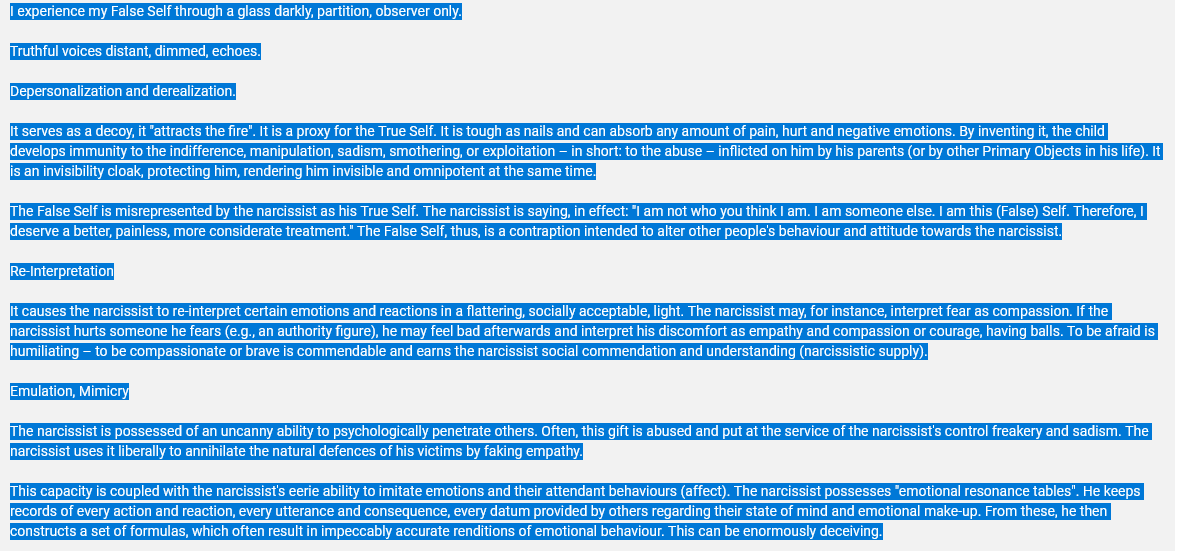
Also watch the two documentaries below. They are about him.
(Documentary 1, Documentary 2, Part 1 and Documentary 2, Part 2).
Sometimes, narcissistic abuse is how people with NPD express how much they are hurting on the inside. It can be the only way for them to express: “This much is how I hurt.” Maybe it is akin to self-harming behaviors like cutting, expressed outward instead of inflicted on oneself.
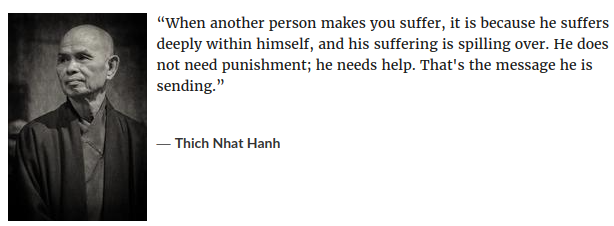
People want to be SEEN, acknowledged, accepted, not ignored or stepped on. This goes for all of us, however. People with NPD see themselves as flawed because they are merely human, just like the rest of us. The rest of us, we accept ourselves the way we are.
The rest of us can usually only help people with NPD by accepting them the way they are, without judgement and criticisms. That is so much easier to write down than to do in practice.
Blessed with high intelligence, Vaknin developed insight into himself and now helps educate the world about NPD, partly in ways he may not be aware of. He may still in a way resemble an angry and hurt young boy although most of the anger is likely gone now. He seems to be much more into philosophy these days, in fact. Some years ago, I watched some of the videos by him and about him. It probably gave me a good idea of his nature, a sense of how he ticks. I found it useful. He often calls himself a psychopath, but he’s a so-called malignant or grandiose narcissist. There is a documentary about him and in it, among other things, he gets tested to find out whether he is a psychopath. He was grandiose about himself in that way too. In that documentary, you can also see him get angry from time to time.
If you have someone like that as a colleague at work, that won’t be easy to deal with, but don’t grant the person control over your emotions and thoughts. You know who you are and you know what your strengths and weaknesses are. What anyone with NPD says about you does not change that.
Understanding where such people are coming from, however, can be really helpful.
This a really good article to start with: https://www.theguardian.com/commentisfree/2022/dec/04/when-exactly-do-everyday-fantasies-go-from-little-white-lies-to-memtal-disorder
Don’t get into arguments with people who needle you at work. Design little “escapes” for yourself, to recharge your battery if you need to. An example? When I was temping somewhere while I was wrapping up my Master’s, an older woman would sometimes walk over to me and start talking to me, likely well aware that I couldn’t leave my (physical) position, hence couldn’t get away from her. She wasn’t a pleasant person. I remember one day, when she had really gotten to me and I found myself fuming. I called someone else at that company, who happened to be a friend and who was also the person who would take over if I needed a bathroom break. I told her to take over for me for 10 minutes, left the building and went for a walk around the block. It worked. It takes you out of the environment and the physical activity helps as well. I can’t remember what on earth the woman in question said to me that made me so angry, but I do remember what I did to avoid blowing up. I think her name was Freda. Did she have NPD? No idea. Probably not.
Psychopathy

NPD with psychopathy is a different story, but with a lot of similarities. To understand it and take it out of its Hollywood hype context, read this article in The Atlantic: https://www.theatlantic.com/magazine/archive/2017/06/when-your-child-is-a-psychopath/524502/ (Free trial required to access the article.)
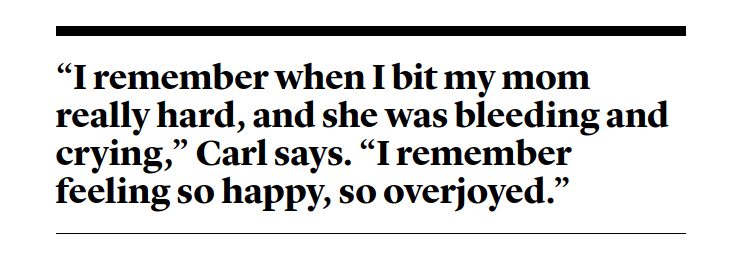
I once encountered a woman who tried to get me to commit suicide and she was so cold about it that she scared me. That’s antisocial psychopathy.
This is what happened.
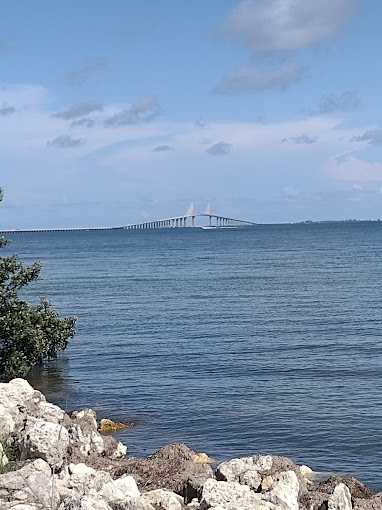
To my horror, I found myself plotting my suicide one evening, while I hadn’t even been depressed. And it wasn’t just that. I was plotting my suicide in a way that made no sense at all. I was going to fly to my beloved Florida to jump off the Sunshine Skyway. As if I would ever do that!
So I went over everything that had happened during the day.
This woman had addressed me from her desk, right behind me while I was at a computer at a library, very loudly, in a way that I noticed but then dismissed. She seemed to be on the phone. She very loudly said something like “Hey you there, you with the glasses”, followed with a remark about me being vain as I had taken off my glasses because I am nearsighted and only need my glasses for looking into the distance. She then kept repeating “I am going to give you directions. When you get to the top of the hill, you take the escalator straight down to death”. She kept repeating it, over and over.
Hours later, I found that I had literally started plotting what she had told me to do.
Years ago, a coach who among many other things studied NLP with Richard Bandler told me that NLP is very powerful and can be dangerous. Now I know what she meant.
…

When I later decided to ask the woman in question why she had tried to get me to commit suicide, she coldly replied “I don’t remember.” There was no protest, no denial. Only this clinical “I don’t remember.”
That coldness strikes me as antisocial psychopathy.
Most people with psychopathy are not like that.
James Fallon was a so-called prosocial psychopath. He was a neuroscientist who was studying the brains of psychopaths and had included some brain images of family members and himself, probably more or less as what is known as “controls” in science (a baseline). He was astonished to find a brain with psychopathy among those images and was even more surprised to discover that that image was of his own brain.
Below is a video about a genuinely scary psychopath, the kind of person Hollywood has shown us for so long. Such people are quite rare.
There is also a genetic condition that can cause people to engage in violent behaviors and for example commit arson, but it also goes with low IQ. There are only a few people in the world who actually have that condition.
