Hi. My main background is in the earth & life sciences, but I now predominantly explore topics in the broad area of bioethics. That's about equality, fairness, justice, diversity and inclusivity. It's also about people's biases, the associated otherization and everything that this can result in. That includes poverty, homelessness, poor health, shabby looks, shrinking personal bubbles, exposure to chemical and noise pollution and lots more. It's also about law, philosophy, speciesism, science & technology, forensic psychology, politics and public policy (governance). Diversity and inclusivity are much bigger challenges than I used to believe. I for example now think that society's lack of genuine acceptance and support for people whose brains work very differently can among other things result in destructive behaviours for which the forensic psychology term is sadistic stalking or resentful stalking.
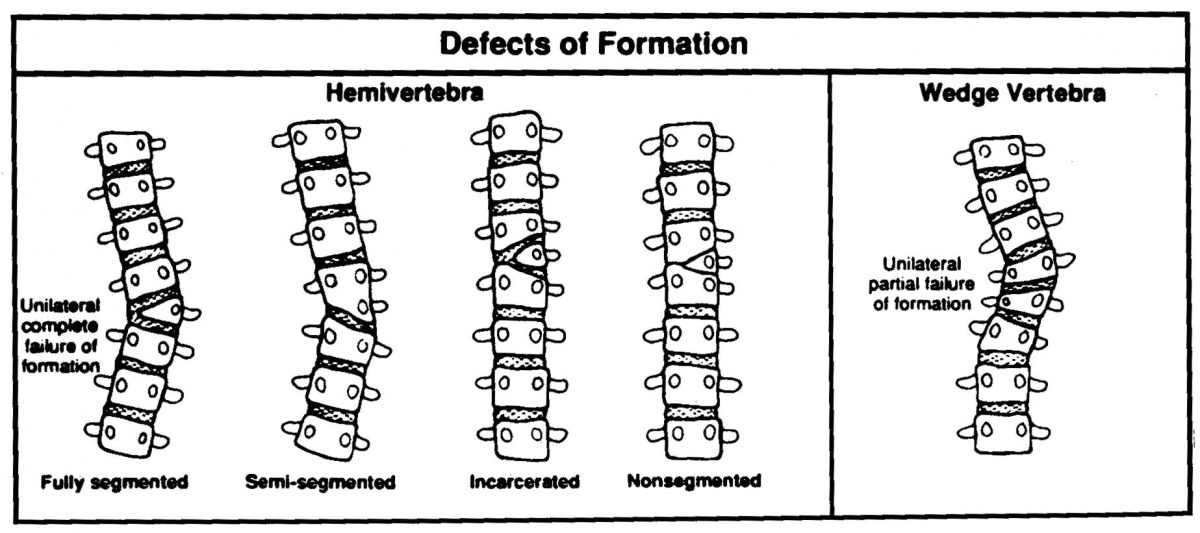
Mine was identified by a friend who was in nursing school and wanted to practice her massage skills on me. I was around 20, working at the Amsterdam Tourist Office at the time. “Weet je dat je scheef bent?” she asked. “Whatever,” I thought.
A chiropractor diagnosed it in my middle sister and our uncle Harrie had it too. I don’t know who else had it, but there must have been others. I don’t know whether my youngest sister has it. Probably.
I’d never looked into it before, but did so last night.
I’d seen how anything that unexpectedly badly impacts my sense of agency can affect my online trading. I start doubting and second-guessing myself (close trades prematurely).
I’m also making other observations right now that have to do with assessing the risk that others present and what their intentions are.
We are biological organisms. Our brain wants to protect us. That is why it tends to assess anything (any different kind of being) that it is not familiar with as potentially risky. This is also key in fostering inclusivity. Familiarity enables us to assess that risk much better and that is why it tends to make us more inclusive.
The better we are provided for, the more at ease we tend to be, the more empathetic. I suspect that this also goes for non-human animals and that there is a seeming correlation with IQ. Because the less of our brain capacity we need to dedicate to finding food and to securing our own safety, the more we can spend on other pursuits.
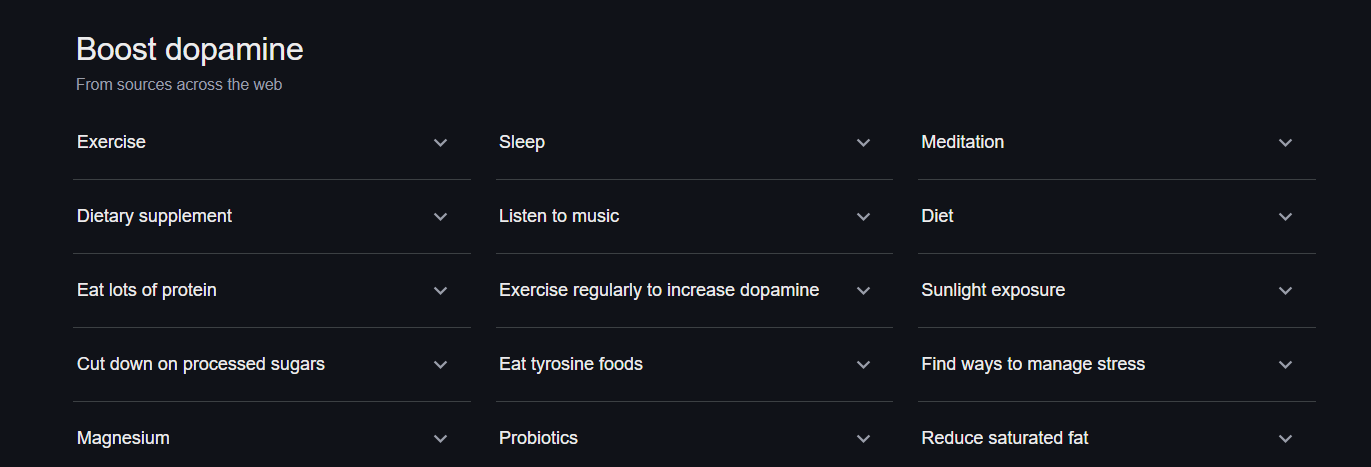
Dopamine.
This paper explains to me why covert narcissists engage in needling (seeking a sense of agency, not a dopamine hit) and why they like to stay away from other people.
It also explains to me what happened when I encountered two meth heads in Portsmouth a few years ago. Their sense of agency was sky-rocketing (but their attention span was minimal). So this is how you can manage them in situation in which they require management? There seems to be a resemblance between meth heads who are high and grandiose narcissists.
I’m trying to see how this relates to myself, too. Agency is very important to me, but I’ve almost always had it and exercised it. Not having agency is something I abhor, though, and it will make me run. It’s what drives many asylum seekers too.
Ageism appears rampant in the UK, with the over-50s losing their jobs at twice the rate of younger people and finding it three times more difficult to find employment after months of job hunting. While there are many reasons for this, perhaps one is the assumption that older people aren’t quite as sharp as they used to be.
We know that older adults, those over 65, don’t perform as well as younger people, aged 18-30, on tests of memory, spatial ability and speed of processing, which often form the basis of IQ tests. However, there’s good news for us all. New research suggests that this difference in ability between younger and older generations appears to be shrinking over time – with older people catching up with their younger peers.
(from the email in my inbox)
From my own observations as a younger person, I know that the impression that older adults are “slow” can be merely the result of the declining near-sight of older adults. It can take them – us – slightly longer to spot things on screens, for example, just because most older adults’ vision is not as good as it used to be.
I remember making this snap judgement about someone else once, when I was much younger. I am fortunate enough to be near-sighted, so while my near sight has declined with age, I still don’t need reading glasses unless I am wearing contact lenses for far sight.
Are young people smarter than older adults? My research shows cognitive differences between generations are diminishing
We often assume young people are smarter, or at least quicker, than older people. For example, we’ve all heard that scientists, and even more so mathematicians, carry out their most important work when they’re comparatively young.
But my new research, published in Developmental Review, suggests that cognitive differences between the old and young are tapering off over time. This is hugely important as stereotypes about the intelligence of people in their sixties or older may be holding them back – in the workplace and beyond.
Cognitive ageing is often measured by comparing young adults, aged 18-30, to older adults, aged 65 and over. There are a variety of tasks that older adults do not perform well on compared to young adults, such as memory, spatial ability and speed of processing, which often form the basis of IQ tests. That said, there are a few tasks that older people do better at than younger people, such as reading comprehension and vocabulary.
Declines in cognition are driven by a process called cognitive ageing, which happens to everyone. Surprisingly, age-related cognitive deficits start very early in adulthood, and declines in cognition have been measured as dropping in adults as young as just 25.
Often, it is only when people reach older age that these effects add up to a noticeable amount. Common complaints consist of walking into a room and forgetting why you entered, as well as difficulty remembering names and struggling to drive in the dark.
The trouble with comparison
Sometimes, comparing young adults to older adults can be misleading though. The two generations were brought up in different times, with different levels of education, healthcare and nutrition. They also lead different daily lives, with some older people having lived though a world war while the youngest generation is growing up with the internet.
Most of these factors favour the younger generation, and this can explain a proportion of their advantage in cognitive tasks.
Indeed, much existing research shows that IQ has been improving globally throughout the 20th century. This means that later-born generations are more cognitively able than those born earlier. This is even found when both generations are tested in the same way at the same age.
Currently, there is growing evidence that increases in IQ are levelling off, such that, in the most recent couple of decades, young adults are no more cognitively able than young adults born shortly beforehand.
Together, these factors may underlie the current result, namely that cognitive differences between young and older adults are diminishing over time.
New results
My research began when my team started getting strange results in our lab. We found that often the age differences we were getting between young and older adults was smaller or absent, compared to prior research from early 2000s.
This prompted me to start looking at trends in age differences across the psychological literature in this area. I uncovered a variety of data that compared young and older adults from the 1960s up to the current day. I plotted this data against year of publication, and found that age deficits have been getting smaller over the last six decades.
Next, I assessed if the average increases in cognitive ability over time seen across all individuals was a result that also applied to older adults specifically. Many large databases exist where groups of individuals are recruited every few years to take part in the same tests. I analysed studies using these data sets to look at older adults.
I found that, just like younger people, older adults were indeed becoming more cognitively able with each cohort. But if differences are disappearing, does that mean younger people’s improvements in cognitive ability have slowed down or that older people’s have increased?
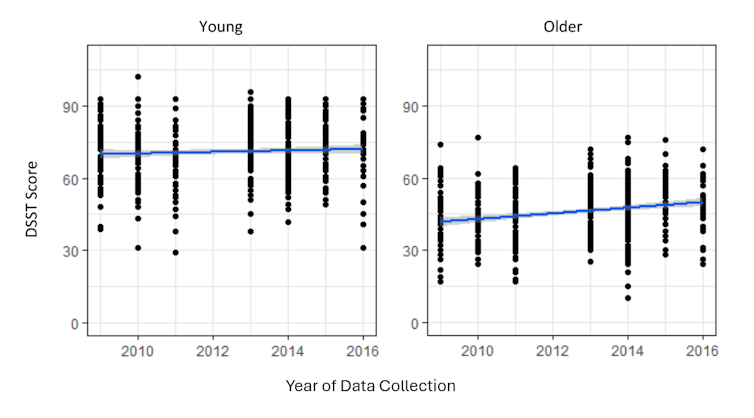
I analysed data from my own laboratory that I had gathered over a seven-year period to find out. Here, I was able to dissociate the performance of the young from the performance of the older. I found that each cohort of young adults was performing to a similar extent across this seven-year period, but that older adults were showing improvements in both processing speed and vocabulary scores.
The figure shows data for a speed-based task where higher scores represent better performance. CC BY-SA
I believe the older adults of today are benefiting from many of the factors previously most applicable to young adults. For example, the number of children who went to school increased significantly in the 1960s – with the system being more similar to what it is today than what it was at the start of the 20th century.
This is being reflected in that cohort’s increased scores today, now they are older adults. At the same time, young adults have hit a ceiling and are no longer improving as much with each cohort.
It is not entirely clear why the young generations have stopped improving so much. Some research has explored maternal age, mental health and even evolutionary trends. I favour the opinion that there is just a natural ceiling – a limit to how much factors such as education, nutrition and health can improve cognitive performance.
These data have important implications for research into dementia. For example, it is possible that a modern older adult in the early stages of dementia might pass a dementia test that was designed 20 or 30 years ago for the general population at that time.
Therefore, as older adults are performing better in general than previous generations, it may be necessary to revise definitions of dementia that depend on an individuals’ expected level of ability.
Ultimately, we need to rethink what it means to become older. And there’s finally some good news. Ultimately, we can expect to be more cognitively able than our grandparents were when we reach their age.