I’ve just updated (slightly) the Kindle edition and paperback version of a book that I first published in 2017, and I did that without having the original files! I may quickly whip up a hardcover edition of it this evening. (Yes, done.)
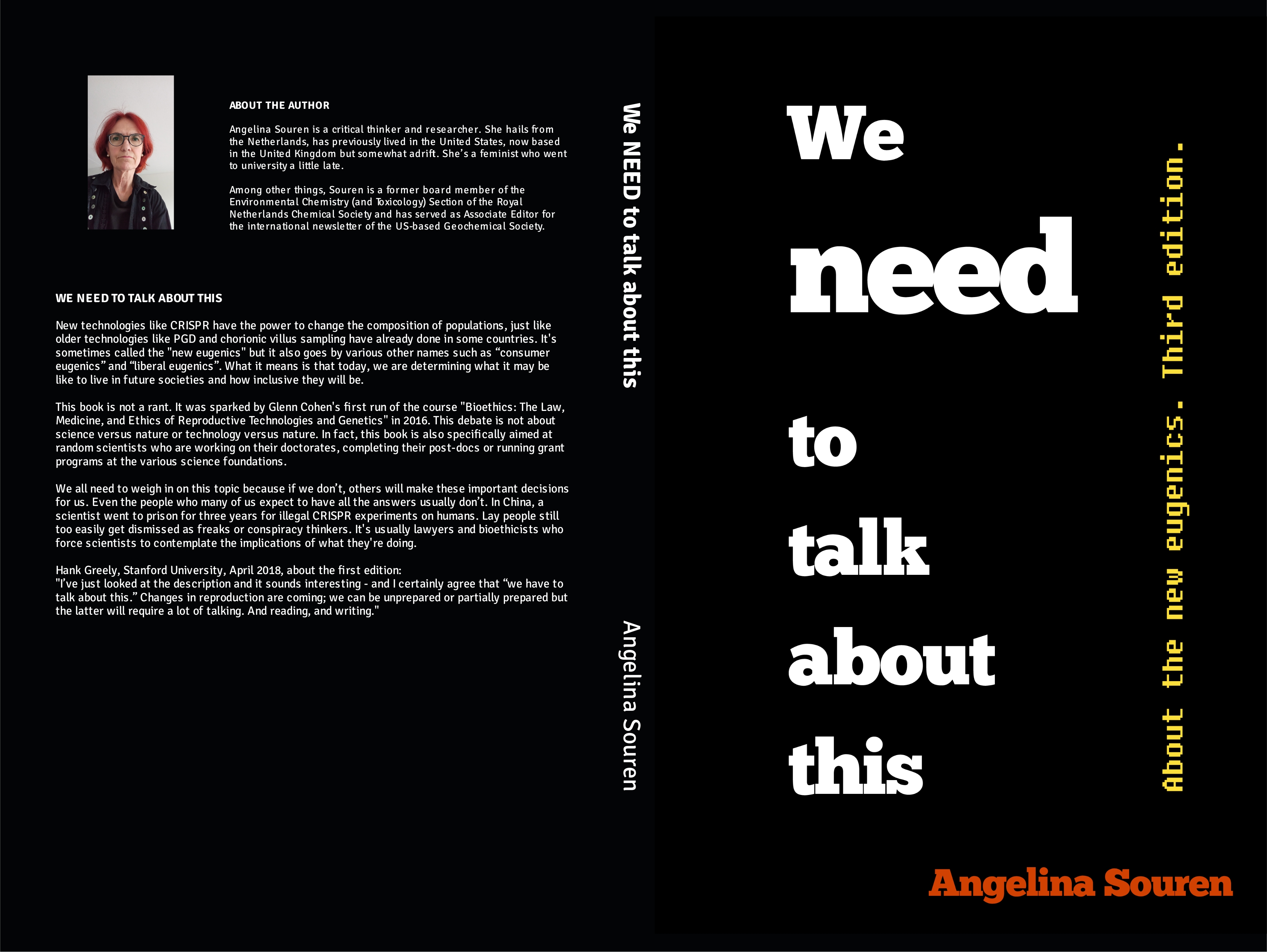
The previous two editions were still quite clumsily written here and there and I hope that I didn’t step on too many toes. Partly, they still are an exercise in logical reasoning – doodles – to arrive at various definitions, for example of what “a life not worth living” might be, and to come up with a guideline that I know is never going to be used in practice. That was true of the 2020 version of this edition and is still true of the present version too. Then a Chinese scientist called He Jiankui made the spotlights because he’d broken all the rules by creating real-life CRISPR’d babies. It changed things.
On 11 February 2023, Dr He attended his first public event since his release, namely ”Looking Back into the Future: CRISPR and Social Values” organized by Dr Joy Zhang at the University of Kent. What struck me during that meeting was not so much He’s perceived arrogance or deception, but the attitude of many scientists, particularly those in very early stages of their careers. I later also saw that reflected at two meetings that I attended in the Netherlands. The idea of pondering the potential consequences of their research does not seem to occur to many scientists. In addition, they often see ethics committees as no more than groups of pesky people who want them to tick boxes.
This worries me, but I understand it. I too used to be very enthusiastic about all science, particularly if it concerned my own favorite areas. I am sure that I never paid any thoughts to possible consequences of mining operations when I was much younger, not just in terms of pollution but also with regard to impact on communities and wildlife. This is probably a point at which I should interject that I went to university relatively late; the issue is not age-related but experience-related.
I could have called this book “The honey mustard chicken society” after the title of a video made by a chronically ill woman who is preparing honey mustard chicken. The woman in question is genetically different from mainstream people. The main differences are a gene mutation and a mitochondrial condition. This was diagnosed when she was about 15 years old. It has many practical consequences including the fact she can’t just eat anything she wants. That led to her video about her honey mustard chicken meal.
That title would have captured the duality of the questions surrounding the new eugenics. You could say that the central question in this book is whether non-mainstream people, like the woman in that video, should get to eat their honey mustard chicken or not. Should we weed them out from the human species as unwanted or undesirable or to spare them pain and discomfort? This may sound trivial but it’s not. When Glenn Cohen talks about intentional diminishment with regard to genetically deaf parents who want genetically deaf children, isn’t that ableism? This is the big issue.
Why is it objectionable to create genetically deaf children to allow them to experience the richness of deaf culture and make them feel included in their family and community but should it be okay to do the reverse? There is also the chicken. The chicken has rights too. Shouldn’t the chicken too get to live her life freely? How can a society claim to be advanced if it still depends on the ruthless exploitation of other species for its food supply? Shouldn’t we simply be able to produce clean, tasty, cruelty-free food instead? How can we reconcile some of the conflicting interests that come to the fore in these discussions?
This is why we need to talk about what kind of society we want our grandchildren to live in and we need to do this before we set ourselves on a course that may be hard to change later. Do we want a world that forces people to be a certain way, such as in the film “The Stepford Wives”? Do we want a society that divides people into separate superior and inferior classes such as in the film “Gattaca” and in the novel “The Ultimate Brainchild”? Or do we prefer one that embraces all diversity, in principle, and sees the good in the “bad”.
After He Jiankui was released from prison in China and the first CRISPR treatments such as Casgevy and Lyfgenia started receiving approval in countries like the UK and the US, it was time to tweak the book slightly and weed out any remaining typos. I also needed to define its audience more clearly. This is not quite a book for lay people, but I feel that it is suitable for interested researchers in any field.
That I don’t have a background in CRISPR research will become clear soon enough for anyone who is familiar with it. The purpose of this book wasn’t to start talking about off-target effects or discuss that making someone immune to HIV, the way He Jiankui did with Nana and Lulu and possibly a third baby, may make them vulnerable to other conditions.
Sorry, the t-shirt sold out pretty quickly.