How to deal with British police

Essentially, you don’t. You avoid them as much as you can because in Britain, you must consider police your enemy. They are not on your side. They are on their own side.

(Note: Anything I say on this page won’t stop me from, say, buying donuts for random police officers when they’ve all been called back from leave and are working very long days out on the streets. I do my best to see them as individual people.)

The only good reason for going to a police station in Britain is when you need to do that to be able to make an insurance claim.

Police in Britain stopped investigating crimes against individuals at least 10 years ago because they lack the resources to do so. The only crime against an individual that they are still bound to look into is when that individual has been murdered or if the individual is a supermarket owner or the like they like and someone has stolen a sandwich because he or she was hungry and was, say, caught red-handed or recorded on CCTV.

Other than that, forget it. That does not have to leave you stranded in all cases in which you’d normally expect to be able to get assistance from the police officers whose salaries you pay for through your council tax, after all.

Below are some tips, first for if you are a crime victim and second for if police are targeting you, for instance, because you are a crime victim.

Here is the GOLDEN RULE:

If police officers knock on your door, never ever open the door. Under no circumstances.

(You can still talk with them through the closed door, if you feel that it’s useful or required.)

1. Are you the victim of a crime?

Unless you need to do this for the sake of an insurance claim, do not go to the police. If you go to the police, the officers may tell you that they will use the information you give them as intelligence (though they won’t tell you that they are more likely to use it against you than against the perpetrator of the crime(s) you are reporting).

In almost all cases, they will also tell you to go to your council (civic offices) and to your GP. Don’t take it personally when they do this, even though it may sound like they are suggesting that you need mental health assistance. (After all, how on earth can a GP help solve a burglary, for instance?) They say this to just about everyone all over the country. It’s nothing personal; it‘s merely national policy.

You can investigate and try to stop crimes having been or being perpetrated against you but you have to proceed very carefully.

  • What you need to do first of all is print several copies of the Protection from Harassment Act 1997. Tuck one away in each of your bags or suit pockets.
  • Next, you write a letter to your local MP and any other politicians and/or journalists worth contacting. You explain to them what happened or is happening (the crime), in no more than one or two sentences, such as “My home was broken into” or “My daughter is being stalked. This has been going on for two years and last week the stalker broke into her home”. Then you write that you “will be approaching persons and taking actions for the purposes of preventing or detecting crime, pursuant to and in compliance with the Protection from Harassment Act 1997, Section 1, subsection 3, sub a.” and that you are sending this letter to him or her for his or her information. Send this letter or these letters by Special Delivery. Yes, that will cost you a few bucks but it’s worth it.
  • If the MP or anyone else you wrote to then asks or tells you to go to the police, ask the person in question to come with you.
  • Use Word or any other program to type up the following text: “Pursuant to and in compliance with the Protection from Harassment Act 1997, Section 1, subsection 3, sub a, I am approaching you for the purposes of preventing or detecting crime.”
  • Print several copies of that text and always have them with you during your crime investigation. Before you say anything else, say this and hand the printout to anyone you want to speak with in relation to the crime in question.
  • Also begin all your e-mails with that sentence if the e-mail is sent for the purposes of preventing or detecting crime.
  • Remain reasonable at all times. That means, do not behave as if you are a police officer, do not get rude and do not lose your temper. You can certainly be firm. You are standing up for your rights. That is perfectly normal in many other countries and it’s a cry and shame that police in Britain don’t help you protect yours.
  • Never undertake any of your crime investigation activities on your own, but always ensure that you have at least two witnesses, not from your family, but perhaps a colleague from work, a fellow member of a sports club you belong to or a neighbour or a client.
  • If you do go to police, tell them as little as possible. They will use anything you report to them as “intelligence” and while they may inform you of that, what they won’t do is let you know that they may well use any information you give them against you. Police officers may act very friendly and reassuring, and talk about the action they will take, but when they do, they are usually just lying to you, unfortunately.
  • The Protection from Harassment Act 1997, Section 1, subsection 3, sub b also means that it is very good (essential) to know the nature of the crime you are investigating, in legal terms. Look up which law applies to what happened, and why what someone did or does was or is a crime according to the law. You can go to the CAB or any other advice organisation, make some calls, see solicitors for a free half-hour consultation, drop in on a law clinic from your local law school and of course research it online and in books.

2. Are you being targeted by police?

British police officers these days seem to go after just about any person that they perceive as easy prey for their arrest (and prosecution) records and whose name and address they have. This could be someone who is probably poor or lower-class, someone who they suspect has a mental health problem and also someone who lives on his or her own or will likely only have kids in the house. So that there won’t be a partner who says “wait a minute!” and they only have to deal with one adult who police officers think will be intimated. Police officers know very well what effect they have on normal citizens and they exploit it when it serves them.

They also are more likely to go after people they don’t like, such as people who report serious crimes and are inexperienced enough to keep asking police officers what they are doing about it, particularly if the person lives on his or her own or will likely have only kids at home.

The problem with reporting a crime is that in the process, you give police officers a lot of information about yourself. They have your name and address now and know what you look like. By contrast, they very likely do not know the identity of the person who committed the crime or is committing the crimes you are reporting. They do now know also some of your personal circumstances, such as that you just broke off your relationship, got fired, just started a new job, whether you rent or own your home and things like that.

If you become the victim of a crime, no matter what cause of action you take (go to the police and/or investigate yourself), it raises the probability that police will start targeting you.

Under no circumstances report a crime and then keep calling to ask what the police officers are doing about it, even if a police officer has told you to do so. (Don’t investigate and report on your investigations either, not even if they have specifically asked you to do so.) All of this is bound to annoy them so much that you may well find them knocking on your door on Sunday morning at 7 am, when you innocently open the door and then find the door slammed into your face and yourself crushed onto the floor and arrested, your kids watching scared and helpless.

Unfortunately, that is the reality in Britain. It happened to Michael Doherty, for instance.

If you’re a woman, it may be more likely that police officers will call the local mental health hospital behind your back and suggest that you are mentally unwell. They may also pay your employer a visit and anyone else who suggesting to that you are not well in the head may disadvantage you.

That too is the reality of Britain today.

Do not open the door if police officers (are targeting you and) knock on your door. You do not have to open the door if police officers knock on your door, no matter what they tell you (with very few exceptions and in those cases, it makes no difference whether you open the door or not, so, don’t). That’s right.

Police officers can sound very convincing when they tell you all sorts of bullshit. Some of them are genuinely convinced that they know the law because they have this law book specifically for police in which they can look things up. If it says anything that does not suit them but would be to your advantage, they won’t tell you that. It will almost never come back to bite them anyway. In practice, police officers in Britain rarely have to adhere to the law, let alone administer it appropriately.

If you ever get arrested, don’t trust whoever shows up as duty solicitor either. He or she will not be interested in your rights. He or she will either want to get out of the police station as soon as possible or milk the circumstances for whatever reason. Of course, there are exceptions – GOOD and HONEST lawyers do exist; in fact, a few of your personal heroes may be lawyers – but under no circumstances assume that a duty solicitor will look out for you.

If you are investigating crime committed or being committed, someone may still call the police and say that you are harassing him or her. This is more likely if that person is the person who committed or has committed the crimes you are investigating, of course, because he or she knows that your powers are nowhere near those of police officers and may have more experience with police than you. He or she will want to make you go away and complaining about you is a possible approach to that.

That is particularly why you need to know what the Protection from Harassment Act 1997, Section 1, subsection 3, sub a says so that you can say that and maybe even show the printout of that law. Do not count on a duty solicitor to do that for you!

The fact that you are investigating crime on your own already indicates that you are not a person in power, after all. It makes you easily dismissible in the eyes of the police and in the eyes of the duty solicitor. Stand your ground. Don’t let them walk all over you. (You were doing what police officers should be doing. It is not your fault that, as a rule, they no longer deal with crimes committed against individuals these days.)

Also, you have informed several persons such as for example your MP about what you were going to do and you have witnesses.

Last but not least, a bit of a warning. Shana Grice, a young woman who reported being stalked to police was accused by police of wasting police time police (and fined, I believe) before her stalker killed her. There are other women in Britain who were killed by their stalkers, and they too were often not taken seriously by police.

I know a woman who was in similar circumstances, in the Netherlands. Her ex-boyfriend started stalking her and strangled her almost to death one day. In stark contrast to British police, Dutch police did not dismiss her but were very helpful. They advised her to relocate to a town in which she did not know anyone so that her ex was least likely to look for her there.

She took the advice, even though it meant breaking off her Master’s. She moved to a town at quite a distance from where she used to be and also from where her family was, enrolled in a lower-level educational program, then enrolled in another Master’s and after that started a PhD track. She got that PhD and she’s also a mother now.

(He eventually tracked her down in her new town too, but it took him a long time, and by then, he was less angry. One of her house mates or neighbors found him on the doorstep one day, and convinced him to go back and leave the woman alone.)

If you are being stalked in a way that seriously worries you, do not investigate or try to stop it by yourself (and certainly don’t bother reporting it to British police, also because they are likely to inform your stalker of everything you told police, whether on purpose of accidentally). Do what Dutch police advised this young Dutchwoman.

Hopefully, you’ll never need to know any of the above.

If you do use any of the above, and you end up killed, stabbed, bullied, hacked, arrested or anything else that you would have preferred to avoid, then note that you cannot hold me liable for any of that. I am not a lawyer, certainly not within this context, and I am not in a position to shield you from all risk.

Like the woman I mentioned above – no, it wasn’t me; it concerns a much younger woman whose acquaintance I made when she was working on her PhD – I too have only very positive experiences with Dutch police, even in sensitive circumstances that could have easily created friction and for which the officers in question had no training. Hats off!

I have worked with Dutch police in a neighbourhood crime prevention initiative. I also have positive experiences with American police, but race riots broke out in the US city where I used to live only shortly after I left. As we all know, American police has its troubles too because there had been too many incidents in which innocent black persons were killed by police officers in that city.

I think such incidents are often the result of irrational fears on the side of the police officers who often work under a lot of tension. I have personally witnessed in the US that when I had to call police in highly suspicious circumstances, they seemed much more scared and nervous than I was (presumably because I was living in a Florida neighbourhood that didn’t have a good reputation at the time). They were also looking out for my safety extremely well and I noticed that with gratitude.

I wish I could be more positive about British police.

I post the following from the work of Dr Lorraine Sheridan, as this can be vital information to have.

Typology 4: Sadistic stalking (12.9%)

Characteristics

· victim is an obsessive target of the offender, and who’s life is seen as quarry and prey (incremental orientation)
· victim selection criteria is primarily rooted in the victim being:

(i) someone worthy of spoiling, i.e. someone who is perceived by the stalker at the commencement as being: – happy – ‘good’ – stable – content and
(ii) lacking in the victim’s perception any just rationale as to why she was targeted

· initial low level acquaintance

 · apparently benign initially but unlike infatuation harassment the means of intervention tend to have negative orientation designed to disconcert, unnerve, and ergo take power away from the victim

– notes left in victim’s locked car in order to unsettle target (cf. billet-doux of infatuated harassment)
– subtle evidence being left of having been in contact with the victim’s personal items e.g. rifled underwear drawer, re-ordering/removal of private papers, cigarette ends left in ash trays, toilet having been used etc.
– ‘helping’ mend victims car that stalker had previously disabled · thereafter progressive escalation of control over all aspects (i.e. social, historical, professional, financial, physical) of the victim’s life

· offender gratification is rooted in the desire to extract evidence of the victim’s powerlessness with inverse implications for his power => sadism
· additional implication => self-perpetuating in desire to hone down relentlessly on individual victim(s)
· emotional coldness, deliberateness and psychopathy (cf. the heated nature of ex-partner harassment)
· tended to have a history of stalking behaviour and the controlling of others · stalker tended to broaden out targets to family and friends in a bid to isolate the victim and further enhance his control
· communications tended to be a blend of loving and threatening (not hate) designed to de-stabilise and confuse the victim
· threats were either overt (“We’re going to die together”) or subtle (delivery of dead roses)
· stalker could be highly dangerous

– in particular with psychological violence geared to the controlling of the victim with fear, loss of privacy and the curtailment of her social world

· physical violence was also entirely possible

– especially by means which undermine the victim’s confidence in matters normally taken for granted e.g. disabling brake cables, disarming safety equipment, cutting power off

· sexual content of communications was aimed primarily to intimidate through the victim’s humiliation, disgust and general undermining of self-esteem
· the older the offender, the more likely he would have enacted sadistic stalking before and would not be likely to offend after 40 years of age if not engaged in such stalking before
· victim was likely to be re-visited after a seeming hiatus

Case management implications

· should be taken very seriously
· acknowledge from outset that the stalker activity will be very difficult to eradicate
· acknowledge that there is no point whatsoever in appealing to the offender – indeed will exacerbate the problem
· never believe any assurances, alternative versions of events etc. which are given by the offender
· however, record them for use in legal action later
· the victim should be given as much understanding and support as can be made available
· the victim should not be given false or unrealistic assurance or guarantees that s/he will be protected
· the victim should carefully consider relocation. Geographical emphasis being less on distance per se, and more on where the offender is least able to find the victim
· the police should have in mind that the sadistic stalker will be likely to:

(i) carefully construct and calculate their activity to simultaneously minimise the risk of intervention by authorities while retaining maximum impact on victim,
(ii) be almost impervious to intervention since the overcoming of obstacles provides
(iii) new  and potent means of demonstrating the victim’s powerlessness (ergo self-perpetuating) and,
(iiii) if jailed will continue both personally and vicariously with the use of a network.

http://www.le.ac.uk/press/ebulletin/archive/speaker_sheridan.html

http://www.le.ac.uk/ebulletin-archive/ebulletin/features/2000-2009/2007/07/nparticle.2007-07-17.html

http://news.bbc.co.uk/1/hi/uk/6300291.stm

http://www.le.ac.uk/press/stalkingsurvey.htm

Northern Ireland abortion refugees: Supreme Court — UK Human Rights Blog

R (o.t.a A and B) v. Department of Health [2017] UKSC 41, 14 June 2017 – judgment here. Sometimes The Law comes to the rescue. And by this I do not mean constitutional law versus populism or the rule of law versus raw-knuckled fighting. It just happens that, occasionally, litigation drawn from ordinary life encapsulates more political […]

via Northern Ireland abortion refugees: Supreme Court — UK Human Rights Blog

Foreign criminals’ deportation scheme ruled unlawful — UK Human Rights Blog

R (Kiarie) v Secretary of State for the Home Department; R (Byndloss) v Secretary of State for the Home Department [2017] UKSC 42 In a nutshell The Government’s flagship scheme to deport foreign criminals first and hear their appeals later was ruled by the Supreme Court to be incompatible with the appellants’ right to respect for […]

via Foreign criminals’ deportation scheme ruled unlawful — UK Human Rights Blog

McKenzie Friends study

Commenting on their findings, Drs Leanne Smith (Cardiff University) and Emma Hitchings (University of Bristol), who carried out the study alongside independent legal researcher Mark Sefton, said: ‘We found much that was positive about the work of paid McKenzie Friends. This is the first research to explore the views of clients of McKenzie Friends and those we spoke to reported receiving a great deal of valuable support from their McKenzie Friends at a relatively low cost.

https://www.solicitorsjournal.com/news/201706/mckenzie-friends-tread-%E2%80%98fine-line%E2%80%99-providing-non-legal-advice

Human rights for just a few, that’s discrimination. Human rights apply to all human beings.

It has just been the 6th anniversary of an important human rights case, that of Mark and Steven Neary. Steven, who is autistic, was detained in local authority care for over a year before his dad used the Human Rights Act to get him home. RightsInfo has made a powerful short film to mark the […]

via A powerful new human rights film  — UK Human Rights Blog

Abortion

Writing the first version of my essay “We need to talk about this” – the updated is in the works – forced me to think about issues I had never thought about before in great depth and I had to leave many of them untouched at the time.

For example, I am a feminist and I have always believed in a woman’s right to abortion. While I was considering how we could regulate the new eugenics, I ran into boundaries. It included having to think about how to fit abortion into the topic. That was a significant hurdle.

I was no longer able to say “of course women should be able to have abortions” – which I had always done in the past – but had to think about why and when they should, regardless of my own personal feelings. Because what I was writing about selecting pre-embryos and fetuses clashed with the general ideas that I had always entertained about abortion but had never examined in detail.

Legislation and protocols can sound very cold to people, but it’s not enough to just state something like “we think this is very very good” or “we think this is very bad”. That wouldn’t work in practice. If you want to make sure legislation is solid and leaves little room for abuse (deliberate misinterpretation), you end up with language that can come across as heartless. But that does not mean that the legislation (or protocol) is heartless or that the people who wrote it are!

It can be difficult to get that across, I have seen in various online comments (on for example the Groningen Protocol). It works the same way for traffic rules or rules for building skyscrapers. The law can’t just say something vague like “drivers should be careful” and “buildings should be safe” and leave it at that.

When Obamacare was introduced, a staunch Republican (and stauncher Libertarian) wrote to me that it was ridiculous that its legislation was taking up more than 2,000 pages or something like that. (Who would ever read that?)

I replied to him that I knew a jurist who works in precisely that area in the Netherlands and explained what that kind of legislation has to include. Fortunately, he listened to that explanation.

Unfortunately, I have found that even people who see themselves as the voice of reason (and sometimes as having absolute wisdom, too) aren’t always willing to listen to what someone “from the other side” is saying.

A certain brand of callousness

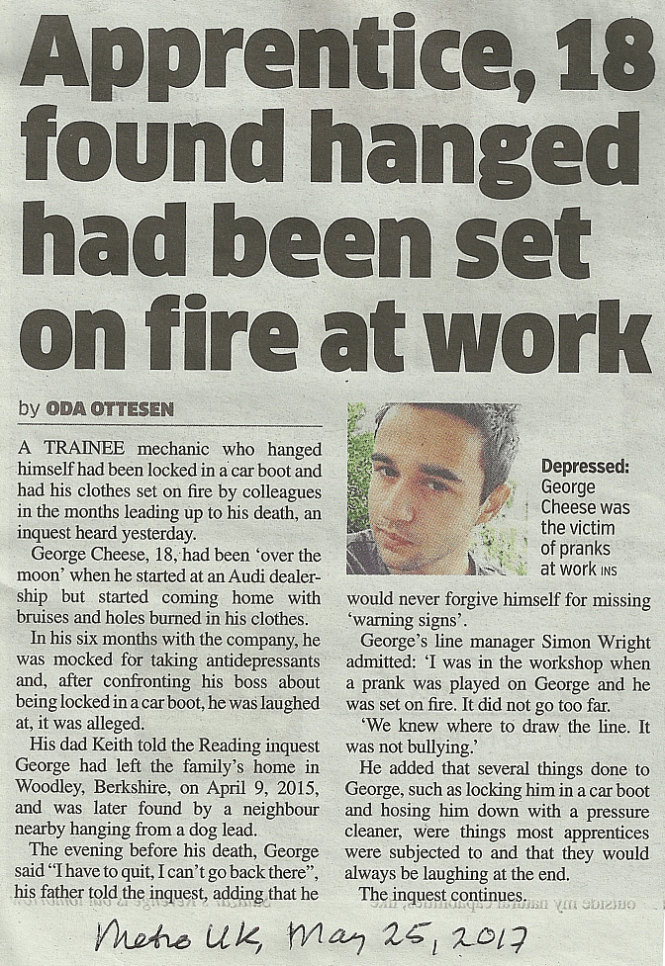
In my essay “We need to talk about this” I mention that I have on occasion been shocked by a certain brand of callousness that I have seen (too) often in Britain (both in the media and in real life). Here is one example of what I mean.


You can only justify such occurrences by applying a tweaked form of utilitarian reasoning. One person was suffering, but “wasn’t really harmed” and the number of people who were enjoying what was being done to George Cheese was greater than 1, hence these occurrences “increased overall happiness”.

The fact that utilitarianism was associated with the higher classes may have given this type of reasoning or events an unfortunate aura of “cleverness”. It could also explain why anyone who condemns the sort of things that were being done to George Cheese is seen by some as “naïve” and “not quite with it”.

Utilitarianism also attached little importance to individual persons’ rights. It would have stopped short from, say, stabbing someone like George Cheese as opposed to setting his clothes on fire and stuffing him into the trunk/boot of a car. This is the kind of background, I think, that enabled Simon Wright to say “It did not go too far.”

In reality, abuse targets like George don’t get to LIVE. All they are allowed to do is wait for their natural deaths. George Cheese said “FUCK THAT!” and stood up for himself in the only way he had left.

At least there is an inquest. That’s good.


The Charlie Gard case

Ouch.

I ran into the story a while ago, and couldn’t find too much information about it back then. However, the parents have just been turned down by the next court and now apparently plan to take the case to the Supreme Court. That’s resulted in more attention for the story, with more background.

Here are two places where you can read more about the case if you’re not familiar with it:
http://www.bbc.co.uk/news/uk-england-london-40047485

https://researchingreform.net/2017/04/12/london-live-interviews-researching-reform-on-charlie-gard/

http://www.bailii.org/cgi-bin/format.cgi?doc=/ew/cases/EWHC/Fam/2017/972.html

In the online discussions, I see something that I also recently mentioned in an essay I wrote and I feel the need to say something about that. (I have also submitted a comment elsewhere.)

Yes, it is true that the British medical profession can be extremely arrogant. As a Dutchwoman who previously lived in the US and is now based in Britain (in Ashya King’s city, I might add), I too feel that the medical profession generally still has that ridiculously old-fashioned god status in Britain. I’ve for instance been ridiculed by an ophthalmologist for asking about possible side effects of a medication, only to find that it did cause serious problems for me. (Thankfully, we have the internet now, which can help us solve such relatively minor problems and bypass physicians who don’t like assisting emancipated patients.) Some people have mentioned Ashya King’s case within this context.

Having said that, Charlie Gard’s case – heart-breaking and difficult – also has a strong element of the opposite. We are now in an era in which doctors are increasingly often perceived as “playing God” when they do NOT do everything in their power to prolong a baby or an adult’s life artificially, no matter how high the cost to the individual in question.

Charlie Gard’s case is not comparable with Ashya King’s case.

Charlie was born with a condition that normally means the infant won’t live very long. I understand that of the few children with his condition, his situation is the worst. Ouch. One can ask whom prolonging Charlie’s life benefits, Charlie or his parents. This will sound incredibly harsh to many and I understand that. It is okay to be very angry with me for that comment.

(I understand, really. I grew up with illnesses and deaths in my very close surroundings; it concerned my mother, one of her sisters and one of her brothers. They died of different kinds of cancer. My mother suffered greatly and for many years, after having been misdiagnosed twice. My youngest sister almost died after she was misdiagnosed when she was 4 or 5. She ended up in critical condition and had to be cooled with ice to keep her fever alone from killing her.) If it hadn’t been for the persistence of my dad, she would never have had the chance to develop into the successful business owner she is today. So, yes, I do know about losing people and wanting to hold on to them.)

On the other hand, allowing Charlie the experimental treatment in the US could yield very important information that may not benefit Charlie but could benefit future infants with mitochondrial DNA depletion syndrome or even other conditions. Could that be worth it? Hard to say.

What would Charlie want? Can you place yourself in Charlie’s situation for even a moment?

Ashya King, by contrast, was a healthy and much older kid who developed a brain tumor. Even with the traditional treatment, Ashya had a fighting chance and treating Ashya as well as possible was certainly going to benefit Ashya (even though there is never a 100% guarantee).

And it has.

One of our problems is that we badly need global regulations for all kinds of medical situations, regulations that people from all sorts of backgrounds all over the world can agree with. The lack of it currently not only causes medical tourism but also the kind of heartbreak we now see in the Charlie Gard case.

If I put myself in the parents’ shoes, I say that most of the hurt and upset for them is currently coming from the legal process. The uncertainty. Even possibly the knowledge that every day they spend in court is one day on which he is not getting the experimental treatment in the US. Unassisted, nature would have already allowed Charlie to cross the rainbow bridge and be at peace and the parents could have had a more normal mourning process.

Is Charlie at peace now? Is he not? How can we know?

It might be possible to avoid this kind of agony if we had much more clarity about what to do to limit harm to such a child as much as possible. Such regulations will have to be a compromise, obviously, and can never avoid heartbreak (but heartbreak is also a normal part of life; life does not come with guarantees and the losses make us cherish what we have).

Conditions like Charlie Gard’s also play a role in the new eugenics, currently particularly in the selection of embryos for IVF procedures, a rapidly growing practice, and soon in the creation of designer babies. It is an incredibly difficult topic that is screaming for attention. So I just wrote a rather provocative essay on it, in a hurry. It is called “We need to talk about this” (the second edition is already in the works) and includes a definition of what constitutes a life not worth living. I have based it on the principle of humanity, namely that every human being has the right to a life in dignity. During the writing of that essay, I grew very depressed a few times, because it is such a hard and dark topic. But we really do need to talk about this, sooner rather than later.

I wish the judges and the parents wisdom and strength and little Charlie lots of eternal sunshine of every possible kind.


Hormones and (mental and physical) health

For most women, PMS is an unpleasant but manageable part of their period. But for 5-8% of women (around 80,000 in the UK), their symptoms are so severe they can be fatal.

Laura experienced anxiety and panic attacks into her twenties, and was forced to temp because she couldn’t hold down a job. “Every month I’d get so tired I’d have to sleep 18 hours a day for three days. I started getting suicidal thoughts.”

She was suffering from Severe PMS or, as it is sometimes referred to in the UK, Premenstrual Dysphoric Disorder. The condition is recognised by the NHS.

“PMDD is actually the American Psychiatric Association’s definition of one type of Severe PMS,” says consultant gynaecologist Dr Nick Panay. The UK’s definition is slightly different. “‘Severe symptoms interfere with someone’s ability to function normally.”

This is an important article. Read it:
http://www.bbc.co.uk/bbcthree/item/82dcd957-fb96-422c-b037-ad2645d7d3b7

I mention something similar in my book “We need to talk about this” in relation to a woman whose child was taken from her womb because she was in advanced pregnancy and has bipolar disorder. Hormones can wreak havoc. Blame the hormones, not the women. Don’t punish the women. Support them.

I happen to know a highly intelligent and spunky woman with bipolar disorder. She has a PhD and her own business. She was hospitalized twice. Want to take a guess as to when that happened? Right. When she had her daughter – who is now an adult and doing fantastically well, I might add – and when she was going through menopause.

Cut people some slack. Don’t punish them for their conditions, certainly not when the condition is otherwise highly manageable and well-managed by the woman in question. Punishing someone with bipolar disorder for going through a rough patch is like punishing someone else for having a bad flu.

By the way, Italy has just introduced period leave for women. And in case that makes you wonder about this, the gender pay gap in Italy is lower than in quite a few other European countries.

It’s time to re-evaluate our relationship with animals

From the description (6 May 2014):

Lesli Bisgould is Canada’s first animal rights lawyer. For ten years, she acted for individuals and organizations in a variety of animal-related cases in the only practice of its kind in the country. She has fought for the rights of students who objected to dissection in science class, for critics of facilities where animals are held captive, and for changes in the law to ameliorate the legal status of animals. Lesli is an adjunct professor at the University of Toronto’s faculty of law where she instructs a course on animals and the law. Lesli is the author of “Animals and the Law”, the only Canadian law text on the subject, published by Irwin Law. Lesli was the 2012 international law lecturer for Australian animal protection institute, Voiceless – she undertook a 12-stop lecture tour of Australia, comparing the commercial hunts for seals in Canada and kangaroos in Australia. In recent years, Lesli’s full-time work has been in the human rights and poverty law fields, and she is currently the Barrister at Legal Aid Ontario’s Clinic Resource Office.

BP oil spill settlement (2010, Gulf of Mexico)

Remember the big oil spill in the Gulf of Mexico a few years back? In 2010, that was. 11 people died in the disaster. I used Twitter to get a shipment of Dawn sent to a group of people who were cleaning up oiled sea birds in Florida, back then. (I used to volunteer there in the mid-1990s.)

Cleaning up oiled pelicans after the 1993 oil spill in Tampa Bay. Photo: Dawn Waldt.

Cleaning up oiled pelicans after the 1993 oil spill in Tampa Bay. Photo: Dawn Waldt.

Well, the damages have finally been settled, and approved by a judge. BP will pay the US government and the five affected states up to $18.7 billion in penalties.

Read more about the settlement: here.

There is also a film about the disaster now.

pelican

Pelican cleaned up after 1993 Tampa Bay oil spill. Photo: Dawn Waldt.

Lawyers’ “fat cat” image leads to more LIPs

On 28 March 2016, Citizens Advice published a new report,called

Standing alone.


It focuses on going to the family court without a lawyer.

The majority found self representing difficult, time consuming and emotionally draining. As well as a bad experience for court users, it also means litigants in person achieve worse outcomes compared with their represented counterparts.

Nine in ten litigants in person say it affected at least one other aspect of their life. Standing alone: going to the family court without a lawyer explores the four key areas affected: mental and physical health, working lives, finances and relationships.

You are not to blame

But you should be aware of what yesterday’s Panorama talked about.

cyber security guy or hackerAmong other things, Panorama told the story of a woman who received an e-mail from her solicitor, informing her that the solicitor’s firm had changed bank.

Could she please pay the £47,000 into the new account instead of to the old account? She did.

The e-mail was spoofed, a genuine-looking but completely fake e-mail, headers (source) and all. She had willingly paid £47,000 into the bank account of a hacker. Continue reading

Panic attacks

How can you prepare yourself for court situations as described in this long article in The Guardian?

Make sure that you feel comfortable in the court room.

You can do that by going to the court house – any court house – as often as you can. Enter the building, empty your pockets, go through the metal detector, and walk around in the building. Attend other people’s court hearings as a member of the public.

Pay a great deal of attention to how you feel and which things make you feel anxious. Or angry, or confused. Ask yourself why they make you feel that way and what you can do about it. Do not fight the feelings that well up in you. Most of the stress comes from trying to suppress feelings. That internal battle drains your energy and overwhelms you.

Go back into the court building time and time again, and teach yourself to look at your emotions from a distance, not seeing them as good or bad but as, heck, potted plants or tumbleweeds. Over time, they’ll probably disappear or show up briefly and then dissipate.

Teach yourself to stay calm in your court hearings.

This is the hard part. You can make sure that the people you will have to deal with in the court room, such as your ex, do not make you feel as panicked as one of the persons the article in The Guardian talks about.

You can do that by sitting in a room at home, with no one else around. Relax and picture yourself in the court room. Look around, and imagine seeing for example your ex there, and the other side’s barrister, and the judge, and everyone else.

Again, pay a great deal of attention to your feelings. Feel the panic and anger come up? The sorrow? The powerlessness? Let them be. Do not fight them.

If you do this over and over and over again, your feelings of panic and anger, powerlessness and pain may slowly start to disappear. It is hard work. Do it! It is worth it. Also, try not to look at your situation in terms of what you stand to lose, but in view of what you may gain, if that helps you.

Easy for me to say? Yeah! But I’ve been there. After my second court hearing, I walked into the ice-cold December sea because I felt terribly powerless. Useless. Later, I’ve stood in a court room’s toilet area, shaking, very nervous before yet another hearing.

I have also witnessed that lawyers themselves can get just as nervous and shaky and upset as you when they are the defendants in civil proceedings. It is a shocking sight. A moment of truth. The lawyers for the other side, too, are merely humans. They are not that different from you and me. They get tired and cranky and weepy, just like we do. But they don’t show it in the court room. Because they’ve taught themselves to remain as calm as possible in the court room.

It is not a matter of suppressing or fighting your feelings. It is a matter of acknowledging your feelings, accepting them and allowing them to come out – embracing them – when they don’t hamper your calm effectiveness. Particularly for Britons, who historically have been taught to abhor emotions, that can be very hard.

People with problems

“Nothing is more difficult than having to deal with people who have problems or who have lost hope. A sincere heart will not here alone suffice, and in such cases it is necessary to possess keen powers of perception in order to see into the other’s spiritual condition so that one may then join with it. A deep heart of love is required in dealing with those who ‘have lost’.

The basic problem, then, is how to nurture such powers of observation and perception, and how to develop a deep, loving heart of one’s own. A person who is simply good and sincere might easily end up thinking the same disgruntled thoughts as the person who is complaining, and might be pulled down by stories of other people’s misfortunes. People might find some sense of relief in complaining or fulminating but in time this habit of complaining takes root and, without even being aware of the weakness that caused them to fall into despair, they choose a way of life that hampers further uplifting of their spirit.”

Masahisa Goi, in The Spirit of Lao Tsu Continue reading

A word of warning

There is a great deal of information on the internet for those who go to court without legal representation, but not all of it is accurate, even when it’s published by a reputable source.

mouseJust before I went to my first court hearing as a litigant in person (in legal proceedings that I had started), I quickly double-checked something on the web. What I then found was not what I remembered about it, but as the web site on which I found the information was high-quality, I assumed that I had remembered things incorrectly.

The judge set me straight. The information I had remembered was correct; the information I found on the reputable web site was out of date. it did not matter in this case, but it could have been important. Mistakes like this can get a case thrown out of court.

Also, even court staff such as ushers sometimes deliberately give you the wrong information, by way of joke. It is not supposed to happen, but it does. Be prepared for that.

Don’t pay too much attention by what that you’re told in the pub either. Many Britons may be excellent bullshitters, certainly when they’ve had a pint or two, but don’t get fooled by appearances. Don’t instantly discard everything you’re told, but don’t blindly take it for the truth either (or the opposite: the person you consider stupid may be smarter than you can imagine).

Rely on solid information. Be your own authority on the law and the legal process. That’s how you need to operate as a litigant in person. You set the course.

Police data

Some points.

citizensWhen you are somehow in contact with police, as a victim, witness or offender, you can expect police to have data on you. Police have to be registered as data controllers, so that you are aware of this and can look up what they may do with the data they have on you (which they primarily obtain from you, in that case).

I carried out a search in the ICO database on “police Hampshire”. It turned up two records, of the Hampshire Police Federation (regarding its members) and the Police and Crime Commissioner for Hampshire (see here). The latter covers the data Hampshire Police has on citizens. It surprised me that the registration includes potential sharing of data with traders in personal data. This is one of the default entries, however, and I am assuming that they have left it in, just in case (a form of “CYA”).

So far so good. You would think that it becomes a different matter if you happen to be standing on the pavement eating a cheeseburger when some kind of demonstration takes place. Does that mean that your photo gets taken and you become included in the National Domestic Extremism Database?

I’ll spare you the details but as of January, I have been extremely aware of the enormous power police officers hold to screw someone royally, to put it bluntly. A chill ran down my spine when I found out something that I had been unaware of until then. The kind of coincidence that I had been a bit worried about as a result happened recently, when I discovered that I had been in Parliament Square just a few hours before Occupy planned to occupy Parliament Square. I was completely unaware of those plans, and saw nothing out of the ordinary (perhaps because I am not familiar with Parliament Square).

I am sure I stood there for a while looking pretty suspicious, however. Among other things, I was timing distances, for the sake of planning any future journeys to meetings. In the past, would that already have gotten me into the National Domestic Extremism Database because my behaviour was out of the ordinary? Non-touristy? Puzzling?

Believe it or not, there can be silly coincidences that have someone present at some kind of demonstration five times in a row. We all see such silly coincidences in other areas of our lives, after all. Does that justify the inclusion in the National Domestic Extremism Database? Of course not, but unless media shine a light on what goes on and one or two gutsy personalities take to the courts, a great deal of this kind of activity remains completely hidden from sight.

The National Domestic Extremism Database is not the only database you have to be concerned about. The police’s Crime Reporting Information System (CRIS)  can keep data up to twelve years. You would think that this CRIS system contains only crime data. It does not. CRIS contains data on serious offences, minor offences and about conduct that does not amount to an offence at all.

One wonders.


Confidence in the police

On 30 December 2009, the home office published Home Office Research Report 28: Improving public confidence in the police: a review of the evidence.

On 4 September 2014, a review of police functioning in England and Wales revealed that victims of crimes are being encouraged to investigate themselves, when they report offences to the police, according to the BBC. Other media, including The Guardian and the Huffington Post, also paid attention to the findings of this review.

Although the Association of Chief Police Officers appear to be explaining them as a consequence of austerity, these practices of telling victims to investigate crimes committed against them are not new.

When I reported an incident that according to the police constituted identity theft and harassment, the officer I spoke with informed me that I had to do the legwork myself if I wanted anything done because the police didn’t have the manpower to investigate these high-volume crimes. He also explained that what had happened to me could be very unsettling. He asked me whether I wanted counselling as it was available if I needed it. I appreciated that, but I declined.

That was in October 2008, when austerity measures did not play any role.

According to the BBC, the reviewers (led by Roger Baker) made similar observations, namely that this trend of telling citizens to solve crimes started before the budget cuts.

What may be related to the budget cuts, is that (in my own experience) police officers appear much less likely to offer any assistance with the psychological consequences of crimes people have been subjected to, even in more serious cases (other than standard phrases about victim support in automated recordings and printed information materials).

I think that I can safely assume that confidence in the police is currently worse than it was in 2009.

A September 2014 poll conducted by my local newspaper, the Portsmouth News, showed that only 8% of the respondents believed that police would properly investigate if they’d reported anything other than very serious crimes to the police. This number remained fairly constant during the increase of the number of respondents; the only brief deviation I saw was a percentage of 9.

But what does this low number mean?

In January 20913, the University of Twente in the Netherlands published a Bachelor thesis on the topic (confidence in the police). Notably researchers in the US and other non-EU countries have already conducted a great deal of work in this area.

When the public has a great deal of confidence in its police force, this can lead to increased feelings of safety and a decrease in fearfulness among citizens. Confidence in the police is also a good indicator for the quality of policing and of how well the public accepts the authority of the police as well as its actions.

Four factors play a role in the theoretical model to predict confidence in the police:

  • age;
  • gender;
  • direct experiences (how much contact people had with the police and whether they viewed it as positive);
  • indirect experiences (how much police-related reality TV people watch and how much they like these shows).

These factors also influence people’s fearfulness.

Confidence in the police consist of the following six components:

  • Integrity;
  • Lawfulness/legitimacy (whether police officers observe the laws in their actions;
  • Efficiency and effectiveness;
  • Democracy (fairness, openness about policies and responsibility for actions);
  • Intention (work ethic).

How does the above relate to crime figures?

In October 2014, Portsmouth City Council’s publication Flagship reported that “crime recorded by police is down by 33% since 2007/8 and 8% since last year.” I wonder how these numbers relate to the numbers of actual occurring crimes. Does citizens still report as many crimes to the police as they used to when they have experienced over the years that the police won’t investigate anyway? About 90% of all rapes go unreported, I read the other day.

The Flagship also gave numbers based on a March 2014 survey with 849 respondents. Of those respondents, 2% had experienced burglary, 1% mugging or robbing and 3% was assaulted such as beaten up. It did not mention the percentage of these crimes had actually been reported to the police. It did mention that 40% of the respondents fear burglary, 17% fear mugging/robbery and 14% fear being assaulted or beaten up.

How fearful citizens are of crime and of becoming crime victims is generally related to how much confidence they have in the police.

In essence, the fearfulness among the public does not represent citizens’ “degree of silliness” but reflects police performance and the degree of confidence people have in the police.

How much confidence people have in the police is also related to how much confidence people have in other organisations, in general.

In the Netherlands, how much confidence people have in the police is positively correlated to the quality of the contact they had with the police in the preceding twelve months, but negatively correlated if they were a victim of crime.

The Dutch study at the University of Twente was based on survey data for 125 respondents in the Netherlands.

In the same year, the Erasmus University published an extensive study of trends in the public’s confidence in the police and what they mean.

Thanks for reading. Do you still report crime to the police?

What Charlie Gard taught me

No matter how you felt about the situation of Charlie Gard and his parents and about how it was handled, you will likely agree that little Charlie’s life and death have not been in vain. Many bioethics scholars and others – predominantly men, I noticed – have been writing up their feelings and opinions on the matter, analyzing what happened and drawing conclusions. This will benefit future babies like Charlie and future parents like Charlie’s.

Or at least, it should!

Like all those other people, I too want to do a write-up because it will be very enlightening for myself (maybe also for others, because I did a surprising U-turn).

In this post, I will not go into the differences between Britain and other countries. Neither will I discuss the British legal background of the case, but I do want to point out that it must be kept in mind as essentially separate from all other considerations. The law of England & Wales must be adhered to, whether we like it or not, and in many cases that should entice the legal profession to pick up the lead in their arena and endeavor to have laws changed where called for. (Legislature, that is your duty! Step up to the plate.)

I was like just about everybody else. When I first heard about Charlie Gard case, I saw it as a consumerist view of babies. Baby has a defect. Must be fixed. Period.

As a teenager, I saw my mother suffer for many years, wither away and die and it was an immense relief for me that her suffering had ended when she died.

So, no, I am not for the extension of life “at all cost” / “no matter what” because that often is very selfish on the side of everyone who is not the patient in question. Family members and friends have to ask themselves what it is that they want. Do they want to hold on to the person no matter what or do they want that person to be free of pain?

Letting go is part of life, part of growing up, part of… being.

When one door closes, another one opens, in so many ways.

So I felt angry and frustrated toward Charlie Gard’s parents, although I certainly understood their anguish.

Earlier this year, I came up with a definition of what constitutes “a life not worth living” and Charlie Gard’s vulnerable little life fit that definition. Please, stop his suffering and let him pass away, as nature itself considers him not viable and he would surely have passed away a long time ago if it hadn’t been for the care and services provided by Great Ormond Street Hospital. That’s what I thought.

Please, please, please, let him go. Let him gooooooooooooooooooooo! That is what life is about!

But I had also come up with a definition of what harm is, within this context…

Both my definitions were very logical. I found them through play, playing with words, playing with ideas, concepts. They’d surely come across as “chilly” and “cruelly objective” to the “public”.

And then I saw that they clashed.

That’s when I saw that there was no conflict.

Both parties wanted what they thought would be the best for little Charlie.

But the only party with a real interest in this – one that didn’t clash with the wishes of the medical staff at GOSH – were Charlie’s parents.

Forgive me, please, for having accused you of a consumerist view of your child at first.

If Charlie had lived, he would be part of YOUR life now – not the hospital’s – and you were willing to accept anything that would have meant, it seems.

Who am I to judge a “vegetable” not worth of living?

Who am I to judge a being able of experiencing joy – and pain – as a life not worth of living?

Isn’t it true that ALL LIVES experience joy and pain?

Isn’t it true that this is LIFE?

I wrote the above after having consumed a considerable quantity of rum. Nothing bad about that! Below are my very (sober and) logical considerations.

Court system overhaul?

“While those with money can secure the finest legal provision in the world, the reality in our courts for many of our citizens is that the justice system is failing them – badly,” Mr Gove will say in a speech in London.

The new Justice Secretary will deliver a damning verdict on the “creaking and dysfunctional” court system, warning that is riddled by inefficiency and bureaucracy which compounds the suffering of crime victims.

In his report last year, which was commissioned by the Lord Chief Justice, Lord Leveson said: “Our conduct of criminal trials was designed in the 19th century with many changes and reforms bolted on, especially over the last 30 years.”

“The result is that it has become inefficient, time-consuming and, as a result, very expensive.”

In The Independent this morning. It all focuses on criminal justice only, but may have consequences for civil cases too. Read the rest of the article.

Relief from sanctions, late witness statements and litigants in person

The judgment of Mr Justice Warren in Chadwick -v- Burling [2015] EWHC 1610 (Ch) highlights some important issues in relation to relief from sanctions in general, and the position of litigants in person in particular.

Reblogged from Civil Litigation Brief

Gordon exall's avatarCivil Litigation Brief

The judgment of Mr Justice Warren in Chadwick -v- Burling [2015] EWHC 1610 (Ch) highlights some important issues in relation to relief from sanctions in general, and the position of litigants in person in particular.

THE CASE

The applicant in the case was the trustee in bankruptcy and bringing an action for possession and declarations of ownership in relation to a number of properties.  An order was made for the filing of evidence. The respondents did not file any evidence. A peremptory order was made that evidence be served by 5th August 2014 or the respondents be debarred from relying on evidence.

The second-respondent was the former wife of the bankrupt. She did not file evidence. She stated that she did not recall receiving the order, but did not positively state she did not receive it.

An application was made for relief from sanctions. That application was refused by the…

View original post 3,463 more words