I want my life back! Been stuck in a sadistic stalking, lockpicking and hacking nightmare since 9 June 2008. This website is currently paid for by whoever is doing this to me.
This sort of thing has been possible since at least 2010.
Back in 2010, I knew it was happening on my equipment, but I couldn’t prove it and when you say something like that out loud, everyone assumes that you’re delusional. After all, accepting that I might be correct is a scary thought.
Too scary for most people.
So when I finally got the proof, when I was able to compare a tweet on my phone with the same tweet on a friend’s computer, I could see that there were words in the tweet on my phone that were not present in the tweet on my friend’s computer… I didn’t show it to anyone. There was no point. Nobody was going to be interested.
The original tweet came from Portsmouth-based Maricar Jagger, but she had nothing to do with the digital mischief (other than that she was connected through her social circles).
I also knew about phone hacking via the invisible text message method before it became news – because I saw it happen on my own phone. (Same thing. Delusional cow who has difficulty grasping technology was the usual response.)
—
PS And OUT goes a big chunk of police “evidence”, of course.
Never had any problems with landlords in the Netherlands. Never.
Had three in Florida. The first and the third were fine, but the second one was not and his attorney was rumoured to have mafia ties, I kid you not. But I heard that later. I think it was actually a legal aid lawyer who told me that who I talked with later, long after I’d moved out and his lawyer started pestering me. I’ll spare you the details.
My third landlord was the husband of the person I volunteered with on Saturdays and sometimes Sundays. (He was a builder, built huge places, the way they are in Florida. Nice guy. I think he was in the US Army for a while, and they lived in places like Morocco. ) She stopped by one day – to bring me two birds – and was appalled and suggested I move in to one of their places. They owned a small apartment building that was mostly used by snowbirds (people from for example Canada who take winter vacations in Florida).
Some time later, I moved to Britain.
In Southampton, I knew several landlords. (Only one of them was mine.)
One said that only educated people were decent human beings, and I was too shocked to respond. He called tenants who rang him because the washing machine or heating wasn’t working (properly) “bad tenants”. This was not my own landlord, but someone I met within a business context and was friendly with for a while. Wasn’t actually a bad guy at all, strangely enough.
I also knew one who proudly told me how he had tricked an elderly woman with beginning Alzheimer’s out of her flat, I kid you not.
On another occasion, the same guy was talking with me about a new building he was constructing and then added that it did not have to be very good “as it is only for tenants”.
In Portsmouth, I’ve met two who dump rubbish on other people’s front courts and patios. I caught one red-handed and the other one admitted it.
I have principles.
If I can help make things better for people who come after me who are less strong in some way – okay, except physically as I am getting old and I am feeling it – I will try to do that. And that baffles the hell out of (most) Brits. But that is not my problem.
They don’t have the time and resources to solve crimes against individuals, unless those individuals have been killed, but they do still have the time and resources to send two or three cars to follow me and hunt me through the city to play PacMan.
They love playing PacMan with migrants and with women.
They first did this to me in 2009. February it was.
Of course, when you call them out on it, they always say that they don’t have the time and resources for that kind of crap.
So on my way back, I walked up to the central police station in Portsmouth, and addressed its CCTV camera:
You. Need. To. Observe. The. Law.
The law!
That’s the kind of police we have in Britain – barbaric, lawless and abusive – for which we pay through our council tax. They’re straight out of a film of police brutality and incompetence of the wild-west US in the past.
Two or three police cars were following me all over town again yesterday evening, slowing down when they passed me, backing up and returning when I took a left or right, etc.
It’s happened too many times before.
And this kind of crap takes up most of their time. Hunting down citizens who dare report crimes and who dare stand up against the utterly lawless British police. They don’t seem to do anything else but this.
I have on occasion stood by on purpose myself to serve as possible witness in police brutality cases when I saw them hunt other people. But they are too clever to attack people in plain public view, I am sure.
We pay for this harassment through our council tax. We pay for it ourselves!
Portsmouth has the highest CCTV density of the UK, so yes, police can hunt anyone through the city, in retaliation or just for fun.
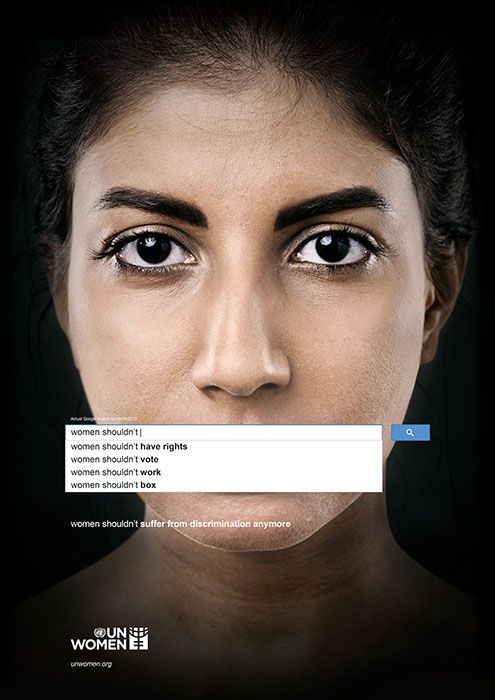
I also got a creep on a bicycle after me, along Albert Road, to tell me that women deserve to go hungry, should not be allowed to own any property of any kind, should not be allowed to work and should not be allowed to earn a living, or even be healthy and happy and that they should generally keep their mouths shut.
I told him it was the 21st century, that the middle ages were a long time ago and I crossed the road. The kid was not even half my age. He should apologize to all the women he owes his existence to, starting with his mother, but he won’t see it that way, clearly. In his eyes, women are lower than cattle. Usable and disposable. Not worth shit.
In case you wonder what the hell I am still doing in this shitty hell hole, well, I’ve tried to escape four times already. I also sometimes foolishly think that I can help make things better here, simply through my presence.
Also, I had formally raised the issue about the problems with local police again this week. Some retaliation was to be expected.
This photo below shows you what my door looks like when I am not in, these days. Three locks on the inside, warning note on the outside and a barricade in front of it, to stop, eh, anonymous elements, from shimmying the locks and carrying out crap in my flat – which has been going on since 2011, with the approval of Portsmouth Police.
Updated on 12 July 2019
At the moment, I am not using the vacuum cleaner to block my door, but the basket and two older printers. There was a time when I believed there was a local person with a brain-related impairment behind it, but it’s more complicated than that.
On paper, whistleblowers are often legally protected, but in practice, well, that’s a different story. Whistleblowers usually end up ruined. It takes guts to take a stand and also often sacrifice.
So a different approach is taken in this case. I shall be following this (to the extent that I can).
Racism and other forms of discrimination in Britain in the 1960s. (Thanks to Theresa May, we’re now going back to this, with many landlords preferring not to rent to foreigners – to avoid prison.)
It may also shatter your illusions, however, if you still believe that police are the good ones, the ones (that you pay for through your council tax, in Britain) to help keep you safe and secure and protect your basic rights.
I suspect that police in England and Wales already are using these “kiosks” that hack into people’s phones and laptops, overriding passwords.
I am sure it can be great fun for some officers to play with these “kiosks”. You can almost hear them talk. “I knew it! She’s a lesbian!” and “Does he really think he stands a chance with that woman?” and “Oh my god! Trying to lose weight? Fat chance!”
Yep, very useful.</end of sarcasm>
We need an alternative to police. Because going to or contacting the police has become one of the worst things to do in almost any situation. (Unless your insurance company wants a copy of a report after a burglary or theft, but leave it at that and do not ask police to do anything else other than give you a copy of the report.) How it got to this point? It’s immaterial. It’s what we have in the here and the now.
As Michael Doherty (a former aircraft engineer who made the mistake of reporting something to police and expecting police to follow up on it) says in the video below, you do have the right to investigate on your own, to try to detect and stop crime on your own. If your investigation is successful, you can also prosecute on your own. (I am talking about England and Wales.)
But before you choose this path, as I have stated several times before, look into the Protection from Harassment Act 1997 because police and others can use this against you, assuming that you are unaware of 1(3)(a), which most people probably are. That means that, before you know it, you can already have confessed to a crime that you didn’t actually commit. To prevent this, you need to know what the law says.
I repeat and highlight:
(3) Subsection (1) [F4 or (1A)] does not applyto a course of conduct if the person who pursued it shows—
(a) that it was pursued for the purpose of preventing or detecting crime,
(b) that it was pursued under any enactment or rule of law or to comply with any condition or requirement imposed by any person under any enactment, or
(c) that in the particular circumstances the pursuit of the course of conduct was reasonable.
(Whether it says “and” or “or” makes a difference. It means that each of these conditions on its own applies, that they do not have to apply all at once.)
The video below dates back to 2015, is rather academic and particularly in the beginning lacks a logical thread, in my opinion, but does contain useful information.
(Also, if you want to protect yourself from police with a camera, you need to have one that does not have wifi or bluetooth.)
It is possible to resolve many situations or at least make them somewhat liveable without going to police, and much more successfully and/or peacefully. If you try this after you’ve been to police, however, police officers are likely to hold it against you. (This is mean because most people who contacted the police in the past decade will have been told that police wouldn’t investigate and would do nothing with what they told the police owing to a lack of resources and/or will have been referred to their GP and the local civic offices.)
Unfortunately, most of us learn these things the hard way – and you can’t undo having contacted the police.
I am in the middle of reading “The war on women” by Sue Lloyd-Roberts. The book was finalized without her input after she suddenly passed away in 2015. I wish that I could still contact her.
Because then I would talk with her about her own bias. She sounds convinced that there is a division between the “liberal West and the traditional East”, and it made her slightly blind to what went on in, say, her own country, assessed by the UN as perhaps the most openly misogynistic country in the world. That can probably be explained that she’d been living on the Spanish island of Mallorca since 2003.
I can’t allow myself to be blind to the fact that people in the West who condemn what goes on in other countries but are blind to what goes on in their own culture may be helping their causes less than they think.
The above is the title of the 2018 Petrie-Flom Center Annual Conference, which took place in June. I had registered for the event because the topic interests me greatly and I have so much to learn in this area. Unfortunately, I turned out to be away and unable to attend after all.
I am delighted that the Petrie-Flom Center not only decided to make some of the lecture materials available beforehand, but recorded the lectures and has made the videos shareable.
Prominent point of discussion at he conference was the question whether a disability is merely a difference, or a bad difference. Putting the question like this is an oversimplification but it is a good starting point. I will discuss this matter and these lectures in greater detail in coming posts.
For now, here are the opening remarks, and first talks.
Last evening, I saw a video and photos that I found shocking. It concerns severe animal cruelty that occurs near Sulphur in Oklahoma. The farm is part of Mahard Egg Farms who appear to be headquartered in Texas. I searched LinkedIn and found nine accounts associated with the company, including that of its CFO, Kaitlin Mahard.
I believe that severe animal cruelty can be considered “violent crimes” which would mean that LinkedIn should remove the accounts associated with Mahard Egg Farms. The LinkedIn Professional Community Policies state that “those who engage in violent crimes are not welcome and not permitted on the Services”.
In 2011, Mahard Egg Farm, Inc., indeed a Texas corporation, was told to pay a $1.9 million penalty to settle claims that the company violated the Clean Water Act (CWA) at its egg production facilities in Texas and Oklahoma, according to the EPA: https://www.epa.gov/enforcement/mahard-egg-farm-inc-clean-water-act-settlement
C. MORTALITY MANAGEMENT
18. Defendant shall comply with the Mortality Management Requirements in Appendix D at the Vernon-Chillicothe Facility, the Springhill Facility, the Prosper Facility, the Boogie Hill Facility, the Nebo Ranch, and the Ravia Facility, unless such facility is not growing poultry.
Appendix D stated:
APPENDIX D:
MORTALITY MANAGEMENT
I. Texas
65.
No later than the Effective Date of this Decree, Mahard shall cease any transfer of
carcasses between Facilities unless a composting plan is in place that is consistent with 30 T.A.C. 332, Subchapter B, and has been approved by EPA and TCEQ.
66.
Mahard shall ensure that all carcass disposal at the Vernon-Chillicothe, Prosper, and
Springhill Facilities is conducted in accordance with TCEQ Regulatory Guidance, RG-326, Handling and Disposal of Carcasses from Poultry Operations (August 2009) and in accordance with 30 T.A.C. § 335.25. Mahard shall collect all carcasses within 24 hours of death and properly disposed of them within three (3) Days of death. Animals must not be disposed of in any liquid manure or process wastewater system. Disposal of diseased animals shall be conducted in accordance with Tex. Agric. Code § 161.004.
II. Oklahoma
67.
Mahard shall comply with the terms and conditions in Mahard’s 4/29/09 Carcass Disposal Plan, as amended and supplemented by the letter from ODAFF, dated May 7, 2009, to Mahard (both attached here as the Appendix D Supplement).
The Kroger chain has meanwhile dropped Mahard’s eggs and I’ve reached out on LinkedIn to it spokeswoman Kristal Howard to thank Kroger and ask her to ensure that Kroger will never be associated with such severe animal cruelty again.
Kroger’s 2018 Sustainability Report includes an animal welfare policy, which states:
“Kroger has a long-standing commitment to responsible business practices, including the humane treatment of animals,” Kroger says in its policy. “We require our suppliers to adopt industry-accepted animal welfare standards that we endorse, and we monitor our suppliers for compliance with these standards. We align with the Food Marketing Institute’s industry-adopted and industry-aligned animal welfare standards for the following animal proteins: beef, pork, chicken, turkey and eggs. For nearly a decade, Kroger has convened our own independent panel of animal science experts to make recommendations on how we can work with the industry to improve animal welfare.”
That is one of the questions I’ve been wondering about, as you’ll know if you read my latest book.
I just watched Brené Brown’s TED Talk about vulnerability again. I first saw it a few years ago. It turns out that her research appears to indicate that yes, the unbridled creation of designer babies would destroy our capacity for connection.
Smell the flowers, feel the wind, go along on the ride. It is possible. And if it is possible, there are only lots of good reasons for all theme parks to put this into practice for attractions that are not accessible to people in wheelchairs.
Because we have been taught that something – whatever it is – is bad. If you let go of the idea that something is good or bad, you may feel a weight lift from your shoulders.
If you simply allow and observe the thing that is supposed to be bad, you may find that it is interesting – hence also good, right or even fun – all by itself.
Feeling depressed is bad, for instance. It is even considered a mental health problem these days. An illness. Feeling cheerful is good. Acting cheerful when you’re feeling depressed is good. Is it?
It can be, but there are times, after the death of a loved one for example, when we really have to allow feelings that are supposedly bad.
(Is mourning someone’s death truly “a mental health issue”? Or could it be a natural part of life?)
It is our resistance to “bad” feelings that often becomes the greater problem. As soon as you allow certain feelings and stop considering them bad, they can lose their power over you quickly.
And heck, even moping can be a heck of a lot of fun too.
What always comes to my mind when I say something like that is an image from the original Swedish Pippi Longstocking TV series.
Pippi is in a foul mood and goes around angrily stamping her feet, probably in puddles of water, powerfully indulging in her foul mood, full of energy. Acceptance. A foul mood is just a foul mood, not the end of the world.
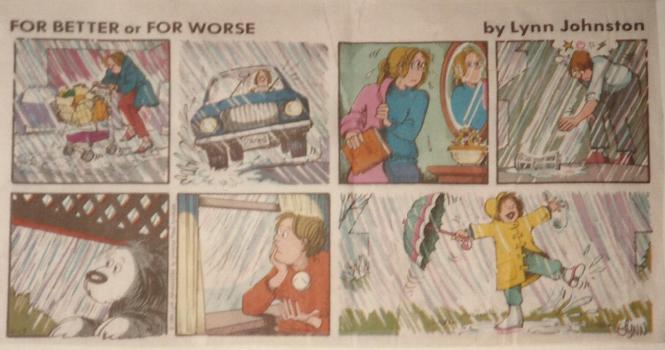
Puddles of water? So it must have rained. Rain! Rain is bad.
I too have my personal good/bad hangups. Ideas that make me feel vulnerable or guilty or inadequate or unhappy. What are yours?
This video will change everything. For anyone who thinks that crawfish and other sea life don’t suffer, watch this crawfish sever their own claw to escape a boiling pot. So powerful. Please RT. 💔 pic.twitter.com/tNEYlvlSv2
The Elephanta Suite, by Paul Theroux. The clickable image on the right and the above link take you to the Kindle version and to used print versions as cheap as 0.01 on Amazon.
It includes, among other things, a tale of inequalities (and colonialism).
Hardback This link and the clickable image on the left take you to the hardcover version.
If you'd like to support what may well be the most important piece of litigation in modern times – what other case could meaningfully extend the valuable rights of 60 million odd people – you can do so here https://t.co/RZusZ30JIl
The Supreme Court, in Robinson v Chief Constable of West Yorkshire Police [2018] UKSC 4, has declared that if “a third party such as a pedestrian is injured as a result of a negligent arrest on the street by a police officer, the police are liable in negligence where that injury was a reasonably foreseeable consequence of the police’s actions.”
It’s always annoyed me immensely that British police could almost never be held accountable for anything they did. It’s a recipe for carelessness, almost literally, when duty of care does not apply.
So I am pleased to see that a little bit more liability is finally appearing.
(I used to have an interesting in policing and the law a few years ago but local police officers weren’t very fond of that, I was made to understand, and I decided to drop it.)
In 2017, the Home Office ignored one court order and attempted to set aside another in the deportation of someone to Afghanistan, only to see itself forced by another court order to collect the person in question in Afghanistan, escort him to an airport and whisk him out of the country to which he had been deported. See for example https://www.theguardian.com/uk-news/2017/sep/18/samim-bigzad-asylum-seeker-deported-illegally-to-afghanistan-is-returned-to-uk. Ignoring the first court order was prima facie contempt of court, according to Mr Justice Jay.
In 2013, however, the UK Treasury challenged the EU’s bonus cap for bankers through the courts. See for example http://www.bbc.co.uk/news/business-24273838 The BBC commented:
In 2018, the Home Office made the decision to deport someone to Afghanistan within 15 minutes after the decision allowing him to continue his appeal, in spite of prior reassurances that he could await the outcome of this appeal in Britain. This is not illegal (yet), but it was unethical (and the campaigners kept some details of the Home Office’s behaviour quiet, apparently out of a fear that releasing those details might do more bad than good). See for example http://www.salisburyjournal.co.uk/news/journalnewsindex/15894362.Refugee_sent_back_to_Afghanistan_after_legal_battle_collapses/
In 2016, the Department of Work and Pensions set about to change the law in order to be able to ignore the outcome of a tribunal. In 2017, the High Court called it “blatantly discriminatory”. In 2018, the DWP decided not to appeal but to review the decisions for 1.6 million disabled citizens, which will eventually lead to back payments (to November 2016) to between 160,000 and 220,000 people. See for example: https://www.mirror.co.uk/news/politics/up-164000-people-higher-disability-11879582
At least one judge has commented that the government is wasting the tax payers’ money as well as judicial capacity.
The pattern shows unequivocally that the British government goes after the most vulnerable in British society and seeks to protect the wealthiest in society.
Apparently, the Lord Chancellor has the task of ensuring the government’s compliance with the rule of law. As of the beginning of this year, that is David Gauke, appointed by HM the Queen on advice of the Prime Minister. So the Prime Minister recommends who gets to monitor the legality of her own government’s actions? Hmm.
His predecessors were Chris Grayling (2012-2015), Michael Gove (2015-2016), Elizabeth Truss (2016-2017) and David Lidington (2017-2018). All Conservatives.
When I voiced my protest against the recent cartoon in The Sun (see previous post), some people said “It is a CARTOON! it is just a cartoon.” That was my point. It wasn’t. Continue reading →
1/ Today is the 7th anniversary of one of the most important and notorious UK human rights cases ever. I think we need to keep talking about it, even if it’s uncomfortable for advocates of the human rights system. Here’s why.
People are currently focusing on Trump and his silly comments, but perhaps they should be focussing on Britain.
A few days ago, British newspaper The Guardian reported about a eugenics meeting that allegedly had been convened in secret, involving someone who has previously advocated child rape. This meeting is supposed to have taken place at University College London and white supremacists supposedly were present at this meeting. Continue reading →
Interview with Mark Easton, BBC. Date unknown, but near the end of Tony Blair’s premiership.
Keep in mind that “hooliganism” and “anti-social behaviour” are often labels used to indicate (and reject) people from a lower socioeconomic class in Britain and that this “hooliganism” for example gets expressed in graffiti.
Of course, causing (increased) financial hardship for parents by taking any benefits away is most definitely not “in the best interest of the child”.
Tony Blair did consider graffiti “anti-social behaviour”. During a photo-op as part of his crusade, he hosed down graffiti and said that older generations of his family would have abhorred such behaviour. It then turned out that his own grandmother had been a “commie” graffiti vandal.
There probably is a work by Banksy somewhere in response to all of this.
Tony Blair also criminalized a lot of behavior that is essentially merely human behavior. That too was in nobody’s best interest and probably did nothing toward decreasing inequality in Britain.
The uproar over allegations that Hollywood producer Harvey Weinstein sexually abused and harassed dozens of the women he worked with is inspiring countless women (and some men) to share their own personal sexual harassment and assault stories.
With these issues trending on social media with the hashtag #MeToo, it’s getting harder to ignore how common they are on the job and in other settings.
I have studied sexual harassment and ways to prevent it as a diversity and inclusion researcher. My research on how people often fail to speak out when they witness these incidents might help explain why Weinstein could reportedly keep his despicable behavior an open secret for decades.
Of course, Weinstein’s alleged wrongdoings went well beyond sexual harassment, which University of British Columbia gender scholar Jennifer Berdahl defines as “behavior that derogates, demeans or humiliates an individual based on that indiviudual’s sex.”
Some of the women speaking out in the U.S. and abroad are accusing him of rape – a crime – during encounters he says were always consensual.
But sexual harassment is such a chronic workplace problem that it accounts for a third of the 90,000 charges filed with the federal government’s Equal Employment Opportunity Commission (EEOC) in 2015. Since only one in four victims report it, however, the EEOC and other experts say the actual number of incidents is far higher than the official number of complaints would suggest.
The usual silence leaves most perpetrators of this toxic behavior free to prey on their co-workers and subordinates. If sexual harassment is pervasive on the job, and most women don’t report it, what can be done?
Some business scholars suggest that the best way to prevent sexual harassment, bullying and other toxic workplace behavior is to train co-workers to stand up for their abused colleagues when they witness incidents. One reason why encouraging intervention makes good sense is that some 70 percent of women have observed harassment in the workplace, according to research by psychologist Robert Hitlan.
The trouble is that most people who witness or become aware of sexual harassment don’t speak out. Screenwriter, producer and actor Scott Rosenberg has both admitted to and denounced how this dynamic enabled Weinstein to become an alleged serial abuser. “Let’s be perfectly clear about one thing,” he wrote in a private Facebook post published in the media. “Everybody-f—ing-knew.” He also said:
“in the end, I was complicit.
I didn’t say s—.
I didn’t do s—.
Harvey was nothing but wonderful to me.
So I reaped the rewards and I kept my mouth shut.
And for that, once again, I am sorry.”
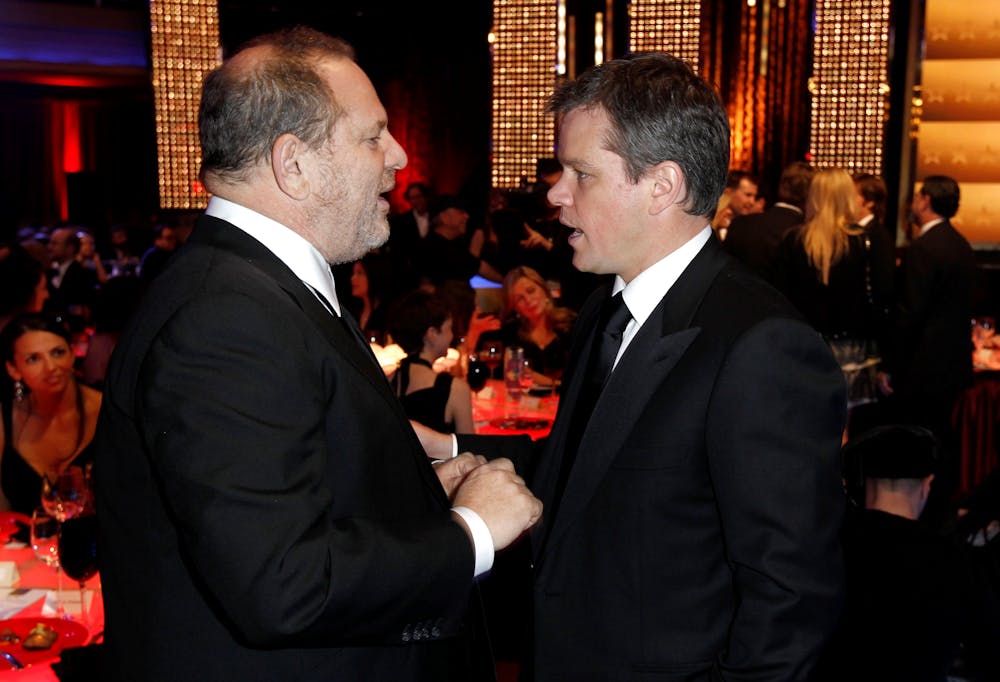
Actor Matt Damon, right, has denied reports that he helped stifle reporting that would have exposed alleged sexual harassment and abuse by movie mogul Harvey Weinstein, left, years ago. AP Photo/Matt Sayles
Researching how people respond
To understand why witnesses often don’t speak up, a colleague and I did a study in 2010 that asked participants to review hypothetical sexual harassment scenarios and indicate if they would respond.
The results seemed promising: Participants generally said they would take steps to stop harassing behavior if they saw it happen. People indicated they’d be more likely to respond if two conditions were met: It was a quid pro quo – that is, if the harasser promised benefits in exchange for sexual favors – and the workplace valued diversity and inclusion. In such cultures, there are open lines of communication, and leaders embrace diversity and inclusion.
There’s a potential problem with experiments using the kind of hypothetical scenario that we and others employed. People don’t always do what they think they will in real-life situations. For example, psychologists find that people tend to believe they’ll feel more distraught during an emotionally devastating event than they actually do when it occurs.
Other researchers find similar patterns with reactions to racists. People think they will recoil and experience distress when hearing racist comments. But when they actually hear those remarks, they don’t.
The same dynamics are at play when examining sexual harassment during job interviews, as illustrated in a study conducted by psychologists Julie Woodzicka and Marianne LaFrance.
Participants, all of whom were women, expected to feel angry, confront the harasser and refuse to answer the hypothetical interviewer’s inappropriate questions. Some of the questions, for example, included asking the job applicant if she had a boyfriend or if women should wear bras at work.
However, when they witnessed this simulated behavior during the experiment’s mock interviews, people responded differently. In fact, 68 percent of participants who only read about the incidents said they would refuse to answer questions. Yet all 50 of the participants who witnessed the staged hostile behavior answered them.
Drawing from these studies, my team conducted an experiment in 2012 to determine how harassment bystanders would react to hearing inappropriate comments about women.
Some of the female participants read about a hypothetical scenario in which harassment took place, while another group observed harassment occurring in a staged setting. We determined that the participants, who were college students, overestimated how they would respond to seeing someone else get harassed.
The reason this matters is that people who don’t feel distress are unlikely to take action.
What stops people from reacting the way they think they will?
Psychologists blame this disparity on “impact bias.” People overestimate the impact that all future events – be they weddings, funerals or even the Super Bowl – will have on them emotionally. Real life is messier than our imagined futures, with social pressures and context making a difference.
This suggests a possible solution. Since context matters, organizations can take steps to encourage bystanders to take action.
For example, they can train their staff to speak up with the Green Dot Violence Prevention Program or other approaches. The Green Dot program was originally designed to reduce problems like sexual assault and stalking by encouraging bystanders to do something. The EEOC says this “bystander intervention training might be effective in the workplace.”
Especially with workplace harassment, establishing direct and anonymous lines for reporting sexist incidents is essential. They also say employees should not fear negative reprisal or gossip when they do report harassment.
Finally, bystanders are more likely to intervene in organizations that make their refusal to tolerate harassment clear. For that to happen, leaders must assert and demonstrate their commitment to harassment-free workplaces, enforce appropriate policies and train new employees accordingly.
Until more people take a stand when they witness sexual harassment, it will continue to haunt American workplaces.
George B. Cunningham, Professor of Sport Management, Faculty Affiliate of the Women’s and Gender Studies Program, and Director, Laboratory for Diversity in Sport, Texas A&M University
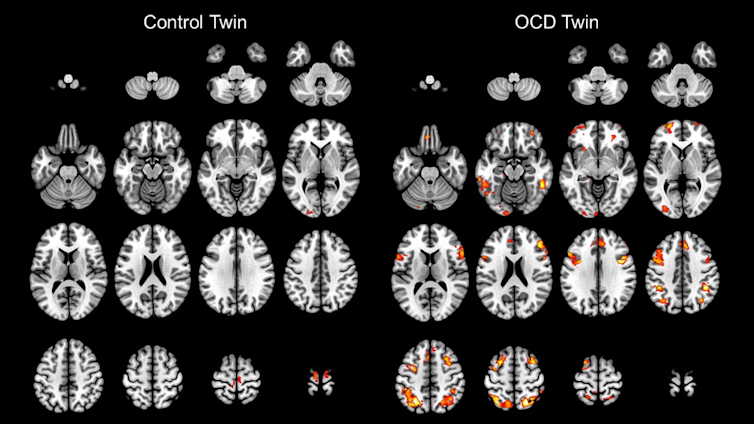
A pair of identical twins. The one on the right has OCD, while the one on the left does not. Brain Imaging Research Division, Wayne State University School of Medicine, CC BY-SA
As a psychiatrist, I find that one of the hardest parts of my job is telling parents and their children that they are not to blame for their illness.
Children with emotional and behavioral problems continue to suffer considerable stigma. Many in the medical community refer to them as “diagnostic and therapeutic orphans.” Unfortunately, for many, access to high-quality mental health care remains elusive.
An accurate diagnosis is the best way to tell whether or not someone will respond well to treatment, though that can be far more complicated than it sounds.
I have written three textbooks about using medication in children and adolescents with emotional and behavioral problems. I know that this is never a decision to take lightly.
But there’s reason for hope. While not medically able to diagnose any psychiatric condition, dramatic advances in brain imaging, genetics and other technologies are helping us objectively identify mental illness.
Knowing the signs of sadness
All of us experience occasional sadness and anxiety, but persistent problems may be a sign of a deeper issue. Ongoing issues with sleeping, eating, weight, school and pathologic self-doubt may be signs of depression, anxiety or obsessive-compulsive disorder.
Separating out normal behavior from problematic behavior can be challenging. Emotional and behavior problems can also vary with age. For example, depression in pre-adolescent children occurs equally in boys and girls. During adolescence, however, depression rates increase much more dramatically in girls than in boys.
It can be very hard for people to accept that they – or their family member – are not to blame for their mental illness. That’s partly because there are no current objective markers of psychiatric illness, making it difficult to pin down. Imagine diagnosing and treating cancer based on history alone. Inconceivable! But that is exactly what mental health professionals do every day. This can make it harder for parents and their children to accept that they don’t have control over the situation.
Fortunately, there are now excellent online tools that can help parents and their children screen for common mental health issues such as depression, anxiety, panic disorder and more.
Most important of all is making sure your child is assessed by a licensed mental health professional experienced in diagnosing and treating children. This is particularly important when medications that affect the child’s brain are being considered.
Seeing the problem
Thanks to recent developments in genetics, neuroimaging and the science of mental health, it’s becoming easier to characterize patients. New technologies may also make it easier to predict who is more likely to respond to a particular treatment or experience side effects from medication.
Our laboratory has used brain MRI studies to help unlock the underlying anatomy, chemistry and physiology underlying OCD. This repetitive, ritualistic illness – while sometimes used among laypeople to describe someone who is uptight – is actually a serious and often devastating behavioral illness that can paralyze children and their families.
Through sophisticated, high-field brain imaging techniques – such as fMRI and magnetic resonance spectroscopy – that have become available recently, we can actually measure the child brain to see malfunctioning areas.
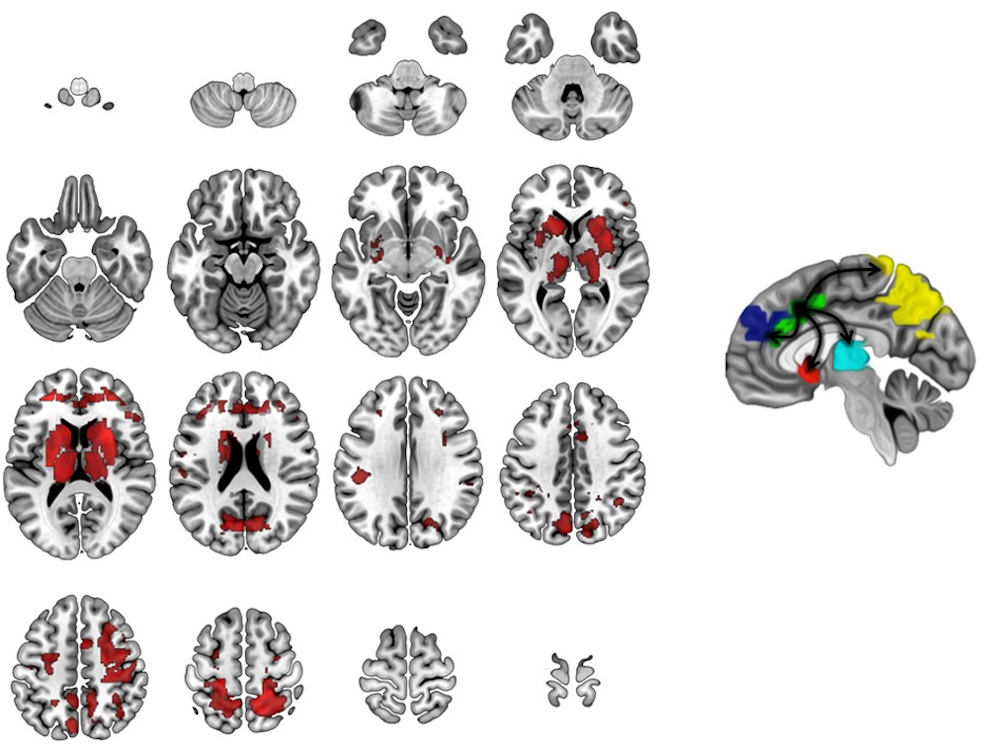
We have found, for example, that children 8 to 19 years old with OCD never get the “all clear signal” from a part of the brain called the anterior cingulate cortex. This signal is essential to feeling safe and secure. That’s why, for example, people with OCD may continue checking that the door is locked or repeatedly wash their hands. They have striking brain abnormalities that appear to normalize with effective treatment.
We have also begun a pilot study with a pair of identical twins. One has OCD and the other does not. We found brain abnormalities in the affected twin, but not in the unaffected twin. Further study is clearly warranted, but the results fit the pattern we have found in larger studies of children with OCD before and after treatment as compared to children without OCD.
Meanwhile, the field of psychiatry continues to grow. For example, new techniques may soon be able to identify children at increased genetic risk for psychiatric illnesses such as bipolar disorder and schizophrenia.
New, more sophisticated brain imaging and genetics technology actually allows doctors and scientists to see what is going on in a child’s brain and genes. For example, by using MRI, our laboratory discovered that the brain chemical glutamate, which serves as the brain’s “light switch,” plays a critical role in childhood OCD.
What a scan means
When I show families their child’s MRI brain scans, they often tell me they are relieved and reassured to “be able to see it.”
Children with mental illness continue to face enormous stigma. Often when they are hospitalized, families are frightened that others may find out. They may hesitate to let schools, employers or coaches know about a child’s mental illness. They often fear that other parents will not want to let their children spend too much time with a child who has been labeled mentally ill. Terms like “psycho” or “going mental” remain part of our everyday language.
The example I like to give is epilepsy. Epilepsy once had all the stigma that mental illness today has. In the Middle Ages, one was considered to be possessed by the devil. Then, more advanced thinking said that people with epilepsy were crazy. Who else would shake all over their body or urinate and defecate on themselves but a crazy person? Many patients with epilepsy were locked in lunatic asylums.
Then in 1924, psychiatrist Hans Berger discovered something called the electroencephalogram (EEG). This showed that epilepsy was caused by electrical abnormalities in the brain. The specific location of these abnormalities dictated not only the diagnosis but the appropriate treatment.
That is the goal of modern biological psychiatry: to unlock the mysteries of the brain’s chemistry, physiology and structure. This can help better diagnose and precisely treat childhood onset mental illness. Knowledge heals, informs and defeats ignorance and stigma every time.
The prospect of engineering the world’s climate system to tackle global warming is becoming more and more likely. This may seem like a crazy idea but I, and over 250 other scientists, policy makers and stakeholders from around the globe recently descended on Berlin to debate the promises and perils of geoengineering.
There are many touted methods of engineering the climate. Early, outlandish ideas included installing a ‘space sunshade”: a massive mirror orbiting the Earth to reflect sunlight. The ideas most in discussion now may not seem much more realistic – spraying particles into the stratosphere to reflect sunlight, or fertilising the oceans with iron to encourage algal growth and carbon dioxide sequestration through photosynthesis.
But the prospect of geoengineering has become a lot more real since the Paris Agreement. The 2015 Paris Agreement set out near universal, legally binding commitments to keep the increase in global temperature to well below 2°C above pre-industrial levels and even to aim for limiting the rise to 1.5°C. The Intergovernmental Panel on Climate Change (IPCC) has concluded that meeting these targets is possible – but nearly all of their scenarios rely on the extensive deployment of some form of geoengineering by the end of the century.
Some geoengineers take their inspiration from supervolcanic eruptions, which can lower global temperatures. patobarahona/Shutterstock.com
How to engineer the climate
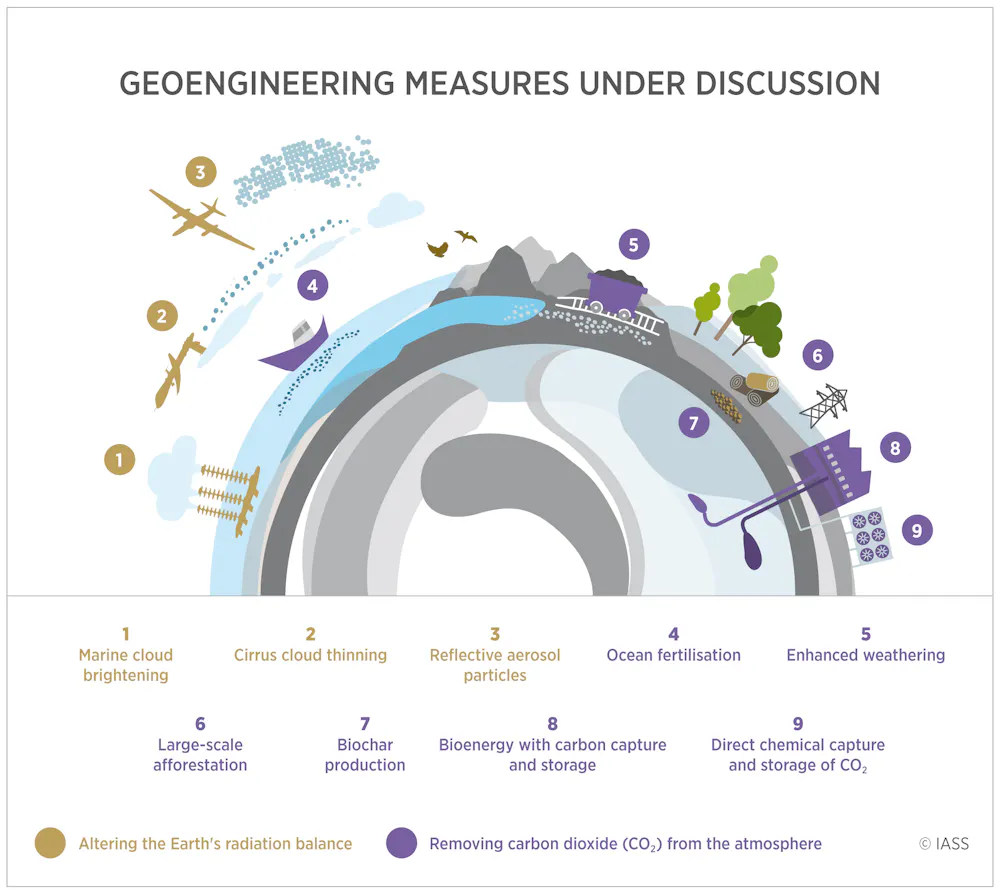
Geoengineering comes in two distinct flavours. The first is greenhouse gas removal: those ideas that would seek to remove and store carbon dioxide and other greenhouse gases from the atmosphere. The second is solar radiation management: the ideas that would seek to reflect a level of sunlight away from the Earth.
Solar radiation management is the more controversial of the two, doing nothing to address the root cause of climate change – greenhouse gas emissions – and raising a whole load of concerns about undesirable side effects, such as changes to regional weather patterns.
And then there is the so-called “termination problem”. If we ever stopped engineering the climate in this way then global temperature would abruptly bounce back to where it would have been without it. And if we had not been reducing or removing emissions at the same time, this could be a very sharp and sudden rise indeed.
Most climate models that see the ambitions of the Paris Agreement achieved assume the use of greenhouse gas removal, particularly bio-energy coupled with carbon capture and storage technology. But, as the recent conference revealed, although research in the field is steadily gaining ground, there is also a dangerous gap between its current state of the art and the achievability of the Paris Agreement on climate change.
The Paris Agreement – and its implicit dependence on greenhouse gas removal – has undoubtedly been one of the most significant developments to impact on the field of geoengineering since the last conference of its kind back in 2014. This shifted the emphasis of the conference away from the more controversial and attention-grabbing solar radiation management and towards the more mundane but policy relevant greenhouse gas removal.
Geoengineering measures. IASS
Controversial experiments
But there were moments when sunlight reflecting methods still stole the show. A centrepiece of the conference was the solar radiation management experiments campfire, where David Keith and his colleagues from the Harvard University Solar Geoengineering Research Programme laid out their experimental plans. They aim to lift an instrument package to a height of 20km using a high-altitude balloon and release a small amount of reflective particles into the atmosphere.
This would not be the first geoengineering experiment. Scientists, engineers and entrepreneurs have already begun experimenting with various ideas, several of which have attracted a great degree of public interest and controversy. A particularly notable case was one UK project, in which plans to release a small amount of water into the atmosphere at a height of 1km using a pipe tethered to a balloon were cancelled in 2013 owing to concerns over intellectual property.
Such experiments will be essential if geoengineering ideas are to ever become technically viable contributors to achieving the goals of the Paris Agreement. But it is the governance of experiments, not their technical credentials, that has always been and still remains the most contentious area of the geoengineering debate.
Critics warned that the Harvard experiment could be the first step on a “slippery slope” towards an undesirable deployment and therefore must be restrained. But advocates argued that the technology needs to be developed before we can know what it is that we are trying to govern.
The challenge for governance is not to back either one of these extremes, but rather to navigate a responsible path between them.
How to govern?
The key to defining a responsible way to govern geoengineering experiments is accounting for public interests and concerns. Would-be geoengineering experimenters, including those at Harvard, routinely try to account for these concerns by appealing to their experiments being of a small scale and a limited extent. But, as I argued in the conference, in public discussions on the scale and extent of geoengineering experiments their meaning has been subjective and always qualified by other concerns.
My colleagues and I have found that the public have at least four principal concerns about geoengineering experiments: their level of containment; uncertainty around what the outcomes would be; the reversibility of any impacts, and the intent behind them. A small scale experiment unfolding indoors might therefore be deemed unacceptable if it raised concerns about private interests, for example. On the other hand, a large scale experiment conducted outdoors could be deemed acceptable if it did not release materials into the open environment.
Under certain conditions the four dimensions could be aligned. The challenge for governance is to account for these – and likely other – dimensions of perceived controllability. This means that public involvement in the design of governance itself needs to be front and centre in the development of geoengineering experiments.
A whole range of two-way dialogue methods are available – focus groups, citizens juries, deliberative workshops and many others. And to those outside of formal involvement in such processes – read about geoengineering, talk about geoengineering. We need to start a society-wide conversation on how to govern such controversial technologies.
Public interests and concerns need to be drawn out well in advance of an experiment and the results used to meaningfully shape how we govern it. This will not only make the the experiment more legitimate, but also make it substantively better.
Make no mistake, experiments will be needed if we are to learn the worth of geoengineering ideas. But they must be done with public values at their core.
Imagine for a moment you are wrongfully convicted of a crime. You get sent to prison, where you start to serve out your sentence – every minute of every day knowing you are innocent. Then the unthinkable happens and you are released. You are elated – this is the moment you’ve been waiting for.
But those feelings of elation and happiness quickly turn to fear and despair as you realise you have nowhere to go. Your old life as you knew it is gone, you have no way of supporting yourself, your relationships have broken down and you have nowhere to turn to for support.
Sadly, this is the reality many exonerees face when they are trying to put their lives back together. Many of these people – who have in some cases spent years behind bars – find upon release that their problems are only exacerbated. Wrongfully wrenched from their families, homes and communities, they struggle to reintegrate into society when they return.
And things seem to be made worse because unlike prisoners who have access to support to help them resettle when they are released from prison, those who suffer a miscarriage of justice do not get this.
“Rightfully convicted” individuals are provided with a plan for release from prison – often starting months in advance. This involves a range of activities, all of which are aimed at helping the person to resettle back into the community. But exonerees have none of these preparations – and often receive very little notice of their release.
Victor Nealon, for example, served 16 years in prison after he was falsely charged with rape. He received three hours’ notice of his release, and ended up in a bed and breakfast on his first night as a free man – he had nowhere else to go.
An unfamiliar world
The wrongfully convicted don’t receive any preparation for their release because of the way the prison system works. Prisoners have to show they are “tackling their offending behaviour” to gain parole. But if you haven’t committed the crime in the first place, this is not possible. The end result is that a person may spend longer in prison than if they had committed the offence and admitted it.
Upon release, the wrongfully convicted are thrust into a world they are unfamiliar with – and they have zero support or guidance. It’s common for exonerees to develop PTSD as a result of their wrongful conviction, alongside other mental and physical health problems requiring significant support.
This in part happens because as soon as the conviction is quashed, these people are no one’s responsibility. They are no longer a prisoner, or an ex-offender. There is no standard programme of support which is triggered at the point of release. And while probation would be well placed to support the wrongfully convicted, they cannot as they are not ex-offenders – ex-prisoners, yes, but not ex-offenders.
Say I’m innocent
There are only two specific organisations that provide support to exonerees. They are the Citizens Advice Bureau (CAB) based at the Royal Courts of Justice, and the Miscarriages of Justice Organisation (MOJO). This was founded by Paddy Hill – one of the six men wrongly convicted of the 1974 Birmingham pub bombings. He set it up in an attempt to provide the support to others that he was not given when released in 1991.
But both services are restricted by funding and staffing limitations, and while both organisations do superb work against a backdrop of austerity measures and extremely limited resources, both are at best a piecemeal response to what is, in reality, a government responsibility.
A recent BBC documentary called Fallout highlights these issues. The the director of the documentary Mark Mcloughlin has launched the “Say I’m Innocent” campaign, and is now fighting for all the services that are available to guilty prisoners on release to be made available to exonerees. The campaign is also calling for a public announcement of a person’s innocence upon their release. As well as other measure including a transition centre in both the UK and Ireland to allow them time and help to reintegrate into society.
This is important because the key issue here is responsibility. The state assumed responsibility for these individuals when they were wrongfully convicted. It is therefore only right that the state continues to take responsibility for them once exonerated.




 Because we have been taught that something – whatever it is – is bad. If you let go of the idea that something is good or bad, you may feel a weight lift from your shoulders.


 A pattern is starting to emerge. The British government does not display a lot of respect for the law.


 Until more people take a stand when they witness sexual harassment, it will continue to haunt American workplaces.
 That is the goal of modern biological psychiatry: to unlock the mysteries of the brain’s chemistry, physiology and structure. This can help better diagnose and precisely treat childhood onset mental illness. Knowledge heals, informs and defeats ignorance and stigma every time.


 Make no mistake, experiments will be needed if we are to learn the worth of geoengineering ideas. But they must be done with public values at their core.
 This is important because the key issue here is responsibility. The state assumed responsibility for these individuals when they were wrongfully convicted. It is therefore only right that the state continues to take responsibility for them once exonerated.