Tiny high-tech backpacks for rats who are trained to find those survivors:
https://edition.cnn.com/2022/10/24/world/search-and-rescue-rats-apopo-hnk-spc-intl/index.html

Tiny high-tech backpacks for rats who are trained to find those survivors:
https://edition.cnn.com/2022/10/24/world/search-and-rescue-rats-apopo-hnk-spc-intl/index.html
While I have said a few times that people cannot change their brain structure on command, which is why it is immensely short-sighted of clinical psychologists and other health professionals to rant and rave about people who have for example a narcissistic personality disorder, I have also mentioned that I hope that new therapies will become available to support people with such brain structures. I’ve dropped the word neurofeedback as a suggestion for an avenue to explore within this context.
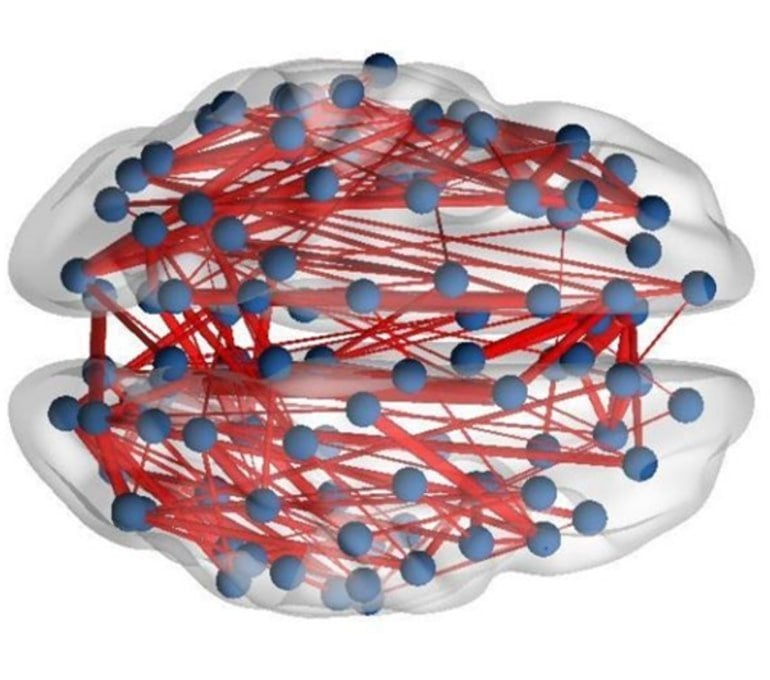
This morning, I read that the brain structure and connectivity of clinically depressed people changes within six weeks under the right treatment.
MARSI stands for “medical adhesive-related skin injuries”. They usually look very ugly, can take a long time to heal and can get infected. They are overlooked and often preventable. They can affect anyone.
Ripping a band-aid off means that a much larger force is exerted on the skin than necessary. It can cause detachment of one or more skin layers and thus can also cause tears in the skin.
In addition, many people are allergic to the adhesives used in plasters and such sensitivities can suddenly become much worse. This can effectively cause a chemical burn injury.
Teach your children to be gentle and you’ll benefit a large number of people, in many more ways than you will hold possible.
For medical professionals, there is a “best practice consensus document on prevention”:

In my Dutch news app this morning: https://nos.nl/artikel/2448414-13-jaar-cel-voor-nederlander-die-canadese-tiener-amanda-todd-afperste
Aydin Coban had already been sentenced by a Dutch court to 10 years and 8 months in prison for crimes he committed against dozens of different girls and a few men. The Amanda Todd case was not included in the Dutch proceedings because Canada wanted to prosecute him on its own.
When he’s completed his sentence in the Netherlands, he will be sent back to Canada to be jailed there.
Amanda Todd was a young teenager who was hounded by Coban and who eventually killed herself to get away from him because he (and others around her) had made living impossible for her.
Do NOT dare to call this a mental health issue (in the sense of blaming it on the victim). Mental health issues can be the result, but they are no excuse for abuse.
This kind of abuse usually simply makes it impossible to live for PRACTICAL reasons alone. Any kind of harassment involving a victim’s suicide still tends to be partly blamed on the victim. And that’s part of the problem.
Want an example? If bullies throw a poor child’s books or notes into a pond, how is he supposed to complete his homework? A child cannot simply relocate to the other side of a country to get away from bullies and start over fresh under a new name.
It may also be helpful to keep in mind that young people’s brains are still developing to some degree, and that neural pathways become reinforced in response to what is happening around you if those experiences are repetitive (prolonged).
See my previous two posts too, about the line that you cross when “humor” becomes abuse and you don’t realize it. This is exactly what I mean. I hope that to most all of you, it is clear that there was nothing funny or hilarious about why this Canadian teen ended her life.
There are copies of two newspaper articles on the inside of my clothes closet door. Both concern two young men who were set on fire at work in England. One in Bristol and the other one in Reading. One of them was abused so badly that he decided to take his life and even after his death was still being blamed for the atrocities at his place of work. Because he took his life.
His colleagues and superiors thought that what they were engaging in was “humor”. They saw nothing wrong with it. His line manager stated openly that no line was crossed when the young man was set on fire; he had been present when it happened.
The other young man ended up in hospital with burns and developed PTSD. Because he did not kill himself, he was not blamed for what happened.
With regard to cases like Amanda Todd’s… most police officers are totally clueless. They’re so out of touch with the online world and with IT aspects, it’s beyond belief. They may proudly tell you that they record interviews on tape so that what’s on it can’t be tampered with, that all anyone can do to it is wipe everything that’s on it. That’s usually the full extent of their IT knowledge. They can actually be informed “I have access to this woman’s computer equipment” and manage to miss it completely. They expect folks like Aydin Coban to communicate under their own names, from their own e-mail addresses and have fixed, identifiable IP addresses, too. When you’re an Amanda Todd, of any age, you’re on your own.
If you wouldn’t want to do the same thing to Boris Johnson or David Cameron or Keir Starmer or Jeremy Corbyn or Vince Cable or Ed Davey, then it’s likely to be otherisation and cruelty. Abuse.
Because it likely indicates that you fear what would happen if you did. If you do something “funny” only to people who you perceive as having less power than yourself, then it’s almost always abuse. Asking yourself if you’d be willing to do the exact same thing to any of the above-mentioned top politicians can help clarify that.
See my previous post about what happened to former nurse Mrs Ann King at Reigate Grange. It wasn’t funny at all, but the people who did it to her seemed to think that it was.
Older adults are demonized in the UK, multiple studies have shown. That’s the over-45s, roughly, certainly when it concerns women.
It also can lead to horrific abuse. These Guardian pages below contain video content that will leave you shaken. The family of this 88-year-old former nurse was shelling out £100,000 a year for her “care” in this “luxury” home. (The money came from the woman’s savings. She was paying for her own abuse.)
Among other things, the rag with which the toilet was cleaned was often – eh, how shall I put this – draped across her face, almost. Someone else can be seen shaking her bed just to pester her while another person says “it’s a wave”. Mrs King has dementia; they’re making fun of her. It’s vile.
I’ve reported this facility to Google as permanently closed. No matter what its management says, cruelty from multiple people can only occur when it’s condoned, whether passively or actively, by the people around them.
https://www.theguardian.com/society/2022/oct/13/ann-king-video-abuse-reigate-grange-care-home-surrey

I am not interested in picking up crumbs of compassion thrown from the table of someone who considers himself my master. I want the full menu of rights.
– Desmond Tutu

I talked about some of this stuff in my most recent book. By the way, somehow the most recent version of that book got lost. It currently makes two people clearly identifiable; I didn’t want that because that was not the purpose of my book at all. I specifically amended the most recent version for that reason and then uploaded it. I don’t know where it’s gone.
Here are the references. They tell their own story.
Alston, Philip (2018) “Statement on Visit to the United Kingdom, by Professor Philip Alston, United Nations Special Rapporteur on extreme poverty and human rights.” https://www.ohchr.org/Documents/Issues/Poverty/EOM_GB_16Nov20 18.pdf
Alston, Philip (2019) “Visit to the United Kingdom of Great Britain and Northern Ireland. Report of the Special Rapporteur on extreme poverty and human rights.” United Nations, General Assembly. A/HRC/41/39/Add.1 https://undocs.org/pdf?symbol=en/A/HRC/41/39/Add.1
BBC (2007) “Red-haired family forced to move” BBC News. https://news.bbc.co.uk/1/hi/england/tyne/6714735.stm
BBC (2007) “Man ‘died at hands of young mob’” BBC News. http://news.bbc.co.uk/1/hi/england/london/6923987.stm
BBC (2007) “Boys sentenced for stoning death” BBC News. http://news.bbc.co.uk/1/hi/england/london/7052267.stm
BBC (2021) “Plymouth shooting: Jake Davison was licensed gun holder” BBC News. https://www.bbc.co.uk/news/uk-england-devon-58197414
Beaney, Abigail (2022) “The life of Sylvia Lancaster after the murder of her daughter Sophie” Lancashire Telegraph. https://www.lancashiretelegraph.co.uk/news/20076099.life-sylvia-lancaster-murder-daughter-sophie/
Bregman, Rutger (2017) “Poverty isn’t a lack of character; it’s a lack of cash.” TED. https://www.ted.com/talks/rutger_bregman_poverty_isn_t_a_lack_of_ch aracter_it_s_a_lack_of_cash
Broderick, Ryan (2014) “Activists Are Outing Hundreds Of Twitter Users Believed To Be 4chan Trolls Posing As Feminists” Buzzfeed News. https://www.buzzfeednews.com/article/ryanhatesthis/your-slip-is-showing-4chan-trolls-operation-lollipop
CIPD (2022) Bullying and harassment at work. Chartered Institute of Personnel and Development. https://www.cipd.co.uk/
Coleman, Gabriella (2014) “Hacker, Hoaxer, Whistleblower, Spy: The Many Faces of Anonymous” Verso. ISBN: 13: 9781781685839
Daynes, Kerry (2019) “The dark side of the mind: True stories from my life as a forensic psychologist” Octopus Publishing Group. ISBN: 9781788402170
Daynes, Kerry (2021) “What lies buried: A forensic psychologist’s true stories of madness, the bad and the misunderstood” Octopus Publishing Group. ISBN: 9781913068578
Elamroussi, Aya, Moshtaghian, Artemis, and Frehse, Rob (2022) “Buffalo suspect’s posts about attack plans could be seen online 30 minutes before mass shooting” CNN. https://edition.cnn.com/2022/05/18/us/buffalo-supermarket-shooting-wednesday/index.html
Evans, Jules (2013) “Being a Stoic saved me from the curse of the British stiff upper lip” https://www.theguardian.com/commentisfree/2013/jan/30/stoic-stiff-upper-lip-feelings
Eve, Carl (2022) “Plymouth shooting: Families meet with Security Minister over online incel culture fears” Plymouth Herald. https://www.plymouthherald.co.uk/news/plymouth-news/plymouth-shooting-families-meet-security-7088898
Feldman Barrett, Lisa (2020) “Seven and a half lessons about the brain” Picador. ISBN: 9781529018622
Gamergate: https://en.m.wikipedia.org/wiki/Gamergate_(harassment_campaign)
Godin, Seth (2018) This is marketing. You can’t be seen until you learn to see. Penguin. ISBN: 9780241370148
Gonzalez, Oscar (2019) “8chan, 8kun, 4chan, Endchan: What you need to know” CNET. https://www.cnet.com/news/politics/8chan-8kun-4chan-endchan-what-you-need-to-know-internet-forums/
Griffin, Andrew (2021) “What is QAnon? The origins of bizarre conspiracy theory spreading online” The Independent. https://www.independent.co.uk/tech/what-is-qanon-b1790868.html
Halliday, Josh and Arthur, Charles (2010) “WikiLeaks: Who are the hackers behind Operation Payback?” The Guardian. https://www.theguardian.com/media/2010/dec/08/anonymous-4chan-wikileaks-mastercard-paypal
Hill, Amelia (2019) “Older people widely demonised in UK, ageism report finds” The Guardian. https://www.theguardian.com/society/2020/mar/19/older-people-widely-demonised-uk-ageism-report
Huffington Post (2012) “England Riots: One In Four Young People Believe Last Summer’s Disorder Could Happen Again.” https://www.huffingtonpost.co.uk/2012/08/02/england-riots-one-in-four-believe-london-riots-tottenham-summer-riots-happen-again-disorder_n_1733418.html
Jamieson, Alastair (2020) “Police warn of homophobic 4chan cyber attack on LGBT+ Pride month celebrations” The Independent. https://www.independent.co.uk/news/uk/crime/pride-month-4chan-cyber-attack-homophobia-lgbt-a9547456.html
Jones, Owen (2022) “Why homophobia against straight men matters” The Guardian. https://www.theguardian.com/commentisfree/2022/may/17/homophobia-against-straight-men-lgbtq
Kent, Lauren & Ritchie, Hannah (2021) “Plymouth shooter made misogynist remarks echoing the ‘incel’ ideology.” CNN. https://edition.cnn.com/2021/08/14/uk/plymouth-shooting-incel-jake-davison-profile-intl/index.html
Kew Law Kew Law (2020) See: https://www.kewlaw.co.uk/our-services/employment-law/ and https://www.fenews.co.uk/skills/over-a-third-of-employees-in-the-uk-have-been-bullied-at-work-in-the-last-3-years/
Lanier, Heather (2017) ‘”Good” and “bad” are incomplete stories we tell ourselves.’ https://www.ted.com/talks/heather_lanier_good_and_bad_are_incomple te_stories_we_tell_ourselves
Leatherdale, Duncan (2022) “Jack Woodley: Why was the 18-year-old killed?” BBC News. https://www.bbc.co.uk/news/uk-england-tyne-60834187
Lewis, Richard D. (2000) “When cultures collide. Managing successfully across cultures.” Revised first edition. Nicholas Brealy Publishing. ISBN: 1857880870
Ling, Justin (2022) “’Cheering section’ for violence: the attacks that show 4chan is still a threat” The Guardian. https://www.theguardian.com/technology/2022/may/01/4chan-extremist-online-forum-raymond-spencer
Lloyd-Roberts, Sue (2017) “The war on women. And the brave ones who fight back.” Simon & Schuster. ISBN: 9781471153921
Lumby, Tommy and McMenemy, Rachael (2018) “‘Vulnerable’ woman attacked with flour and eggs speaks out” Cambridge News. https://www.cambridge-news.co.uk/news/local-news/vulnerable-woman-attacked-flour-eggs-14973146
Manjoo, Rashida (2015) “Report of the Special Rapporteur on violence against women, its causes and consequences, Addendum. Mission to the United Kingdom of Great Britain and Northern Ireland” United Nations, General Assembly. A/HRC/29/27/Add.2. https://www.ohchr.org/EN/HRBodies/HRC/RegularSessions/Session2 9/Documents/A_HRC_29_27_Add_2_en.doc
Mann, Tanveer (2018) “Boys who ‘attacked disabled woman with flour get police protection’” Metro News. https://metro.co.uk/2018/07/31/boys-attacked-disabled-woman-flour-get-police-protection-7779513/
Marsh, Abigail (2016) “Why some people are more altruistic than others.” TED. https://www.ted.com/talks/abigail_marsh_why_some_people_are_more_altruistic_than_others/
Moss, Dawn (2018) “Kate Pickett and Richard Wilkinson: ’Inequality strikes at our health and happiness’” The Guardian. https://www.theguardian.com/inequality/2018/sep/18/kate-pickett-richard-wilkinson-mental-wellbeing-inequality-the-spirit-level
New Zealand shootings: https://en.wikipedia.org/wiki/Christchurch_mosque_shootings#Al_Noor_Mosque
PA News Agency (2020) “Incels believe women owe them sex, experts tells terrorism trial” The National. https://www.thenational.scot/news/uk-news/18935470.incels-believe-women-owe-sex-experts-tells-terrorism-trial/
Piff, Paul (2013) “Does money make you mean?” TED. http://www.ted.com/talks/paul_piff_does_money_make_you_mean
Pizzagate: https://en.wikipedia.org/wiki/Pizzagate_conspiracy_theory
Potter, Tom (2018) “‘Flour bombing’ teen sentenced for ‘nasty attack’ on woman” East Anglian Daily Times. https://www.eadt.co.uk/news/cohan-semple-court-flour-eggs-howard-estate-social-media-1-5806320
Press TV Documentaries (2015) “Murder in Bristol (The Tragic Case of Bijan Ebrahimi’s Murder)” Press TV. https://vimeo.com/149993525
Quinn, Ben (2022) “Glorification of Plymouth shooter by ‘incels’ prompts calls for action.” https://www.theguardian.com/uk-news/2022/jan/03/glorification-plymouth-shooter-incels-prompts-calls-for-action
Reynolds, Emily (2020) “We’re less likely to spread alarming information while experiencing physiological stress” The British Psychological Society. https://digest.bps.org.uk/2020/05/26/were-less-likely-to-spread-alarming-information-while-experiencing-physiological-stress
Samuelson, Kate (2016) “What to Know About Pizzagate, the Fake News Story With Real Consequences” Time. https://time.com/4590255/pizzagate-fake-news-what-to-know/
Saxe, Rebecca (2019) “The neuroscience of hate” Talk given at Harvard Law School’s Petrie Flom Center for Health Law Policy, Biotechnology, and Bioethics. https://vimeo.com/333105887
Serani, Deborah (2018) “Bullycide When a bullied child dies by suicide” Psychology Today. https://www.psychologytoday.com/gb/blog/two-takes-depression/201806/bullycide
Solomon, Andrew (2013) “Love, no matter what” TED. https://www.ted.com/talks/andrew_solomon_love_no_matter_what
Slack, Paul (2018) “Businessman ruined after false online claims of paedophilia” Sunday Times. https://www.thetimes.co.uk/article/businessman-ruined-after-false-online-claims-of-paedophilia-dnkddg93x
Snider, Mike (2017) “Steve Bannon learned to harness troll army from ‘World of Warcraft’” USA Today. https://eu.usatoday.com/story/tech/talkingtech/2017/07/18/steve-bannon-learned-harness-troll-army-world-warcraft/489713001/
Statistics New Zealand (2019) “One in 10 workers feels discriminated against, harassed, or bullied at work” https://www.stats.govt.nz/news/one-in-10-workers-feels-discriminated-against-harassed-or-bullied-at-work
Taylor, Kathleen (2009) “Cruelty. Human evil and the human brain” Oxford University Press. ISBN: 9780199552627
Thorleifsson, Cathrine (2021) “From cyberfascism to terrorism: On 4chan/pol/ culture and the transnational production of memetic violence” Nations and Nationalism. 2021;1–16. https://doi.org/10.1111/nana.12780
TUC (2019) “Bullying at work” Trades Union Congress. https://www.tuc.org.uk/resource/bullying-work
Veritas (2022) “Who are stalkers?” Veritas stalking advocacy service. https://veritas-justice.co.uk/who-are-stalkers/
Wainwright, Martin (2008) “Woman died after drunken gang attacked couple dressed as goths”. The Guardian. https://www.theguardian.com/uk/2008/mar/13/ukcrime
(See also https://en.wikipedia.org/wiki/Murder_of_Sophie_Lancaster)
Wilkinson, Richard (2011) “How economic inequality harms societies” TED. http://www.ted.com/talks/richard_wilkinson
Wilkinson, Richard and Pickett, Kate (2010) “The spirit level: Why Equality is Better for Everyone”. ISBN: 9780241954294
Wilkinson, Richard and Pickett, Kate (2018) “The inner level: How More Equal Societies Reduce Stress, Restore Sanity and Improve Everyone’s Well-being”. ISBN: 978-1846147418
Woolf, Nicky (2016) “The ‘alt-right’ thrives in opposition. What happens now it’s the establishment?” The Guardian. https://www.theguardian.com/us-news/2016/nov/15/alt-right-victory-donald-trump-mainstream-what-next
Yeo, Amanda (2019) “8chan returns with a new name and a reminder not to do illegal stuff” Mashable. https://mashable.com/article/8chan-8kun-rebrand-return
Younge, Gary (2017) “’It was pure racism’: the family of Bijan Ebrahimi on their fight for answers” The Guardian. https://www.theguardian.com/world/2017/jul/05/it-was-pure-racism-the-family-of-bijan-ebrahimi-on-their-fight-for-answers
A message in my inbox today:
| The question I am asked most as Mayor is: “What are you doing to tackle violent crime in London?” It’s something I’ve thought about and grappled with every day since I was first elected. I know you know this, but violent crime doesn’t happen in a vacuum. It’s often a by-product of deprivation, social alienation, increasing inequality and government cuts to public services including youth activities. Where the Government is failing to step up, City Hall is taking action. Today I’m pleased to announce that my Violence Reduction Unit has invested £5 million to help support London Boroughs in delivering prevention and early intervention programmes to drive down violence during the summer holidays. Young people need opportunities to build community and succeed. That’s why we’re also investing £1 million into a sports programme to deliver activities for young Londoners in neighbourhoods affected by violence. We’re also supporting the Local Village Network app: it’s free to download and provides young people aged 14-24 with more than 2,500 opportunities and activities to get involved in across London. |
| Tackling violence is my top priority, and I’m determined to do everything I can to ensure we do not see a rise in incidents over the summer months. I will continue to be tough on crime by supporting the police in removing dangerous weapons, tackling drugs and gangs, supporting communities through neighbourhood policing, and bearing down on the complex causes of violence. We cannot neglect our young people and then expect them to thrive. This investment will help make London fairer and safer for everyone. Best wishes, Mayor of London, Sadiq Khan |
(enjoy)
CNN’s national security analyst Peter Bergen just wrote that attacks such as the one in Buffalo can be prevented. Yes, they can. Not always, but often.
However, this requires a lot more than the six steps Peter Bergen offers in his article. Bergen is not only CNN’s national security analyst, a vice president at New America (a think tank) and a professor of practice at Arizona State University.
What is a professor of practice?
Bergen begins by making a terrible mistake by calling this “a very American tale of domestic terrorism”, ignoring victims of similar attacks all over the world. A dreadful shooting in New Zealand, a horrible attack in Norway and a recent tragic incident in Plymouth in England come to mind as first examples. Also in Asia and Africa there have been many of these incidents, but they likely come about differently, though I can’t be sure of that.
First, “let’s stop naming the terrorists,” Peter Bergen continues. He writes that “these misguided individuals are typically zeros trying to be heroes”. Not only is this a useless suggestion because even if journalists were to refrain from naming these people, many more others still do and they would do so even more to counter that silence. Crucially, however, Bergen completely misses that this – feeling like zeros – is often exactly what is at the root of these incidents. I find it hard to believe that he completely overlooks the significance of what he is saying.
A great deal of this violence stems from the fact that so many youngsters – and not just youngsters – feel that their lives have no significance and are overwhelmed by feelings of hopelessness and powerlessness, not to mention sheer boredom.
Second, Bergen mentions social media, and argues for the removal of content that encourages violence. This overlooks that this kind of content does not only pop up on regular social media, but still more often in the dark nooks and crannies of the internet. This also overlooks that if you ban content, you may merely be pushing it underground where it can’t be monitored. He does not even mention 4chan. That said, I agree that it is important to police fake news and fake science as any otherizing language lowers the threshold toward violence, neuroscience teaches us.
After the 2011 riots in England, some of the participants indicated that boredom had been an important driver and that merely providing access to sports facilities can help prevent such escalations.
Leaders who want to learn about how big a role boredom plays should watch the video about the “Philmarillion”, a person who for months documented every move and twitch of a particular online user based in England. This person created an entire world made up of the posts of said user, and even engaged in performance art to simulate that said user was living with him.
We should be grateful that the Philmarillion was artistically inclined.
Can you see what boredom can do to others, who have nowhere else to be and to go and no outlet for whatever ails them?
As a third step towards preventing shootings like the one in Buffalo, Peter Bergen mentions the discipline of threat management. He explains that suspects often follow a predictable path to violence, but that still does not identify them to us and does not enable us to interfere. The article does mention that the FBI has recently doubled the number of people who work on domestic terrorism and extremism, but that reflects the developments rather than predates them.
As a fourth step, Bergen mentions that “officials” need a better understanding of the concept of “leakage,” that peers usually have “the most useful information about attack planning, but were the least likely to come forward with relevant information to law enforcement”.
He then makes the following nonsensical statement:

How do you investigate a “potential act of terrorism”? Because that’s like potentially winning the lottery. You can’t investigate something that does not exist or has not happened. I think what he means is that if school officials etc are concerned about a student, law enforcement should talk with the student’s friends and take them seriously.
As the fifth step, he mentions an American policy that sounds like the UK counterpart called “Prevent”. Logos of pro-cycling and pro-wildlife activists are examples of what UK school teachers need to be on the lookout for and report. If the US policy is anything like Prevent, all we end up with is more distrust in society instead of less.
As sixth and final step, Bergen kicks against an open door by stating that kids like this shooter should never have been able to purchase his weaponry. That is certainly true, but the Plymouth shooter – in England, where guns are not a birthright, unlike in the US – not only had a shotgun, it had been confiscated yet returned to him shortly before the incident.
There currently seems to be a large number of mostly young white males out there who feel indeed, as Peter Bergen puts it, like zeros. They often feel disenfranchised, whether it is about their perceived right to have sex with any woman or another issue, but something happens right before this starts to fester and they go online, looking for echo chambers in which they finally feel heard and understood.
Guys like Payton Gendron are not that different from guys like Jake Davison.
They need people to blame, to direct their powerlessness at, whether it is non-whites in general or a particular group of people in particular, or Jews or women or immigrants.
(Women too are sometimes part of these movements, though.)
The question to ask is:
The problem is that they’re still too young to monitor themselves, recognize what is happening to them, stop themselves in time and turn away, surround themselves with positivity instead. Echo chambers come in all kinds.
Apparently, it was particularly types like Bannon and Trump who have very deliberately been targeting these dark places on the internet, who whip up this hate, to make people feel that something has been taken from them that should be theirs and that it’s the Trumps of the world who will get it back for them. Divide people, promise to defend them against the “enemy” and get their votes.
They certainly should be monitored for otherizing language and be called out on it, be made aware of how dangerous that is, if they don’t know that yet.
Where are things going wrong for these youngsters, people like Payton Gendron? At what age does this start? Around 10 or 12 or perhaps even earlier? They are often still as young as 14 when they end up on these forums where they become radicalized. What exactly is it that goes wrong in their lives?
(It certainly does not match Tony Blair’s old theories about “hooligans” and graffiti artists. Payton Gendron’s parents are two happy-looking civil engineers.)
WHY do these kids feel like fat zeros?
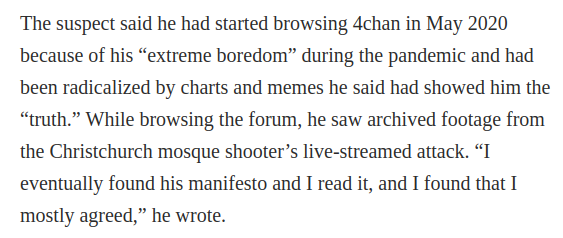
Payton Gendron had just started college. The pandemic probably cut it short. He went to 4chan because he was bored. Could it really be only boredom that drives young people to these places of hate?? Boredom does make angry. Boredom does lead to a buildup of energy.
What was Payton Gendron like before he started hanging out on 4chan?
I wrote a bundle of poems and flash fiction about my own stalking experience. One is titled “Tentacles of cling film”. The last few words are a word play on “You’re stone-deaf, tone-deaf”. I called the bundle “Crunchy Peanuts”. You can find it on Amazon.
(September 2011)
I am so angry.
So very very angry.
So so angry
I carry out boxing exercises,
imagine beating your face,
breaking your nose.
Teaching someone – me – how to be afraid
afraid – afraid – afraid
is not a nice thing to do.
You wrapped your cling film tentacles
around my throat,
around the throat of my life.
You robbed me
of all my air,
of all my oxygen.
And I hate you
hate you – hate you – hate you –
hate that.
My anger
has nowhere
to go.
It punches air.
It flows into fairy tales.
I am powerless.
Because I am
nothing but a woman
and that, they say, means I don’t count.
My head pounds
and my fists fly
against the air
You sucked from my lungs,
you sucked from my days,
you sucked from my future.
Now I feel better
because voicing my anger
any way
is better
than the silence
wrapped within your cling film.
Your butt crack
is not
my punch line.
It’s yours,
and yours
alone.
You.
Took Joy
and killed her.
You killed her,
killed her killed her
killed her dead.
Still I wish
I wish I wish you
well.
Though your
stone tone
death.
Walking back from Lidl, I run into two young people who are screaming their heads off at a family in a car. This is at this notorious spot next to Ma’s in Kingston Road, where you need X-ray vision to be able to turn into the road.
They have a child in a buggy. They walk on, leaving an utterly flabbergasted family behind. “Fucking hell.” the guy says calmly, clearly stunned. Ethnic minorities, by the looks of it, but clearly English. “Just laugh about it.” I tell them.
To my frustration, the young female goes after the car again a few minutes later, and then the male runs after the car. Probably as high as a kite on meth?
I’m not having it.
Worried that he will pull the driver out of the car in busy traffic, I decide to interfere and yell very loudly “Don’t be ridiculous!” and “Hey! Stop it!”
The female turns and runs towards me and I had just spotted that that had distracted the dude before she starts shouting into my face from a distance of about five centimetres.
Good. Because I thought she was going to hit me and I am not feeling well so I can’t run away.
“Nobody tells me in my own country what to do!” Some stuff follows about her child, which she has just abandoned in its pram on the pavement at least twice, with no adult looking after it. “Go back to where you came from!”
“I’m from Amsterdam!” I yell as she walks away again.
“Go back then!”
I retort “I would love to but you won’t let me. You won’t let me!”
I say sorry to a woman who’s walking by, clearly not happy with this kind of thing that you run into all the time when you live here instead of in Gerald Vernon-Jackson’s pretty little street. She smiles at me. A genuine smile.
I pass the young woman and her child at a bus stop later. I sensed that she was aware of me approaching and I sense that she is not keen on another confrontation. I walk by without paying any attention.
The guy had disappeared somewhere between Ma’s and the bus stop.
I’m exhausted. But I think I achieved my goal.
I was actually feeling really unwell and wouldn’t have been able to run away if either of the duo had decided to attack me.
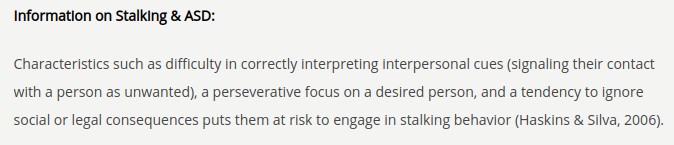
https://ibcces.org/blog/2017/04/26/stalking/
IBCCES, that’s the International Board of Credentialing and Continuing Education Standards. There are people who mediate in courts, who serve as advocates for autistic people. IBCCES can provide training (and a certificate) to that end.
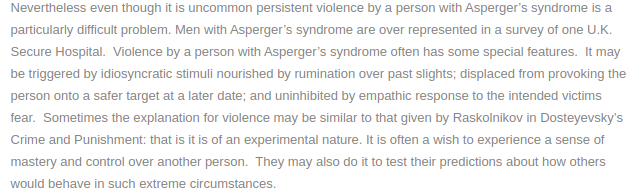
https://stalkingdetective.wordpress.com/2014/01/29/stalkers-with-aspergers-syndrome/
This is a former police officer’s website.
That’s him: https://en.wikipedia.org/wiki/Michael_Fitzgerald_(psychiatrist)
People with Asperger’s do not necessarily want to be rigid and controlling, but they can have trouble with what we call “boundaries” in the west. They can infringe upon other people’s “territories” and do various other things without realizing how intensely that may affect that other person.
Similarly, they may not see other people as individuals in their own right. I suspect that their egos can be so fluid that they sometimes perceive other people as not really separate from themselves. They “feel” other people’s presence rather than see them as beings with physical boundaries and they often don’t attach much significance to what a person looks like. (This may also be why autistic people, if they engage in stalking behaviors, take photos. They may not recognize a person if that person changes her hairstyle or hair color, so I understand.)
They certainly see other people differently than neurotypicals do and while they may not really “like” other people, they do like having a certain presence around, like having the presence of another soul in their vicinity. They like a certain feeling rather than a certain person, maybe.
All of these things can create tension and clashes very early on and may eventually build up into a lot of resentment (feel slighted when they get rebuffed because they don’t understand what on earth they are supposed to have done wrong). That’s the impression or feeling I have come away with while thinking about this.
For decades, I turned out to have known a woman who is somewhat autistic without me having a clue about this. She’s confirmed that she is autistic. I’ve since done a lot of thinking.
It’s often said that autistic people avoid looking you in the eye. It’s my impression that that’s often not true. What autistic people don’t do is “rules” as to what an appropriate period is to look at someone’s face. They don’t do societal “rules and customs” to a large degree because they do not necessarily attach judgments to all sorts of things, unlike the rest of us. They can teach themselves a heck of a lot, though, just like the rest of us can learn, and we call can learn for example a foreign language, and hence you may have no clue that someone is autistic. There is no stereotypical property, not even a sign on the forehead.
https://kennethrobersonphd.com/eight-tips-handling-anger-someone-aspergers/
https://www.autism.org.uk/advice-and-guidance/what-is-autism/asperger-syndrome
Two posts ago, I included an ITV program in which “Eamonn and Ruth” talked about the topic with two experts.
Now I see that there also was a BBC documentary a few years ago.

Holy crap, that is seriously creepy.
That said, yes, England is deeply misogynistic and many boys get fed a hatred for women at a very young age, before they’re able to form independent opinions. When boys under the age of 10 or 12 yell “Suck my dick!” at women the age of their grandmothers and grab their penis at the same time, you know that they learned this from someone else.
Below is the link to the BBC documentary (requires a TV licence, so it will cost you £159 to watch this legally, unless, lol, you want to watch it in black and white).
https://www.bbc.co.uk/iplayer/episode/p07fvhmw/inside-the-secret-world-of-incels
This podcast video does not require a TV licence:
The problem with these guys is not that women are horrible or that these men are not physically attractive or that that they are “genetically inferior” as many of them seem to believe.
It’s the negative views they hold of themselves. It’s also often their negativity in general.
It could well be that quite a few of these guys have Asperger’s, I thought, but I found it very tricky to say something like that, off the cuff, because of the risk of perpetuating existing stigmas or creating new ones.
However, one of the people interviewed in the BBC documentary mentions “Asperger’s” himself.
Why do these people feel that random women who they’ve never met or interacted with have caused their lives to be so miserable that they feel that they need to take revenge out on these women? It makes no sense.
I share some of those experiences Laura talks about.
https://www.theguardian.com/lifeandstyle/2020/aug/27/laura-bates-on-the-men-who-hate-women-idolise-murderers

This evening, I was suddenly reminded of what my life was like a long time ago, in the early 1980s, when I was working in tourism and hospitality in Amsterdam. I wasn’t making tons of money but I sure was making a lot more than what one third of England’s population needs to get by on, for whom life is mostly a cruel punishment for having been born. But that’s beside the point. Or is it? We’ll see.
I wore Cool Cat jogging pants from Fiorucci in the Kalverstraat and got to enjoy tons of music and dance performances as well as modern art exhibitions.
If you work in tourism and hospitality, you work shifts.
One of the best things in my life, one of my nicest memories, but I have plenty more, was to stop by at a particular “avondwinkel” on my way back home, often exhausted. It was really wonderful to stop by there on your last evening shift – get out of the tram or bus and then hop back on again or, hey, walk home if it was after midnight after I had moved from the “Gooi” to “De Pijp” – and take some goodies with you to enjoy when you got home. Utter bliss! That stuff was so good. It made you feel that it was really really GOOD to be ALIVE.
It was called Heuft, I think, just around the corner from the Vrijheidslaan. In the Rijnstraat.
That kind of experience, that’s something that, I reckon, 90% of Brits have never had and will never have.
I can’t put this into words well enough so that you’d understand.
Heuft still exists, but I know it isn’t what it used to be. I know because I stopped by again, also quite a long time ago by now, and even then, it no longer was what it used to be. These days… it makes me weep… it seems to sell burgers and French fries. Okay, they’re home-made. But… oh man, you guys who go there now have no idea what the place used to be like, in spite of the fact that it still sells champagne.
If you’re from Portsmouth and want at least some idea of what I may be talking about, consider that little precious treasure we lost when Le Café Parisien (Lord Montgomery Way) closed. It served very different foods but what they served was delicious and the ambience superb. Le Café Parisien was one of the reasons why I moved to Portsmouth. There is nothing else like it, not in Portsmouth, not in Southampton. If you’re from Portsmouth, and you’ve never sat down there and ate some of its goodies, you’re poor.
The News called it “popular among students” when it closed, indicating that the journalist who wrote it was sadly clueless about the place or clueless about food or was living in poverty.
It was that place that gave Portsmouth its cosmopolitan allure.

Portsmouth University held its Café Jurist meetings there and it was also where people flocked to Café Scientifique meetings (both held after regular opening hours).
Here’s MIGRANT and human rights lawyer Conor Gearty (LSE), and yes, I attended that event and yes, he’s been one of my heroes ever since. That guy rocks. Boris Johnson? David Cameron? Theresa May? Priti Patel? Not so much…
Café Jurist – ‘In or Out in the European Convention on Human Rights?’ by Professor Conor Gearty from Strong Island Media on Vimeo.
Here is another one, one that I did not attend. (I was unwell, I think. A bit of flu or something.)
Café Jurist – ‘Social Inequality and Justice’ by Professor Jonathan Wolff from Strong Island Media on Vimeo.
Human rights are NOT about being allowed to watch porn in prison or only about people in third-world countries. Human rights are about things like the right to safety in your own home and the right to choose a profession, the right to own things, to have legal recourse and not to be discriminated against. Health is part of it too as is education.
(Do the universal human rights have a western values bias? Yes. Are they still slightly sexist? Yes.)

My computer froze at 12:12, requiring me to throw the power of it, has been hiccuping ever since,is hiccuping now too and at 13:09 I needed to throw power off the pc again to get it out of its hacking-induced freeze. The mysterious “he” has also disabled the control-key copy/paste function again. (Oh, that’s just press duration.) And my phone told me that I was in Devon this morning. Okay. (I’m also often in Scotland.) And I had an automatically forwarded e-mail from an e-mail address that I no longer own. (And it looks like my older computer has suddenly folded again, lol.)
(14:44: I am now in the West Midlands? Location is “on” and I am not in the West Midlands, just like I was not in Devon this morning either.)
Anyway…
Last night, Hank Greely tweeted this article:
https://www.newyorker.com/science/elements/is-mars-ours
It made me remember a discussion on LinkedIn; the Dutch were contemplating giving the Wadden Sea legal status. Here is a related article. Food for thought.
https://www.openaccessgovernment.org/protect-biodiversity/102506/
If you consider the question whether humans own parts of earth or other species, you also have to ask whether other species have “priority rights” so to speak and whether other species might have claims on or against us, in view of the fact that most have been on the planet much longer than the species Homo, let alone modern humans.
(We are supposed to be the smart ones. Are we?)
https://nos.nl/artikel/2384251-een-op-negen-studentes-verkracht-tijdens-studententijd
Sex without consent = rape = insertion of body parts or objects
It will carry a custodial sentence of 4 to 9 years.
(Amnesty International has been campaigning in favour of sex on the basis of equality, consent and free will for over a year in the Netherlands.)
It’s not clear to me from which date the new legislation will apply.
Some time ago, I read about a family that was being bullied to pieces because several people in the family were autistic. I think this was somewhere in Somerset. Next, I read about a Newcastle case in which a family was being bullied in a similar way as that family in which several people are autistic.
Different about them is… that they have red hair. That small difference alone seems to have been enough to trigger massive community bullying.
They too were forced to move as the bullying included smashed windows and graffiti. You can live with graffiti, but you can’t live with smashed windows.
Ya can’t make it up.

DEFRA currently has a consultation called “the regulation of genetic technologies”. Post-Brexit adaptations or not? Will we drop the phrase “even if their genetic change(s) could have been produced through traditional breeding” or not?
Post-Brexit, animal welfare protections are being abandoned. We can’t let that continue unbridled. This consultation is not just about animals, however. It is also about agriculture, bacteria and foodstuffs.
If you want to weigh in, you have up to 17 March, 1 minute before midnight. It will take you some time and you’d better have a bunch of references and links to data ready.
consult.defra.gov.uk/agri-food-chai
It consists of two parts, that is, the actual consultation is Part 1. You can come back to Part 2 later after you’ve completed Part 1. I have been working on Part 1 so far.
When I downloaded the 14-page document that goes with this gene editing consultation, I spotted several problems. There is a pretence of an emphasis on science and there is at least one or one half paragraph that has nothing to do with genetic technologies (obfuscation).
The document starts as follows:
“Building back greener is integral to creating a healthier, more resilient world for future generations and the Prime Minister has highlighted the need to take a more scientifically credible approach to regulation to help us meet some of the biggest challenges we face.”
This is the document’s fourth paragraph:
“While GE is unlikely to be able to address all these complex challenges, a whole range of innovative approaches could help us make progress over time. These could include increasing agro-ecological approaches for land management, the use of robotics and artificial intelligence, vertical farming, and the development of undervalued protein sources.“
The part in blue has nothing to do with gene editing. So why throw it in? The first sentence seems to suggest that there may not even be a need for gene editing. What is the purpose of this paragraph? To obfuscate?
On page 5 it says:
“Our position follows the science, which says that the safety of an organism is dependent on its characteristics and use rather than on how it was produced.”
That, with all due respect, sounds like pretentious nonsense. No references are given, no scientists are mentioned, no agencies or universities are named.
Anyone wishing to take part in this consultation, however, is supposed to provide evidence and literature references and the consultation is clearly not intended to draw the public’s opinion.
Also on page 5 of the consultation document, DEFRA mentions that Japan, Brazil, Australia and Argentina take a different position than the EU and there is the suggestion that the EU’s view is flawed.
“Now the transition period has ended, retained EU law requires that all GE organisms are classified as GMOs irrespective of whether they could be produced by traditional breeding methods. This was confirmed by a Court of Justice of the European Union (CJEU) judgment in 20181. This is not consistent with the position taken by most countries who have reviewed their respective regulations like Argentina, Australia, Brazil and Japan, which have concluded that certain GEOs should not be regulated as GMOs.”
There is also a 2-page Gene Editing Explainer, which tells the public what to think, again without providing any literature references or links.
(Only Rothamsted Research in Hertfordshire is mentioned in it. Wikipedia says:
“previously known as the Rothamsted Experimental Station and then the Institute of Arable Crops Research” “one of the oldest agricultural research institutions in the world, having been founded in 1843”. It is located on the campus of “Rothamsted Enterprises”. I assume that it is comparable to some of the departments of Wageningen University and Research. I am unfamiliar with it, had never heard of it before.)
I am a little disgusted with the approach taken by DEFRA here. I have taken part in DEFRA consultations before, when that particular PM mentioned at the start of the document was not PM yet. I may not often agree with DEFRA, but DEFRA’s consultations did not use to annoy me. This one does.
It is a political document, isn’t it?
I may be way off, but I hear the PM’s voice in the background and I sense the assumption that the public at large does not have the capability to understand the science and/or that the public is not well informed enough to be able to contribute to this consultation.
(Note that research in Germany showed that providing more information did not make the public more accepting of the use of genetic technologies; link below. These kinds of studies are not my field of expertise and there may be plenty of studies that found the opposite. But if that were the case, then why did DEFRA provide so little information?)
Below are my two cents, so far. Also biased, namely skewed toward caution, and written off the cuff.
In my opinion, organisms developed using genetic technologies such as gene editing (GE) must continue to be regulated as genetically modified organisms (GMOs) even if their genetic change(s) could have been produced through traditional breeding.
Regarding the question as to the risk associated with the application, the problem is that we cannot predict what we don’t know yet.
If you look back into history, you can see that in the past, we’ve often hailed as great progress what we later ended up banning.
None of what I just wrote has anything to do with the use of genetic technologies. My point is that we never know with 100% certainty that all forms of progress are safe and we have missed the blatantly obvious in the past. This uncertainty also goes for genetic technologies.
I also think that dropping “even if their genetic change(s) could have been produced through traditional breeding” would likely make the regulation harder to apply. It would have companies trying to find all sorts of shortcuts (to “prove” that the effect of the technology they used could also have been produced through natural breeding). It might lead to frustrating discussions and costly legal proceedings. It might even lead to more campaigning, protests, etc.
(I did not look into how Japan, Brazil, Argentina and the United States handle these matters.)
There might well be effects on trade as well. German consumers for example traditionally have put great emphasis on ensuring that their food is as “clean” as possible.
https://www.loc.gov/law/help/restrictions-on-gmos/germany.php
https://www.researchgate.net/publication/326462738_Does_information_change_German_consumers’_attitudes_about_genetically_modified_food
From the abstract:
“The consumers who are more accepting of genetic modifications are younger, less educated and less concerned about their nutrition. The average effect of our provided information is negligible. However, the initially less opposed become slightly more opposed. Our results thus do not support the view that a lack of information drives consumer attitudes. Instead, attitudes seem to mostly reflect fundamental preferences.”
Many of the questions and the choices for answers in the DEFRA consultation survey are blatantly biased and it is quite clear that DEFRA would like to see the phrase “even if their genetic change(s) could have been produced through traditional breeding” dropped.
Am I being too critical? I don’t think so.
See also for example these two articles:
https://angelinasouren.com/2018/12/11/an-opinion/ by Cecile Janssens, professor at Emory University. A quote: “Most DNA mutations do nothing else other than cause the disease, but DNA variations may play a role in many diseases and traits. Take variations in the MC1R “red hair” gene, which not only increases the chance that your child will have red hair, but also increases their risk of skin cancer. Or variations in the OCA2 and HERC2 “eye color” genes that are also associated with the risk of various cancers, Parkinson’s and Alzheimer’s disease. To be sure, these are statistical associations, reported in the scientific literature, some may be confirmed; others may not. But the message is clear: Editing DNA variations for “desirable” traits may have adverse consequences, including many that scientists don’t know about yet.“
https://www.nature.com/articles/d41586-019-02087-5
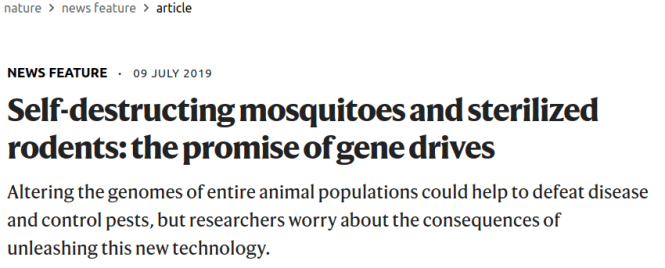
So, what exactly is the science that DEFRA claims to be following? It is not this kind of science.
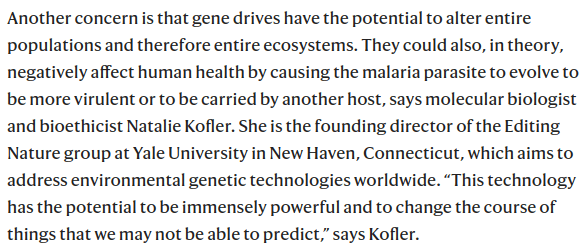

It is too soon to abandon caution.
12 March 2021
Here is the PDF with my response:
I expected Part 2 to take as long as Part 1 – I imagine that the start of Part 2 is the point at which many give up – but it did not. And in essence, it was a repeat of Part 1.
I started attending various webinars some time ago, like lots of people, and like lots of people, I also got a little webinar fatigue at times. 
A great series continues to be organised by the National Academy of Medicine and the American Public Health Association in the US, looking into many topics such as the science of the virus, finding vaccines, health inequalities and so on.
Today’s session, on mitigating direct and indirect impacts in the coming months, was excellent for decisionmakers at all levels – also in the UK! – because it addressed a lot of practical aspects and many angles of the pandemic.
It mentioned the need to provide free wifi, talked about telehealth (telemedicine) and developments expected to take a decade suddenly being realised in a mere three weeks, about the complications food deserts pose, about the politicizing of the pandemic, about how to cope with emergencies such as hurricanes and related evacuations, how to remedy the impact the pandemic is having on non-Covid-related healthcare (such as people with heart attacks not seeking help out of fear of catching the virus), the healthcare clinics getting into financial difficulties as a result (as, I think, we saw earlier with those two doctors in California who owned a small chain of facilities and saw their turnover drop so dramatically that they resorted to unorthodox action), the challenge and need to communicate well and perhaps have ambassadors explain the purpose and reasoning behind social distancing, the massive impact social distancing has on the infection rate and the risk of people that people will no longer observe distancing when lockdowns are relaxed and developing a false sense of safety, and so on and so forth.
Here is a link for a model (simulator) that people can play with to explore the effects of lifting lockdowns: https://budgetmodel.wharton.upenn.edu/
The video recording of the webinar will be online soon, at covid19conversations.org:
https://covid19conversations.org/webinars/summer.
The slides have already been uploaded, but not all presenters used slides and the Q&A of course is not online yet either. I’ll post the unedited transcript below.
This is straight from the e-mail I received:
Today, Justice Alison Y. Tuitt of the Bronx Supreme Court today issued a decision in the Nonhuman Rights Project’s New York elephant rights case that is powerfully supportive of our legal arguments to free Happy from the Bronx Zoo to a sanctuary.
While Justice Tuitt “regretfully” denied the habeas corpus relief the NhRP had demanded because she felt bound by prior appellate court decisions in the NhRP’s chimpanzee rights cases, she essentially vindicated the legal arguments and factual claims about the nature of nonhuman animals such as Happy that the NhRP has been making during the first six years of our rights litigation.
Deeply encouraged by Justice Tuitt’s embrace of the merits of the NhRP’s case following 13 hours of oral argument over three days, we already begun working on our appeal.
In her analysis and conclusion, Justice Tuitt agreed with New York Court of Appeals Justice Eugene M. Fahey’s conclusion that an elephant, like a chimpanzee, is not merely a “thing.” Instead, Happy “is an intelligent, autonomous being who should be treated with respect and dignity, and who may be entitled to liberty.” Further, Justice Tuitt rejected the Bronx Zoo’s claim that its continued imprisonment of Happy is good for her, stating that “the arguments advanced by the NhRP are extremely persuasive for transferring Happy from her solitary, lonely one-acre exhibit at the Bronx Zoo” to The Elephant Sanctuary in Tennessee.
In late 2018, Happy—currently held alone in an industrial cement structure lined with windowless, barred cages (the zoo’s “elephant barn”) while the elephant exhibit is closed for the winter—became the first elephant in the world to win a habeas corpus hearing intended to determine the lawfulness of her imprisonment after the NhRP filed a petition for a writ of habeas corpus on Happy’s behalf. Such world-renowned elephant experts as Dr. Joyce Poole and Dr. Cynthia Moss supported Happy’s rights case while making clear that the Bronx Zoo cannot meet the needs of Happy or any elephant.
While we lament Happy’s continued imprisonment, we thank Justice Tuitt for breaking ground on the long road to securing liberty and justice for Happy and other autonomous nonhuman animals. Happy’s freedom matters as much to her as ours does to us, and we won’t stop fighting in and out of court until she has it.
Anyone who’s become curious should look into the story of Guida, who’d become so severely mentally ill in her confinement that there were serious doubts about the potential for recovery.
Upon release to the Global Elephant Sanctuary in Brazil (sister of that in Tennessee), Guida bounced back remarkably. When having the choice of taking an easy path toward food or picking a difficult one, she was often observed selecting the more challenging path, which required her to climb up an edge (a small straight cliff), which took some effort.
She rejoiced in having the choice and in being able to conquer the cliff.
(I have seen something similar in a pigeon, to my utter astonishment, the animal setting herself a goal, a challenge. Also, pigeons are able to recognize individual human faces, whereas humans generally have a very hard time recognizing individual pigeons.)
Sadly, Guida is no longer with us, but at least she lived the last part of her life in friendship with another elephant and doing the kinds of things that she enjoyed doing.
I just received an e-mail from Henny Kupferstein that was an eye opener. I knew that she works with autistic children via music, often using services like Skype. I had no idea, however, that she too is autistic!
As far as I know, I’ve never met anyone who is autistic or at least interacted with the person extensively. So I’ve been wondering what it is like to be autistic and I’ve watched videos that weren’t very enlightening to me, other than to make me realize that autistic people deal with the world in a different way, and find ways to deal with the expectations of mainstream people.
I’d previously gotten the impression, from Temple Grandin’s TED Talk, that autistic people have different abilities, special abilities.
In this video, Henny explains in detail how the visual/mathematical world works for her and that it is a thing of great beauty.
Now I understand it a lot better!
Never had any problems with landlords in the Netherlands. Never.
Had three in Florida. The first and the third were fine, but the second one was not and his attorney was rumoured to have mafia ties, I kid you not. But I heard that later. I think it was actually a legal aid lawyer who told me that who I talked with later, long after I’d moved out and his lawyer started pestering me. I’ll spare you the details.
My third landlord was the husband of the person I volunteered with on Saturdays and sometimes Sundays. (He was a builder, built huge places, the way they are in Florida. Nice guy. I think he was in the US Army for a while, and they lived in places like Morocco. ) She stopped by one day – to bring me two birds – and was appalled and suggested I move in to one of their places. They owned a small apartment building that was mostly used by snowbirds (people from for example Canada who take winter vacations in Florida).
Some time later, I moved to Britain.
In Southampton, I knew several landlords. (Only one of them was mine.)
One said that only educated people were decent human beings, and I was too shocked to respond. He called tenants who rang him because the washing machine or heating wasn’t working (properly) “bad tenants”. This was not my own landlord, but someone I met within a business context and was friendly with for a while. Wasn’t actually a bad guy at all, strangely enough.
I also knew one who proudly told me how he had tricked an elderly woman with beginning Alzheimer’s out of her flat, I kid you not.
On another occasion, the same guy was talking with me about a new building he was constructing and then added that it did not have to be very good “as it is only for tenants”.
In Portsmouth, I’ve met two who dump rubbish on other people’s front courts and patios. I caught one red-handed and the other one admitted it.
I have principles.
If I can help make things better for people who come after me who are less strong in some way – okay, except physically as I am getting old and I am feeling it – I will try to do that. And that baffles the hell out of (most) Brits. But that is not my problem.
They don’t have the time and resources to solve crimes against individuals, unless those individuals have been killed, but they do still have the time and resources to send two or three cars to follow me and hunt me through the city to play PacMan.
They love playing PacMan with migrants and with women.
They first did this to me in 2009. February it was.
Of course, when you call them out on it, they always say that they don’t have the time and resources for that kind of crap.
So on my way back, I walked up to the central police station in Portsmouth, and addressed its CCTV camera:
You. Need. To. Observe. The. Law.
The law!
That’s the kind of police we have in Britain – barbaric, lawless and abusive – for which we pay through our council tax. They’re straight out of a film of police brutality and incompetence of the wild-west US in the past.
Two or three police cars were following me all over town again yesterday evening, slowing down when they passed me, backing up and returning when I took a left or right, etc.
It’s happened too many times before.
And this kind of crap takes up most of their time. Hunting down citizens who dare report crimes and who dare stand up against the utterly lawless British police. They don’t seem to do anything else but this.
I have on occasion stood by on purpose myself to serve as possible witness in police brutality cases when I saw them hunt other people. But they are too clever to attack people in plain public view, I am sure.
We pay for this harassment through our council tax. We pay for it ourselves!
Portsmouth has the highest CCTV density of the UK, so yes, police can hunt anyone through the city, in retaliation or just for fun.
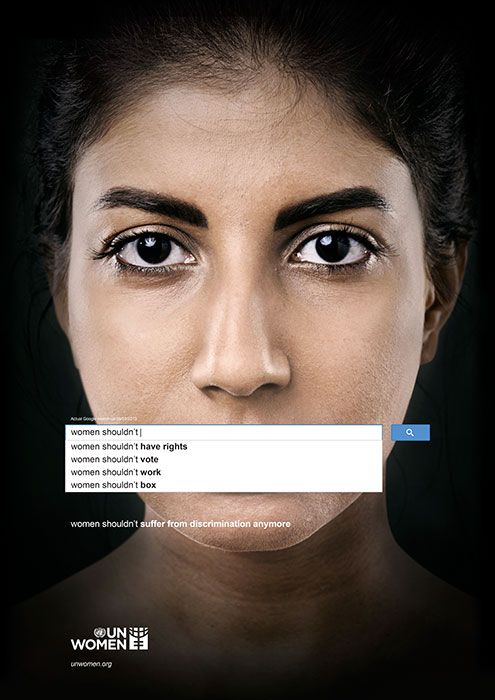
I also got a creep on a bicycle after me, along Albert Road, to tell me that women deserve to go hungry, should not be allowed to own any property of any kind, should not be allowed to work and should not be allowed to earn a living, or even be healthy and happy and that they should generally keep their mouths shut.
I told him it was the 21st century, that the middle ages were a long time ago and I crossed the road. The kid was not even half my age. He should apologize to all the women he owes his existence to, starting with his mother, but he won’t see it that way, clearly. In his eyes, women are lower than cattle. Usable and disposable. Not worth shit.
In case you wonder what the hell I am still doing in this shitty hell hole, well, I’ve tried to escape four times already. I also sometimes foolishly think that I can help make things better here, simply through my presence.
Also, I had formally raised the issue about the problems with local police again this week. Some retaliation was to be expected.
This photo below shows you what my door looks like when I am not in, these days. Three locks on the inside, warning note on the outside and a barricade in front of it, to stop, eh, anonymous elements, from shimmying the locks and carrying out crap in my flat – which has been going on since 2011, with the approval of Portsmouth Police.
Updated on 12 July 2019
At the moment, I am not using the vacuum cleaner to block my door, but the basket and two older printers. There was a time when I believed there was a local person with a brain-related impairment behind it, but it’s more complicated than that.
I watch this and realize that I don’t know a thing about autism…
The BBC sent FOI requests to all 24 universities in the Russell Group of highly selective, research-based universities, and 22 responded.
At these universities, the data showed average salaries of:
£52,000 for white academics
£38,000 for black academics
£37,000 for academics from an Arab background