Here we go again

I am receiving account statements from companies where I don’t have accounts (Boost and BD Swiss), payments that were supposed to come in have not arrived (not yet, in any case, but they’re usually earlier; we’ll see how it goes) (royalties from Amazon and a repayment from HMRC), the browser buttons including the back button on my new phone’s screen have disappeared as had (yesterday) the bit of video that I shot of the UoP marine sciences building near the Hayling Island ferry (the day before yesterday). Or am I merely imagining this latter bit? Did I cut it from the file, myself, perhaps? Okay, maybe I did! (lol) Okay, I probably did. Yep. (I had to transfer it to the older computer to be able to rotate it by 180 degrees and then transfer it back again so I probably cut a lot from the file to speed it all up a bit.)

I am getting something else too.

The something else that I am getting confirms the position of slavery that I am considered to be in. The “I will break you, goddammit” signal.

No, you won’t.

Continue reading

A reminder. How is workplace bullying affecting your business? Do you know?

(image from the NY Post)

Since the start of the first lockdown, the number of internet searches for “workplace bullying” went down. As of about July, the number began to increase again. This indicates that now is a good time to ensure that such practices do not flare up again once the bulk of the pandemic is behind us.

Because workplace bullying is costing businesses a lot of money and not just that, business owners are expected to deal with it. They must look after their employees.

I am aware of two cases in England in which employees were set on fire at work and Landrover / Jaguar has just experienced a landmark case of constructive dismissal to do with workplace bullying.

In the UK, the incidence of workplace bullying is around 30% (2015, Trades Union Congress), with 71% of disabled women reporting some form of abuse and 91% of workers stating that bullying in the workplace wasn’t being dealt with appropriately.

The Chartered Institute of Personnel and Development (HR professionals) found a percentage of 15 for the years 2017, 2018 and 2019 yet added that more than half did not report bullying.

  • Most bullying at work in the UK appears to take place in London and the southeast.
  • Most bullying is carried out by someone higher in the hierarchy.

In a study by Kew Law (employment law), 71% of the employees at 131 companies in the UK stated that they had either been bullied or witnessed bullying.

Are you sticking your head in the sand over it, ostrich-style?

Workplace bullying. Don’t pretend it isn’t happening when you know it is.


How is workplace bullying affecting your business?

(image from the NY Post)

Do you know?

In the UK, the incidence of workplace bullying is around 30% (2015, Trades Union Congress), with 71% of disabled women reporting some form of abuse and 91% of workers stating that bullying in the workplace wasn’t being dealt with appropriately.

The Chartered Institute of Personnel and Development (HR professionals) found a percentage of 15 for the years 2017, 2018 and 2019 yet added that more than half did not report bullying.

In a study by Kew Law (employment law), 71% of the employees at 131 companies in the UK stated that they had either been bullied or witnessed bullying.

Workplace bullying is very costly. Are you sticking your head in the sand over it, conveniently closing your eyes? Well then, with most staff still working from home, NOW may be the perfect time to wake up and address it. Workplace bullying. Don’t pretend it isn’t happening.


Excellent COVID-19 resource for decisionmakers at various levels

I started attending various webinars some time ago, like lots of people, and like lots of people, I also got a little webinar fatigue at times.

A great series continues to be organised by the National Academy of Medicine and the American Public Health Association in the US, looking into many topics such as the science of the virus, finding vaccines, health inequalities and so on.

Today’s session, on mitigating direct and indirect impacts in the coming months, was excellent for decisionmakers at all levels – also in the UK! – because it addressed a lot of practical aspects and many angles of the pandemic.

It mentioned the need to provide free wifi, talked about telehealth (telemedicine) and developments expected to take a decade suddenly being realised in a mere three weeks, about the complications food deserts pose, about the politicizing of the pandemic, about how to cope with emergencies such as hurricanes and related evacuations, how to remedy the impact the pandemic is having on non-Covid-related healthcare (such as people with heart attacks not seeking help out of fear of catching the virus), the healthcare clinics getting into financial difficulties as a result (as, I think, we saw earlier with those two doctors in California who owned a small chain of facilities and saw their turnover drop so dramatically that they resorted to unorthodox action), the challenge and need to communicate well and perhaps have ambassadors explain the purpose and reasoning behind social distancing, the massive impact social distancing has on the infection rate and the risk of people that people will no longer observe distancing when lockdowns are relaxed and developing a false sense of safety, and so on and so forth.

Here is a link for a model (simulator) that people can play with to explore the effects of lifting lockdowns: https://budgetmodel.wharton.upenn.edu/

The video recording of the webinar will be online soon, at covid19conversations.org:
https://covid19conversations.org/webinars/summer.

The slides have already been uploaded, but not all presenters used slides and the Q&A of course is not online yet either. I’ll post the unedited transcript below.

Continue reading

And we have a posterboy !

Boris Johnson is in hospital (and to my surprise, I managed to tweet the news before most of the UK news sites posted it because a financial news popup on my screen beat them to it).

I wish him and his pregnant partner well. Of course I do!

The good news?

He may now become the posterboy for making people take this thing seriously and stop assuming that only “dumb people in other countries” and “old folks” get knocked down by it.

This is no time for cavalier attitudes, unless it is the kind of attitude that Captain Crozier displayed. He is the kind of hero we need now.

And the kind of heroes who work and volunteer on the front lines of all care as well as the people who continue to deliver postal mail, who are at work at the supermarkets, supply them with stock and all the others who continue to keep as many things working as possible.


Non-human rights: Update on Happy’s case

This is straight from the e-mail I received:

Today, Justice Alison Y. Tuitt of the Bronx Supreme Court today issued a decision in the Nonhuman Rights Project’s New York elephant rights case that is powerfully supportive of our legal arguments to free Happy from the Bronx Zoo to a sanctuary.

While Justice Tuitt “regretfully” denied the habeas corpus relief the NhRP had demanded because she felt bound by prior appellate court decisions in the NhRP’s chimpanzee rights cases, she essentially vindicated the legal arguments and factual claims about the nature of nonhuman animals such as Happy that the NhRP has been making during the first six years of our rights litigation.

Deeply encouraged by Justice Tuitt’s embrace of the merits of the NhRP’s case following 13 hours of oral argument over three days, we already begun working on our appeal.

In her analysis and conclusion, Justice Tuitt agreed with New York Court of Appeals Justice Eugene M. Fahey’s conclusion that an elephant, like a chimpanzee, is not merely a “thing.” Instead, Happy “is an intelligent, autonomous being who should be treated with respect and dignity, and who may be entitled to liberty.” Further, Justice Tuitt rejected the Bronx Zoo’s claim that its continued imprisonment of Happy is good for her, stating that “the arguments advanced by the NhRP are extremely persuasive for transferring Happy from her solitary, lonely one-acre exhibit at the Bronx Zoo” to The Elephant Sanctuary in Tennessee.

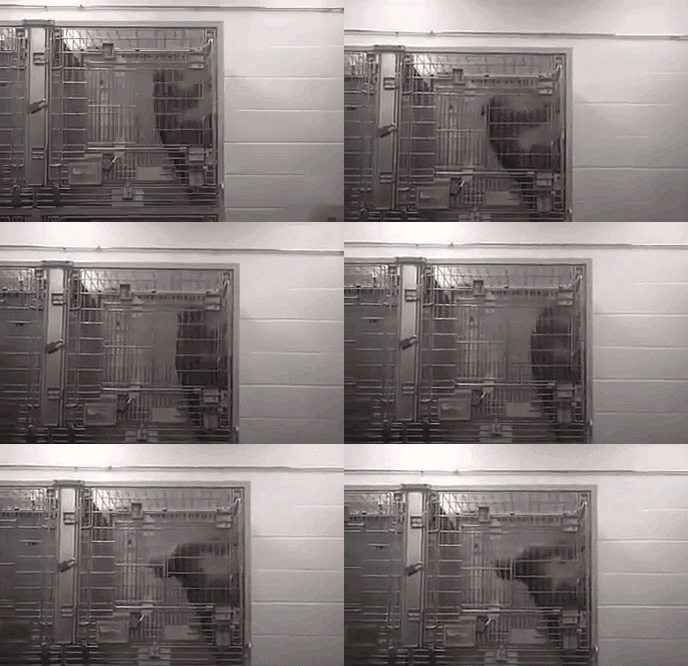
In late 2018, Happy—currently held alone in an industrial cement structure lined with windowless, barred cages (the zoo’s “elephant barn”) while the elephant exhibit is closed for the winter—became the first elephant in the world to win a habeas corpus hearing intended to determine the lawfulness of her imprisonment after the NhRP filed a petition for a writ of habeas corpus on Happy’s behalf. Such world-renowned elephant experts as Dr. Joyce Poole and Dr. Cynthia Moss supported Happy’s rights case while making clear that the Bronx Zoo cannot meet the needs of Happy or any elephant.

While we lament Happy’s continued imprisonment, we thank Justice Tuitt for breaking ground on the long road to securing liberty and justice for Happy and other autonomous nonhuman animals. Happy’s freedom matters as much to her as ours does to us, and we won’t stop fighting in and out of court until she has it.

Anyone who’s become curious should look into the story of Guida, who’d become so severely mentally ill in her confinement that there were serious doubts about the potential for recovery.

Upon release to the Global Elephant Sanctuary in Brazil (sister of that in Tennessee), Guida bounced back remarkably. When having the choice of taking an easy path toward food or picking a difficult one, she was often observed selecting the more challenging path, which required her to climb up an edge (a small straight cliff), which took some effort.

She rejoiced in having the choice and in being able to conquer the cliff.

(I have seen something similar in a pigeon, to my utter astonishment, the animal setting herself a goal, a challenge. Also, pigeons are able to recognize individual human faces, whereas humans generally have a very hard time recognizing individual pigeons.)

Sadly, Guida is no longer with us, but at least she lived the last part of her life in friendship with another elephant and doing the kinds of things that she enjoyed doing.

Moratoria no longer enough

Moratoria are sometimes seen as “knee jerk” responses.

But this is what Jennifer Doudna, one of the “inventors” of CRISPR, says:

https://platform.twitter.com/widgets.js

Autism, and the fourth dimension

I just received an e-mail from Henny Kupferstein that was an eye opener. I knew that she works with autistic children via music, often using services like Skype. I had no idea, however, that she too is autistic!

As far as I know, I’ve never met anyone who is autistic or at least interacted with the person extensively. So I’ve been wondering what it is like to be autistic and I’ve watched videos that weren’t very enlightening to me, other than to make me realize that autistic people deal with the world in a different way, and find ways to deal with the expectations of mainstream people.

I’d previously gotten the impression, from Temple Grandin’s TED Talk, that autistic people have different abilities, special abilities.

In this video, Henny explains in detail how the visual/mathematical world works for her and that it is a thing of great beauty.

Now I understand it a lot better!

WhatsApp flaw “puts words in your mouth”

https://www.bbc.co.uk/news/technology-49273606

This sort of thing has been possible since at least 2010.

Back in 2010, I knew it was happening on my equipment, but I couldn’t prove it and when you say something like that out loud, everyone assumes that you’re delusional. After all, accepting that I might be correct is a scary thought.

Too scary for most people. 

So when I finally got the proof, when I was able to compare a tweet on my phone with the same tweet on a friend’s computer, I could see that there were words in the tweet on my phone that were not present in the tweet on my friend’s computer… I didn’t show it to anyone. There was no point. Nobody was going to be interested.

The original tweet came from Portsmouth-based Maricar Jagger, but she had nothing to do with the digital mischief (other than that she was connected through her social circles).

I also knew about phone hacking via the invisible text message method before it became news – because I saw it happen on my own phone. (Same thing. Delusional cow who has difficulty grasping technology was the usual response.)


PS
And OUT goes a big chunk of police “evidence”, of course.


(See also this page.)

Landlords…

Never had any problems with landlords in the Netherlands. Never.

Had three in Florida. The first and the third were fine, but the second one was not and his attorney was rumoured to have mafia ties, I kid you not. But I heard that later. I think it was actually a legal aid lawyer who told me that who I talked with later, long after I’d moved out and his lawyer started pestering me. I’ll spare you the details.

My third landlord was the husband of the person I volunteered with on Saturdays and sometimes Sundays. (He was a builder, built huge places, the way they are in Florida. Nice guy. I think he was in the US Army for a while, and they lived in places like Morocco. ) She stopped by one day – to bring me two birds – and was appalled and suggested I move in to one of their places. They owned a small apartment building that was mostly used by snowbirds (people from for example Canada who take winter vacations in Florida).

Some time later, I moved to Britain.

In Southampton, I knew several landlords. (Only one of them was mine.)

One said that only educated people were decent human beings, and I was too shocked to respond. He called tenants who rang him because the washing machine or heating wasn’t working (properly) “bad tenants”. This was not my own landlord, but someone I met within a business context and was friendly with for a while. Wasn’t actually a bad guy at all, strangely enough.

I also knew one who proudly told me how he had tricked an elderly woman with beginning Alzheimer’s out of her flat, I kid you not.

On another occasion, the same guy was talking with me about a new building he was constructing and then added that it did not have to be very good “as it is only for tenants”.

In Portsmouth, I’ve met two who dump rubbish on other people’s front courts and patios. I caught one red-handed and the other one admitted it.

I have principles.

If I can help make things better for people who come after me who are less strong in some way – okay, except physically as I am getting old and I am feeling it – I will try to do that. And that baffles the hell out of (most) Brits. But that is not my problem.

Portsmouth Police breaking the law again

They don’t have the time and resources to solve crimes against individuals, unless those individuals have been killed, but they do still have the time and resources to send two or three cars to follow me and hunt me through the city to play PacMan.

They love playing PacMan with migrants and with women.

They first did this to me in 2009. February it was.

Of course, when you call them out on it, they always say that they don’t have the time and resources for that kind of crap.

So on my way back, I walked up to the central police station in Portsmouth, and addressed its CCTV camera:

You. Need. To. Observe. The. Law.

The law!


That’s the kind of police we have in Britain – barbaric, lawless and abusive – for which we pay through our council tax. They’re straight out of a film of police brutality and incompetence of the wild-west US in the past.

Two or three police cars were following me all over town again yesterday evening, slowing down when they passed me, backing up and returning when I took a left or right, etc.

It’s happened  too many times before.

And this kind of crap takes up most of their time. Hunting down citizens who dare report crimes and who dare stand up against the utterly lawless British police. They don’t seem to do anything else but this.

I have on occasion stood by on purpose myself to serve as possible witness in police brutality cases when I saw them hunt other people. But they are too clever to attack people in plain public view, I am sure.

We pay for this harassment through our council tax. We pay for it ourselves!

Portsmouth has the highest CCTV density of the UK, so yes, police can hunt anyone through the city, in retaliation or just for fun.

I also got a creep on a bicycle after me, along Albert Road, to tell me that women deserve to go hungry, should not be allowed to own any property of any kind, should not be allowed to work and should not be allowed to earn a living, or even be healthy and happy and that they should generally keep their mouths shut.

I told him it was the 21st century, that the middle ages were a long time ago and I crossed the road. The kid was not even half my age. He should apologize to all the women he owes his existence to, starting with his mother, but he won’t see it that way, clearly. In his eyes, women are lower than cattle. Usable and disposable. Not worth shit.

In case you wonder what the hell I am still doing in this shitty hell hole, well, I’ve tried to escape four times already. I also sometimes foolishly think that I can help make things better here, simply through my presence.

Also, I had formally raised the issue about the problems with local police again this week. Some retaliation was to be expected.

This photo below shows you what my door looks like when I am not in, these days. Three locks on the inside, warning note on the outside and a barricade in front of it, to stop, eh, anonymous elements, from shimmying the locks and carrying out crap in my flat – which has been going on since 2011, with the approval of Portsmouth Police.

Updated on 12 July 2019
At the moment, I am not using the vacuum cleaner to block my door, but the basket and two older printers. There was a time when I believed there was a local person with a brain-related impairment behind it, but it’s more complicated than that.


Highly interesting legal case!

Was this whistleblower’s sacking discrimination?

On paper, whistleblowers are often legally protected, but in practice, well, that’s a different story. Whistleblowers usually end up ruined. It takes guts to take a stand and also often sacrifice.

So a different approach is taken in this case. I shall be following this (to the extent that I can).

Sacked vegan claims discrimination:

https://www.bbc.co.uk/news/uk-46385597

Something you may want to watch

It may also shatter your illusions, however, if you still believe that police are the good ones, the ones (that you pay for through your council tax, in Britain) to help keep you safe and secure and protect your basic rights.

This morning, this caught my eye:

(Scottish) Police Pause Rollout Of Device That Hacks Into Phones After Fears ‘It Is Unlawful’

I suspect that police in England and Wales already are using these “kiosks” that hack into people’s phones and laptops, overriding passwords.

I am sure it can be great fun for some officers to play with these “kiosks”. You can almost hear them talk. “I knew it! She’s a lesbian!” and “Does he really think he stands a chance with that woman?” and “Oh my god! Trying to lose weight? Fat chance!”

Yep, very useful.</end of sarcasm>

We need an alternative to police. Because going to or contacting the police has become one of the worst things to do in almost any situation. (Unless your insurance company wants a copy of a report after a burglary or theft, but leave it at that and do not ask police to do anything else other than give you a copy of the report.) How it got to this point? It’s immaterial. It’s what we have in the here and the now.

As Michael Doherty (a former aircraft engineer who made the mistake of reporting something to police and expecting police to follow up on it) says in the video below, you do have the right to investigate on your own, to try to detect and stop crime on your own. If your investigation is successful, you can also prosecute on your own. (I am talking about England and Wales.)

But before you choose this path, as I have stated several times before, look into the Protection from Harassment Act 1997 because police and others can use this against you, assuming that you are unaware of 1(3)(a), which most people probably are. That means that, before you know it, you can already have confessed to a crime that you didn’t actually commit. To prevent this, you need to know what the law says.

I repeat and highlight:

(3) Subsection (1) [F4 or (1A)] does not apply to a course of conduct if the person who pursued it shows—

(a) that it was pursued for the purpose of preventing or detecting crime,

(b) that it was pursued under any enactment or rule of law or to comply with any condition or requirement imposed by any person under any enactment, or

(c) that in the particular circumstances the pursuit of the course of conduct was reasonable.

(Whether it says “and” or “or” makes a difference. It means that each of these conditions on its own applies, that they do not have to apply all at once.)

The video below dates back to 2015, is rather academic and particularly in the beginning lacks a logical thread, in my opinion, but does contain useful information.

You may want to read this as well:
The Human Rights Act Can Transform Lives Without Going To Court

(Also, if you want to protect yourself from police with a camera, you need to have one that does not have wifi or bluetooth.)

It is possible to resolve many situations or at least make them somewhat liveable without going to police, and much more successfully and/or peacefully. If you try this after you’ve been to police, however, police officers are likely to hold it against you. (This is mean because most people who contacted the police in the past decade will have been told that police wouldn’t investigate and would do nothing with what they told the police owing to a lack of resources and/or will have been referred to their GP and the local civic offices.)

Unfortunately, most of us learn these things the hard way – and you can’t undo having contacted the police.

The war on women

I am in the middle of reading “The war on women” by Sue Lloyd-Roberts. The book was finalized without her input after she suddenly passed away in 2015. I wish that I could still contact her.

Because then I would talk with her about her own bias. She sounds convinced that there is a division between the “liberal West and the traditional East”, and it made her slightly blind to what went on in, say, her own country, assessed by the UN as perhaps the most openly misogynistic country in the world. That can probably be explained that she’d been living on the Spanish island of Mallorca since 2003.

I can’t allow myself to be blind to the fact that people in the West who condemn what goes on in other countries but are blind to what goes on in their own culture may be helping their causes less than they think.

Continue reading

Beyond Disadvantage: Disability, Law, and Bioethics

The above is the title of the 2018 Petrie-Flom Center Annual Conference, which took place in June. I had registered for the event because the topic interests me greatly and I have so much to learn in this area. Unfortunately, I turned out to be away and unable to attend after all.

I am delighted that the Petrie-Flom Center not only decided to make some of the lecture materials available beforehand, but recorded the lectures and has made the videos shareable.

Prominent point of discussion at he conference was the question whether a disability is merely a difference, or a bad difference. Putting the question like this is an oversimplification but it is a good starting point. I will discuss this matter and these lectures in greater detail in coming posts.

For now, here are the opening remarks, and first talks.

“Beyond Disadvantage: Disability, Law, and Bioethics” Opening Remarks and Panel 1: Theory and Definitions of Disability from Petrie-Flom Center on Vimeo.


Very severe animal cruelty at Mahard Egg Farms in the US

Last evening, I saw a video and photos that I found shocking. It concerns severe animal cruelty that occurs near Sulphur in Oklahoma. The farm is part of Mahard Egg Farms who appear to be headquartered in Texas. I searched LinkedIn and found nine accounts associated with the company, including that of its CFO, Kaitlin Mahard.

I believe that severe animal cruelty can be considered “violent crimes” which would mean that LinkedIn should remove the accounts associated with Mahard Egg Farms. The LinkedIn Professional Community Policies state that “those who engage in violent crimes are not welcome and not permitted on the Services”.

In 2011, Mahard Egg Farm, Inc., indeed a Texas corporation, was told to pay a $1.9 million penalty to settle claims that the company violated the Clean Water Act (CWA) at its egg production facilities in Texas and Oklahoma, according to the EPA:
https://www.epa.gov/enforcement/mahard-egg-farm-inc-clean-water-act-settlement

The latter apparently resulted in this:
https://www.epa.gov/sites/production/files/2013-09/documents/mahardegg-cd.pdf

That document includes the following:

C. MORTALITY MANAGEMENT
18. Defendant shall comply with the Mortality Management Requirements in Appendix D at the Vernon-Chillicothe Facility, the Springhill Facility, the Prosper Facility, the Boogie Hill Facility, the Nebo Ranch, and the Ravia Facility, unless such facility is not growing poultry.

Appendix D stated:

APPENDIX D:
MORTALITY MANAGEMENT

I. Texas
65.
No later than the Effective Date of this Decree, Mahard shall cease any transfer of
carcasses between Facilities unless a composting plan is in place that is consistent with 30 T.A.C. 332, Subchapter B, and has been approved by EPA and TCEQ.

66.
Mahard shall ensure that all carcass disposal at the Vernon-Chillicothe, Prosper, and
Springhill Facilities is conducted in accordance with TCEQ Regulatory Guidance, RG-326, Handling and Disposal of Carcasses from Poultry Operations (August 2009) and in accordance with 30 T.A.C. § 335.25. Mahard shall collect all carcasses within 24 hours of death and properly disposed of them within three (3) Days of death. Animals must not be disposed of in any liquid manure or process wastewater system. Disposal of diseased animals shall be conducted in accordance with Tex. Agric. Code § 161.004.

II. Oklahoma
67.
Mahard shall comply with the terms and conditions in Mahard’s 4/29/09 Carcass Disposal Plan, as amended and supplemented by the letter from ODAFF, dated May 7, 2009, to Mahard (both attached here as the Appendix D Supplement).

The Kroger chain has meanwhile dropped Mahard’s eggs and I’ve reached out on LinkedIn to it spokeswoman Kristal Howard to thank Kroger and ask her to ensure that Kroger will never be associated with such severe animal cruelty again.

Kroger’s 2018 Sustainability Report includes an animal welfare policy, which states:

“Kroger has a long-standing commitment to responsible business practices, including the humane treatment of animals,” Kroger says in its policy. “We require our suppliers to adopt industry-accepted animal welfare standards that we endorse, and we monitor our suppliers for compliance with these standards. We align with the Food Marketing Institute’s industry-adopted and industry-aligned animal welfare standards for the following animal proteins: beef, pork, chicken, turkey and eggs. For nearly a decade, Kroger has convened our own independent panel of animal science experts to make recommendations on how we can work with the industry to improve animal welfare.”

I’ve also contacted the EPA.

Why do we often feel guilty?

Because we have been taught that something – whatever it is – is bad. If you let go of the idea that something is good or bad, you may feel a weight lift from your shoulders.

If you simply allow and observe the thing that is supposed to be bad, you may find that it is interesting – hence also good, right or even fun – all by itself.

Feeling depressed is bad, for instance. It is even considered a mental health problem these days. An illness. Feeling cheerful is good. Acting cheerful when you’re feeling depressed is good. Is it?

It can be, but there are times, after the death of a loved one for example, when we really have to allow feelings that are supposedly bad.

(Is mourning someone’s death truly “a mental health issue”? Or could it be a natural part of life?)

It is our resistance to “bad” feelings that often becomes the greater problem. As soon as you allow certain feelings and stop considering them bad, they can lose their power over you quickly.

And heck, even moping can be a heck of a lot of fun too.

What always comes to my mind when I say something like that is an image from the original Swedish Pippi Longstocking TV series.

Pippi is in a foul mood and goes around angrily stamping her feet, probably in puddles of water, powerfully indulging in her foul mood, full of energy. Acceptance. A foul mood is just a foul mood, not the end of the world.

Puddles of water? So it must have rained. Rain! Rain is bad.

I too have my personal good/bad hangups. Ideas that make me feel vulnerable or guilty or inadequate or unhappy. What are yours?


Update on the Brexpat case

See this post

https://platform.twitter.com/widgets.js

https://platform.twitter.com/widgets.js