People! Fake news!

How many more times do I have to say it? There IS no such thing as hacking! That’s just something that feeble-minded women make up to hide that they don’t understand technology!

Same with DeepFake videos. There’s no such thing! All you need to do is ask everyone to turn around quickly.

Note that it says “pathology”, Portsmouth.

And yes, such things happens all the time. Usually, it’s email conversations that get hijacked. Big companies fall for this. If you fall for something like this, it doesn’t mean that you’re stupid. (No, I didn’t.)

Moody’s delusional !

Everybody knows that there’s no such thing as hacking. 😂

https://www.theguardian.com/technology/2024/feb/04/elevated-risk-of-hackers-targeting-uk-drinking-water-says-credit-agency

I am still dealing with a lot of hacking interference myself. They were at it again this weekend. Yesterday evening, they were playing random MT5 sounds. MT5 wasn’t even open. In Portsmouth, they used to shut down MT5 and make my browser play an MT5 closing sound for a while if I first started up MT5 and then my browser. MT5 was constantly getting “updates”, thus introducing system modifications. I’d usually be able to remedy the bullshit by installing a clean version of MT5. Some of this nonsense was quite tolerable, but the problem with such jokers is that your entire life becomes about these jokers. (Plus, I had to hide a clean version of MT5.)

When they delete grant proposals on your 60th birthday because hey, no more “proposals” for you now, ha ha, it’s my client who suffers.

(It took me three years to figure out what that this was about. It had seemed like the usual random stuff – or anger, actually – until it hit me some weeks ago. Before that, a LaTeX file for a slightly dyslexic scientist mysteriously acquired a virus that garbled the letters and when I mentioned that the track changes function in Word sometimes produces corrupt documents, all files from this scientist from then on were corrupt, doubling or tripling the amount of time that I needed to spend on them. Etc.)

Suzanne Hulscher’s group was affected by this birthday joke. Thankfully, they got the grant, in spite of my refusal to do any more work on that proposal.

Grant proposals are often submitted in a great rush and I couldn’t guarantee that such jokers wouldn’t also have messed with the file that I would end up sending to the client.

Such jokes can cost millions.

Doesn’t have to be intentional.

Come to think of it, NWO should probably check if its ransomware attack took place after submission of a proposal that I happened to have worked on.

Continue reading

Google Bard makes me laugh

No matter what I type, this is its response.

Some time ago, I uploaded a short about ChatGPT and the dangerous drivel it was producing, from accusing a Canadian professor of sexual harassment during a trip that never happened to referring to articles in The Guardian that didn’t exist.

The hacking interference is currently pretty hard to ignore again, by the way. It just hit me that we are in the run-up to Christmas. He always goes crazier than normal then. It seems to be a highly frustrating time for him.

Also, just after I got the tethering option back on some of my equipment from which it had previously mysteriously disappeared, forcing me to rely on a dongle, the local public WiFi was down for a while. Interesting coincidence.

How to spot bugs

Whoever’s been messing with me for so long once informed me that he had bugged my place. This was years ago. I couldn’t find anything. I installed some kind of detection app on the phone I had back then – couldn’t afford a proper detector because I had barely any income – and got mocked by the hacker(s) while I was using it. This may be a point to remind you that I have had many phones fried to death because the hacking would cause them to overheat.

They’d been picking my locks for years. I never saw it coming.

The video below starts with the example of an AirBnB in Ireland.

8:59: What does this tell you?

 
Remember that I also have a hacked phone that is telling me that my NatWest banking app will stop working within 6, sorry now 5, days and a printer that is suddenly missing its drivers. All at the same time.

This is the kind of nonsense I’ve been dealing with ever since I moved into my current flat, but hey, “I am just an old cow who can’t handle technology”. May I remind you that my webpage about the bit of IT background I have disappeared from this site, too, all by itself?

9:12: the screens have gone back to normal again

I’d switched on the computer at around 8:30. I’d overslept, yes. Deserves the death penalty, I know, Portsmouth.

09:30: NatWest banking app issue resolved. (Meanwhile, made 11 bucks trading, too; am slowly making my way back toward overcoming the experience I had last year, the losses caused by the stupid “football matches” hackers last year, the idiots that left me a message about their experience with betting on football matches, yes, just in case I was not quite sure what exactly was going on. The fact that I had warned them that I was going to put in losing trades and let them run if they didn’t stop fucking with me and then went ahead and did it, didn’t entirely stop them from fucking with me but it did help A LOT. They or he had made the fatal mistake of getting me into the position in which I literally had nothing left to lose, after they had literally taken everything from me that I had achieved or that had mattered to me. I started trading because I wanted to get out of Portsmouth asap – escape! get my life back! – and because I can no longer travel when it’s too cold.)

09:48: now tackling the printer driver issues again. I thought nothing useful had downloaded other than perhaps a tar ball archive, which I just found in my downloads, but which previous versions of the operating system and I never managed to handle, but my current version does seem to know how to deal with it.


10:00: Let’s see if that did the trick…

10:01: yes

But nobody in Portsmouth is fucking with me, right? People in Portsmouth are all sweet little angels who knit and tend to their gardens all day, and do little else but smile oh so sweetly, except when they don’t and give you the full blast of their blind hatred.

Emma Watson is not alone

https://www.washingtonpost.com/technology/2023/03/05/ai-voice-scam/

Those of you locals who still think that I have dementia, am delusional, learning-disabled or what not and am making up the idea of voice cloning may want to read:

Some of my Dutch WhatsApp calls were recorded in the past. It worried the other person on the calls too when I mentioned it because it was just really really odd. It happened two or three times that I couldn’t make the call unless I okayed its recording but the recordings did not end up on my equipment. I no longer use WhatsApp. The person I was on the calls with once reported me missing to Dutch police after hacking interference with e-mails related to my third attempt to escape from Portsmouth, but he did that in person. He went to a police station.

On one occasion, “he” e-mailed me and told me to travel to Florida, wrote that I could stay at his place until I had worked things out with my friend in “Saratoga”. First of all, he was referring to Sarasota and second, it’s not even Saratoga but Saratoga Springs, which third is many miles away from Florida which a geologist, Brown and West Point graduate and former US Army Major would most certainly know (and I was not working anything out with any person in Florida either, by the way).

It is not the kind of typo you make unless perhaps if you have a strong connection to the other place, which he does not.

We are no longer in contact and he ain’t stupid. NO need to go try and scam him, you scammers out there.

Is your phone hacked?

Eh, more likely than not, these days. Anywhere you leave your phone number, there will be folks who’ll try hacking into people’s phones out of mere boredom. For fun. Or to store files on that they don’t want others to see. Hacking is a largely risk-free crime. Unless you hack into the Pentagon or steal really large sums of money, it doesn’t matter what you do, in practice, because it is such a hard crime to investigate and tackle.

Norton says the following. 

(Italics = my words)

If your phone is displaying one of the following unusual behaviors, and especially if it’s displaying more than one, there’s a good chance that it may be hacked. 

1. Strange or inappropriate pop-ups:

One apparent sign of a hacked phone is nonstop pop-ups. Bright, flashing ads or X-rated content popping up on  your phone is a big indicator that your phone has been compromised. (Note: They can also be innocent-looking.)  

2. Texts or calls not made by you

As the owner of your device, you likely remember every time you use your phone throughout the day. So, if you  notice texts or calls from your phone that you didn’t make, you may have had your phone hacked.   

3. Higher than normal data usage

There are many reasons for high data usage (for example, increased use of a new app). But if your phone behavior  has stayed the same and your data usage has skyrocketed, it’s time to investigate.  

4. Apps you don’t recognize on your phone

Keep in mind that new phones often come with pre-downloaded apps. But if you notice new apps popping up  once you already own the phone, there may be malware involved.  (Note: This is almost impossible to check on Androids nowadays because Google installs so much crap.)

5. Battery draining quickly

Phone batteries aren’t meant to last forever, but they’re also designed efficiently. So, if your phone use habits have  remained the same, but your battery is draining more quickly than normal, hacking may be to blame. (This tends to include that the phone gets HOT.) 

Reset your phone

The majority (=not all!) of malware can be removed with a factory reset of your phone. This will, however, wipe any data  stored on your device, such as photos, notes, and contacts, so it’s important to back up this data before resetting  your device. Follow the instructions below to reset your iPhone or Android.  

Instructions for resetting an iPhone

  1. If you have a Mac with macOS Catalina 10.15, open Finder. Otherwise, open iTunes. 
  2. Connect your iPhone to your computer. 
  3. Select your device on your computer. 
  4. Select “Restore iPhone.” 

For more detailed instructions, visit Apple support

Instructions for resetting an Android phone

  1. Android reset instructions vary by manufacturer. You should visit your phone manufacturer’s website for specific instructions. 
  2. For most Android phones, you can access the reset option via your Settings menu, or by holding down the  power and volume buttons.  

For more detailed instructions, visit Google support. 

Change your passwords

It’s possible that your login credentials were compromised when your phone was hacked. Once you’ve removed  the malware, reset all of your passwords and create unique passwords for each account. (Tip: write them down on index cards if you find it hard to have many different passwords. My locks get picked all the time, but yours likely are not so your index cards should be safe.) 

Does resetting your phone get rid of viruses? 

Yes, a factory reset is one way to potentially remove a virus from an infected mobile device. 

Why do hackers hack your phone? 

Hackers compromise smartphones to access the personal information stored on each device, oftentimes  exploiting and/or selling what they get their hands on. (Note: They can also do this for fun, out of boredom, in the hope to find compromising or silly photos or videos, just for a laugh, or to mess with you.)

Does turning off your phone stop hackers? 

Yes, turning off your phone can stop hackers, as most cyberattacks targeting cell phones require the device to be  turned on. (Note: Your phone can still be detected though, if the battery is still in it, even if there is no SIM card in it.)

Can hackers hear you? 

Yes, hackers may be able to hear you if they’ve gained access to your phone’s camera and microphone. (Note: This is probably often the first thing that they do.) 

Does airplane mode block hackers? 

Turning on airplane mode can temporarily block hackers while the device is not connected to Wi-Fi or a cellular network.

What can a hacker do with your phone number? 

Hackers often compromise phone numbers in order to: 

  • Verify 2FA requests 
  • Send malicious links 
  • Complete vishing attacks
  • Clone your phone
  • Redirect outgoing calls and texts (possibly also as part of vishing)
  • Block access to the nearest cell phone tower to force you to go somewhere else (this may be called “jamming” – it’s happened to me here in Portsmouth)
  • Spy on you (exes, stalkers, jealous partners, parents)
  • Record your voice (to use in voice-cloning)
  • Look at your contacts (and your communications) so that they can contact them (text, e-mail, voice-cloning), pretend to be you and for example ask for money (or high-jack e-mail conversations with suppliers or clients)
  • Steal video or image files (for revenge porn or deepfakes)

Can someone hack your phone and turn on your camera? 

Yes, cybercriminals can hack phones to gain access to their cameras. (Note: This is probably often the first thing that they do.) 

https://us.norton.com/blog/malware/is-my-phone-hacked#

How Runaway Algorithms Brought Down the Dutch Government

(Click on the “CC” button for subtitles if the Dutch accents get in the way.)

By the Center for Human Rights and Global Justice, New York University School of Law.

This concerns shockingly discriminatory use of self-learning black-box algorithms, designed to discriminate on the basis of factors such as socioeconomic status and nationality in the Dutch tax authorities’ (and other organizations’) scrutiny for fraud. And that’s far from the whole story.

It’s also true that regulation in the Netherlands is often way too rigid. It makes us cloggies abroad often look really strange (OCD-like) because we are so used to having to be super precise and document everything. This can for example lead to people having to pay back 90,000 euro because they made a 100-euro typo in a form or perhaps because they forgot to sign the form or because paid the childcare center one day late or the amount they paid the childcare facility was 10 euro less than it should be.

However, this scandal was about people being labeled fraudsters and being treated as fraudsters mostly on the basis of nationality without them being fraudsters at all and without them having an idea what error they were supposed to have made and beingg unable to obtain any information. It’s destroyed many lives. Some people lost their homes, others even their children (taken into care) or their marriage.

The first signs of the scandal emerged in 2014. It would take until 2018 before some people started waking up and started looking into it. (Do we owe this delay to the phenomenon of conspiracy theorists?)

It’s 2022 now. It’s doubtful that all the people who were harmed in this have already received compensation, so I understand. (I know that several individual court cases are ongoing or will be started soon.)

A problem with the complete opacity of and the secrecy surrounding these black box algorithms is that you wouldn’t even know it if hackers interfered and, for example, inserted their own parameters into the model. They could perhaps, also feed it highly biased learning data, but indeed, the innate biases in the model would also steer it toward concluding that poor people and foreigners are more likely to commit fraud.

How does this work? If you are looking for fallen leaves in parks, but only or predominantly look in two specific parks, you might erroneously conclude that those two parks have high numbers of fallen leaves and that there are no leaves in other parks. As you haven’t looked at all (or well) in those other parks, you found no or much fewer fallen leaves there.

Btw, the term “white-washing” is Dunglish. It’s called “money laundering” in English.

Similarly, “Minister President” is “Prime Minister” (Rutte). Turns out that he (Mark Rutte) was found guilty (by the court) of encouraging discrimination in his role in 2003, when he was not Prime Minister but ran the Dutch version of the English DWP. He had asked for people of Somali descent to be traced and scrutinized for fraud. https://www.trouw.nl/politiek/rechter-rutte-zette-aan-tot-rassendiscriminatie~bc40d2da/ Rutte did not get it at all at the time and expressed surprise. Apparently, he laughed and commented that the law should be changed, then. The reason for this was that some Somalis had committed fraud. That’s like saying that all Dutch people are blond and blue-eyed because some are. It’s nonsense.

(This latter court case ran its course after I had moved to England. I was not aware of it.)

Continue reading

Someone’s been messing with my HMRC data

  1. I logged in to file my VAT return – why hadn’t I gotten the usual e-mail from HMRC? – and found a message that TWO VAT returns were due! Did something go wrong with my previous return? No, turns out that the second return “due” is the one that I can submit as of 1 January 2022. That’s on HMRC.
  2. When I clicked on the link to file my return, I initially went to a http (no s) site that had nothing to do with HMRC. So I clicked back in my browser.
  3. Next, I started looking for where I can change my bank account for VAT refunds. I didn’t find it, but I did find a link for setting up direct debit so I did that.
  4. I noticed that my mobile phone number had been changed to something odd – not my number, but a number starting with 078 – and I also noticed that the email address for VAT-related messages from HMRC had been changed to an address that is no longer mine. WTF? I changed the phone number and I corrected the e-mail address and then when I had to wait for the confirmation code, it took so long that I logged out. I wish I had taken a screenshot but I was highly focused on correcting the information asap.
  5. When I then logged in again, I did find the opportunity to change the bank account for VAT refunds, but now I could no longer find where to enter the code for where to receive my VAT-related e-mails from HMRC and confirm my correct e-mail address and I can’t find where to change my password either. That’s on HMRC.
  6. The HMRC site also informed me that they only send out one e-mail confirmation code per 24 hours yet I received two different codes at 14:37.

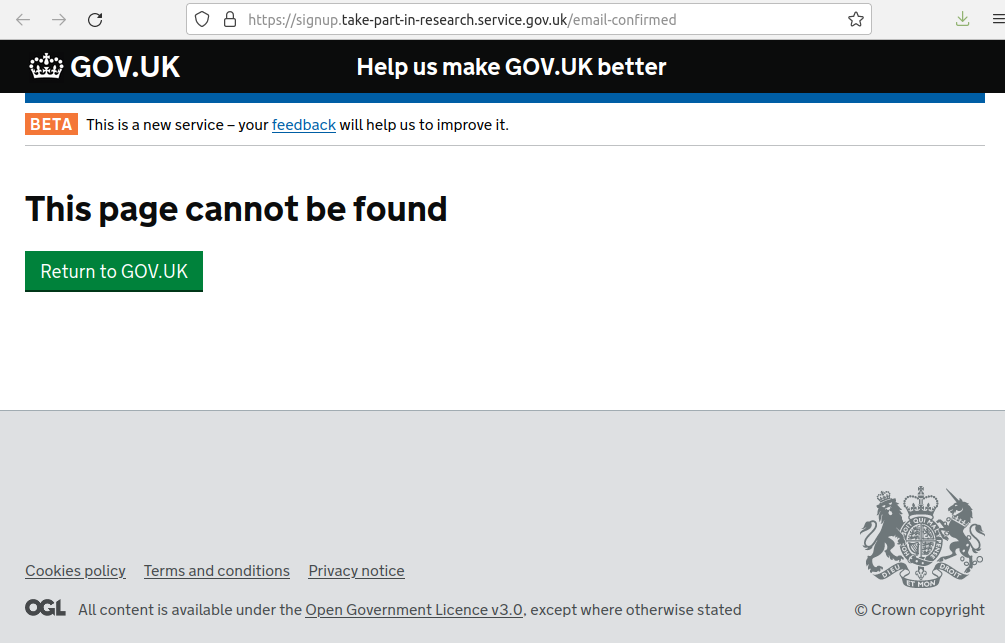
Next, when I wanted to sign up for usability research, and clicked on the link in the e-mail, I got this:

That’s the kind of thing that I also got with the Barclays business banking website a while ago, only worse (making clear that it had nothing to do with Barclays whatsoever). I’ve closed my account there.

Continue reading

Here we go again

I am receiving account statements from companies where I don’t have accounts (Boost and BD Swiss), payments that were supposed to come in have not arrived (not yet, in any case, but they’re usually earlier; we’ll see how it goes) (royalties from Amazon and a repayment from HMRC), the browser buttons including the back button on my new phone’s screen have disappeared as had (yesterday) the bit of video that I shot of the UoP marine sciences building near the Hayling Island ferry (the day before yesterday). Or am I merely imagining this latter bit? Did I cut it from the file, myself, perhaps? Okay, maybe I did! (lol) Okay, I probably did. Yep. (I had to transfer it to the older computer to be able to rotate it by 180 degrees and then transfer it back again so I probably cut a lot from the file to speed it all up a bit.)

I am getting something else too.

The something else that I am getting confirms the position of slavery that I am considered to be in. The “I will break you, goddammit” signal.

No, you won’t.

Continue reading

WhatsApp flaw “puts words in your mouth”

https://www.bbc.co.uk/news/technology-49273606

This sort of thing has been possible since at least 2010.

Back in 2010, I knew it was happening on my equipment, but I couldn’t prove it and when you say something like that out loud, everyone assumes that you’re delusional. After all, accepting that I might be correct is a scary thought.

Too scary for most people. 

So when I finally got the proof, when I was able to compare a tweet on my phone with the same tweet on a friend’s computer, I could see that there were words in the tweet on my phone that were not present in the tweet on my friend’s computer… I didn’t show it to anyone. There was no point. Nobody was going to be interested.

The original tweet came from Portsmouth-based Maricar Jagger, but she had nothing to do with the digital mischief (other than that she was connected through her social circles).

I also knew about phone hacking via the invisible text message method before it became news – because I saw it happen on my own phone. (Same thing. Delusional cow who has difficulty grasping technology was the usual response.)


PS
And OUT goes a big chunk of police “evidence”, of course.


(See also this page.)

Yelp trolls

Last year, a New York steakhouse took legal steps to force Yelp to identify who wrote a certain post on Yelp. The writer claimed to be a waiter habitually spitting into the food served at the steak house. The writer used the name of a real person who said he had nothing to do with it and apparently filed a police report about the matter. The steak house took Yelp to court in an attempt to track  down the real poster. (Read more here, here and here.)

Earlier, another company had taken a similar matter to the courts in Virginia, claiming defamation. These cases force the US courts to carry out a delicate legal balancing act. The Virginia Appeals Court initially ruled that Yelp had to reveal the identities of seven posters, but Yelp appealed against that decision (read more here, here and here). The Virginia Supreme Court heard the matter in October 2014.

I haven’t been able to find recent information on the internet about these cases so it’s not clear to me how either of them ended. As there is a great deal of debate about the validity of Yelp reviews and the company’s ability to manipulate reviews, the point may be moot.


“Solicitors should not use email at all”

In an article in Computing News last year about the warning ICO issued to the legal profession after a series of data breaches, Richard Anstey, CTO EMEA for collaboration tools provider Intralinks, was asked for his input on ICO’s top tips for barristers and solicitors. computerHe said the following:

“instead of ensuring email is encrypted or password-protected, solicitors should not use email at all”

You can read what he recommends using instead in the article in Computing News.

7 out of 10 UK law firms affected by cyber crime in 2014?

The Solicitors Regulation Authority (SRA) has reported that in 2014, nearly 70% of UK law firms reported a cyber security incident.

cyber security guy or hackerRead more: here.

The first half of the article focuses on bogus law firms. The second paragraph under the ad is about how cyber crime affects law firms.


Uber Technologies – not a law firm – has billions at its disposal; that allowed it to do some investigating that enabled it to file a John Doe lawsuit after its recently reported hacking incident. Which it discovered about half a year after the fact and then kept silent about for another six months. Give or take a few days.

Data security in the legal profession

ICO, the Information Commissioner’s office, issued a warning last year after several data breaches at law firms.

circuitAccording to the ICO, there were fifteen reported incidents of data breaches in the legal profession within a period of three months.

You can read more about it in this article in the online magazine Computing News and on
this article on the ICO website as well as in this pdf file by ICO.

  • How many legal professionals have ever built a computer from scratch? I have. It worked fine right away, too. (To my own amazement.)
  • How many legal professionals were taught a little bit of computer programming at university? I was.

Another mark against Uber

There are many misgivings regarding the app-based taxi company Uber. One of those is a belief that Uber’s databases will get hacked.

Apparently, they already did. Get hacked.

Uber found out four months after the fact and kept quiet about it for months afterward. Last Friday, it finally came clean. In the New York Post, you can read more about Uber getting hacked.

Uber has meanwhile started a lawsuit against the hacker, identifying him or her as John Doe. This is also how you can sometimes take action against anonymous internet trolls as the FindLaw blog explains.

Keeping a PC offline keeps it safe, right?

Wrong.

Cyber crime is much sneakier than most people think. It is not limited to someone accessing your hotmail or Facebook account. it can take over your life. And gobble up your business.

There are various ways to access a computer that is offline. A term sometimes used for an offline computer is ‘air-gapped’, but for starters, a true air-gapped computer should never ever have been connected to the internet to minimise the chance that there is any software (code) on it that shouldn’t be on it. It should be brand-new, out of the box.

Unless you put it in a Faraday cage, some of the information on an offline computer can still be accessed although this is usually merely passive. It concerns information displayed on a screen or entered on a keyboard, for example. This can be accessed but not altered.

Here are a few technical articles for those who want some background:

Here is a really nice old video about it:

And this one, in German and much more recent, is quite clear too:

Here is another one:

In addition to the above, I see at least four more or less regular ways to access a computer and tamper with it:
– via cable or telephone line, directly;
– via cable or telephone line, using unused capacity on the line;
– wireless/wifi network;
– powerline networking.

In the case of powerline networking, there may be a need for that computer to have been hacked before it was taken offline. That also seems to be the case for at least one of the air-gap hopping methods.

It may also be possible to access printer memory via powerline networking and acquire information that way.

A computer does not have to be accessed through its operating system such as Windows, as is often thought. Computers can be accessed at a much more basic level as well, but it depends on the hardware and its settings.

Hackers can also purchase or build scanning equipment that can detect your mobile equipment. Phone hacking and spying software is available from regular retailers and its use has ‘reached epidemic proportions‘ (article in the Independent).

Here are four more articles, in The Independent and the Huffington Post:

If you are really intrigued now, read this article in NewScientist about new bugging devices.