Older adults are getting smarter


Ageism appears rampant in the UK, with the over-50s losing their jobs at twice the rate of younger people and finding it three times more difficult to find employment after months of job hunting. While there are many reasons for this, perhaps one is the assumption that older people aren’t quite as sharp as they used to be.


We know that older adults, those over 65, don’t perform as well as younger people, aged 18-30, on tests of memory, spatial ability and speed of processing, which often form the basis of IQ tests. However, there’s good news for us all. New research suggests that this difference in ability between younger and older generations appears to be shrinking over time – with older people catching up with their younger peers.

(from the email in my inbox)

From my own observations as a younger person, I know that the impression that older adults are “slow” can be merely the result of the declining near-sight of older adults. It can take them – us – slightly longer to spot things on screens, for example, just because most older adults’ vision is not as good as it used to be.

I remember making this snap judgement about someone else once, when I was much younger. I am fortunate enough to be near-sighted, so while my near sight has declined with age, I still don’t need reading glasses unless I am wearing contact lenses for far sight.


Are young people smarter than older adults? My research shows cognitive differences between generations are diminishing

AshTproductions/Shutterstock

Stephen Badham, Nottingham Trent University

We often assume young people are smarter, or at least quicker, than
older people. For example, we’ve all heard that scientists, and even more so mathematicians, carry out their most important work when they’re comparatively young.

But my new research, published in Developmental Review, suggests that cognitive differences between the old and young are tapering off over time. This is hugely important as stereotypes about the intelligence of people in their sixties or older may be holding them back – in the workplace and beyond.

Cognitive ageing is often measured by comparing young adults, aged 18-30, to older adults, aged 65 and over. There are a variety of tasks that older adults do not perform well on compared to young adults, such as memory, spatial ability and speed of processing, which often form the basis of IQ tests. That said, there are a few tasks that older people do better at than younger people, such as reading comprehension and vocabulary.

Declines in cognition are driven by a process called cognitive ageing, which happens to everyone. Surprisingly, age-related cognitive deficits start very early in adulthood, and declines in cognition have been measured as dropping in adults as young as just 25.

Often, it is only when people reach older age that these effects add up to a noticeable amount. Common complaints consist of walking into a room and forgetting why you entered, as well as difficulty remembering names and struggling to drive in the dark.

The trouble with comparison

Sometimes, comparing young adults to older adults can be misleading though. The two generations were brought up in different times, with different levels of education, healthcare and nutrition. They also lead different daily lives, with some older people having lived though a world war while the youngest generation is growing up with the internet.

Most of these factors favour the younger generation, and this can explain a proportion of their advantage in cognitive tasks.

Indeed, much existing research shows that IQ has been improving globally throughout the 20th century. This means that later-born generations are more cognitively able than those born earlier. This is even found when both generations are tested in the same way at the same age.

Currently, there is growing evidence that increases in IQ are levelling off, such that, in the most recent couple of decades, young adults are no more cognitively able than young adults born shortly beforehand.

Together, these factors may underlie the current result, namely that cognitive differences between young and older adults are diminishing over time.

New results

My research began when my team started getting strange results in our lab. We found that often the age differences we were getting between young and older adults was smaller or absent, compared to prior research from early 2000s.

This prompted me to start looking at trends in age differences across the psychological literature in this area. I uncovered a variety of data that compared young and older adults from the 1960s up to the current day. I plotted this data against year of publication, and found that age deficits have been getting smaller over the last six decades.

Next, I assessed if the average increases in cognitive ability over time seen across all individuals was a result that also applied to older adults specifically. Many large databases exist where groups of individuals are recruited every few years to take part in the same tests. I analysed studies using these data sets to look at older adults.

I found that, just like younger people, older adults were indeed becoming more cognitively able with each cohort. But if differences are disappearing, does that mean younger people’s improvements in cognitive ability have slowed down or that older people’s have increased?

I analysed data from my own laboratory that I had gathered over a seven-year period to find out. Here, I was able to dissociate the performance of the young from the performance of the older. I found that each cohort of young adults was performing to a similar extent across this seven-year period, but that older adults were showing improvements in both processing speed and vocabulary scores.
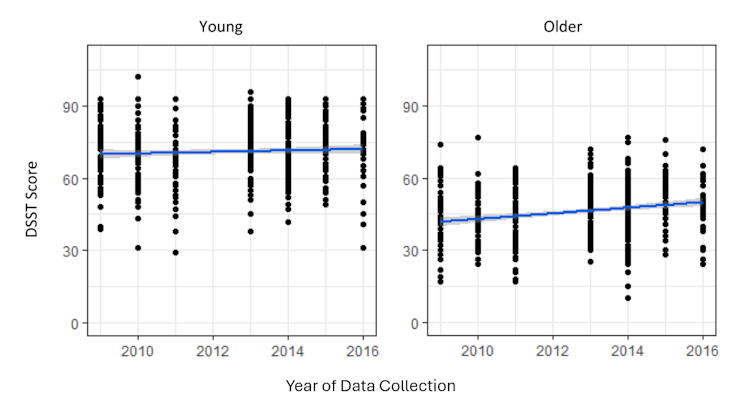
The figure shows data for a speed-based task where higher scores represent better performance.
CC BY-SA

I believe the older adults of today are benefiting from many of the factors previously most applicable to young adults. For example, the number of children who went to school increased significantly in the 1960s – with the system being more similar to what it is today than what it was at the start of the 20th century.

This is being reflected in that cohort’s increased scores today, now they are older adults. At the same time, young adults have hit a ceiling and are no longer improving as much with each cohort.

It is not entirely clear why the young generations have stopped improving so much. Some research has explored maternal age, mental health and even evolutionary trends. I favour the opinion that there is just a natural ceiling – a limit to how much factors such as education, nutrition and health can improve cognitive performance.

These data have important implications for research into dementia. For example, it is possible that a modern older adult in the early stages of dementia might pass a dementia test that was designed 20 or 30 years ago for the general population at that time.

Therefore, as older adults are performing better in general than previous generations, it may be necessary to revise definitions of dementia that depend on an individuals’ expected level of ability.

Ultimately, we need to rethink what it means to become older. And there’s finally some good news. Ultimately, we can expect to be more cognitively able than our grandparents were when we reach their age.The Conversation

Stephen Badham, Professor of Psychology, Nottingham Trent University

This article is republished from The Conversation under a Creative Commons license. Read the original article.
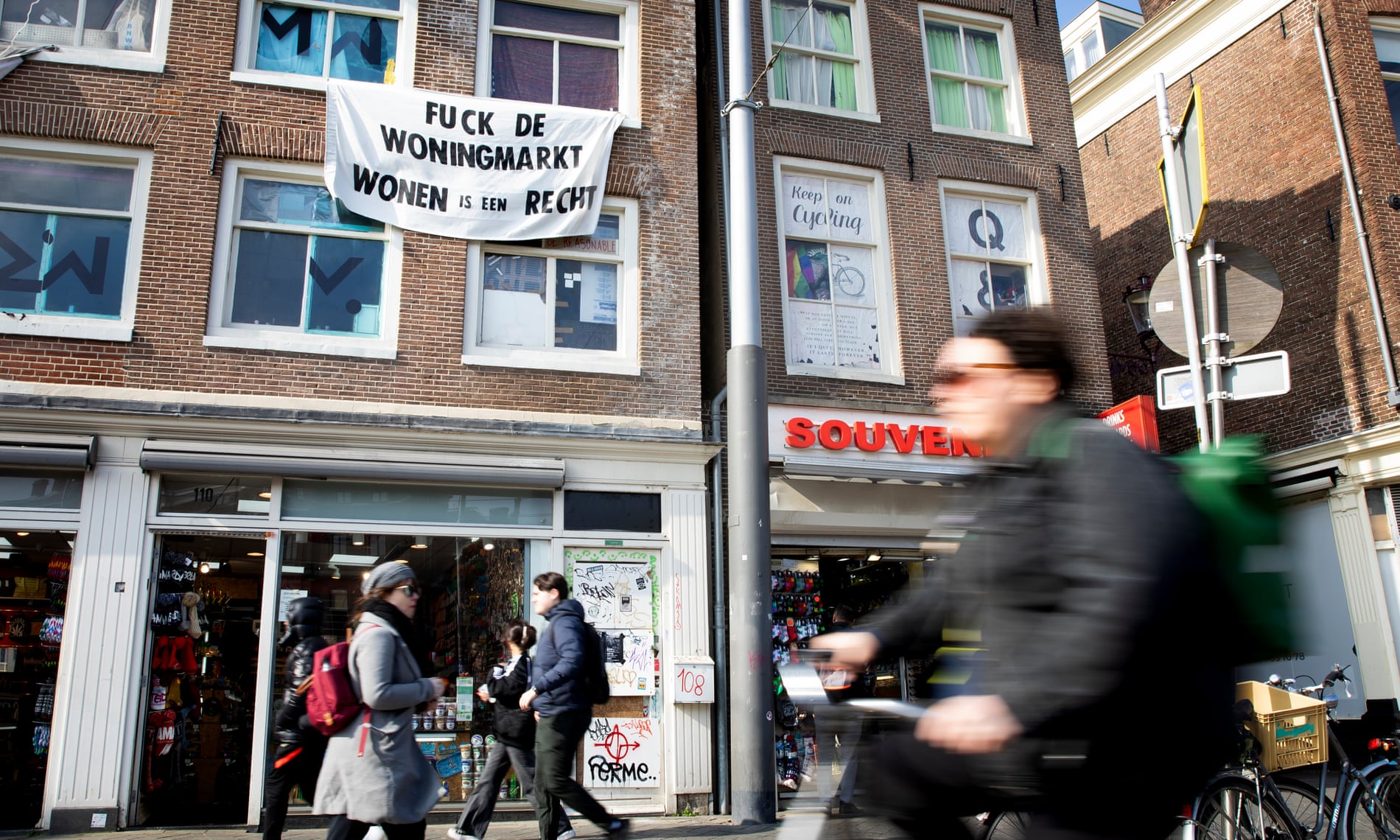

This is not a joke

https://www.theguardian.com/news/article/2024/may/06/netherlands-amsterdam-next-level-housing-crisis

I remember receiving a communication from someone in Florida, asking me “where do you want to live?” when I was about to relocate to Florida. “Where do you want to live? Which neighborhood?” was not an option I was familiar with. You live wherever it is where you find a place to live.

Things have been getting much worse recently, however, and apparently it is the fault of successive Dutch governments.

Don’t dismiss the role that sheer good luck and bad luck play in life


Here is an example.

Decades ago, as I was emigrating to the US in the winter holiday season, a courier I had arranged was supposed to collect the paperwork in the US that I needed for my visa. After several days, nothing had happened.

The university in the US engaged FedEx, their regular courier, and I rented a car, drove to the airport (Schiphol) where FedEx allowed me to collect my paperwork straight from the plane (desk), after which I drove to the American consulate and got my visa right before the consulate shut down early because of new year.

My flight was leaving, pets and all, when the consulate was still closed.

The fact that everything else worked out too… that was great. There could so easily have been a snag on my way back from the airport.)

But if it hadn’t been for FedEx…

So whenever I can, if I need to use a courier, I will use FedEx. (I’ve held an account with them once or twice.)

What is gossip?

Some people fascinate me so much that I end up talking about them with others but I sometimes can’t escape wondering whether I am gossiping when I do that. I now try to keep things as vague as possible so that the people in question remain unidentifiable – it’s a small world, after all – but that’s not always easy.

Does someone have a problem with who you are?

never sacrifice who you are just because someone has a problem with it

One exception: If your behavior is hurting others, then you still do not have to sacrifice who you are, but you’ll have to learn how to modulate your behavior. That’s also for your own sake, to stay out of trouble.

This sounds easier than it is. Behaviors can have become part of someone’s identity and when someone’s any kind of artist, the idea of modulating one’s behavior surely has to feel like a potential threat to one’s creativity.

Baby steps is all it takes. No big leaps or major transformations are needed.

I’ve actually been shocked to see how being mistreated – or even merely dismissed – in England started to change me into someone I no longer liked much at all. This began happening to me when I was in my forties. So I understand very well how certain behaviors can come about. We do not live in a vacuum, no matter what people may say, and what happens around us and to us – particularly when it concerns children – can change us. Neural pathways get reinforced; this happens beyond our control, before we know it.

(Just consider how TBIs and brain tumors can change someone’s personality. Then you see how true this is. We are biological organisms, not separate from nature but part of it.)

Some people are lucky enough to be able to reclaim the power to be who they want to be. Others need a bit of compassionate support to be able to do that, a guide. Not everyone can change their behaviors, but there are ways to limit its impact on others.

Poverty policies

If writing off household debts – the government buying the debts and then paying them, which boils down to having the debts written off, for households – is much cheaper than the government providing household debt assistance, isn’t a big part of the solution to shift the household debt amount toward the income of the people who get into household debt?

Photo by Pixabay on Pexels.com
Available as paperback and Kindle e-book.

What on earth is going on in Dutch trains?

Last night, two boys aged 13 and 14 attacked a train guard in Purmerend. He needed medical treatment after that.

https://nos.nl/artikel/2518846-twee-jongens-van-13-en-14-jaar-mishandelen-conducteur-in-purmerend

Just a few weeks ago, another train guard was attacked, and even thrown down a staircase by a bunch of youngsters. That happened between Delft and The Hague. The woman broke her arm.

https://nos.nl/artikel/2516813-conducteur-ns-mishandeld-in-trein-van-trap-gegooid-geschopt-geslagen

I have just spent fifteen years in an English town that has a LOT of violence and intimidation and harassment and I’ve stood up against bullies a few times. Fairly recently, I’ve even stopped two people who were high on meth from pulling a driver out of his car in rush hour, for example, but that is very different.

This violence in Dutch trains is really worrisome and I wouldn’t want to deal with that at all.

What is behind this? Is it still an aftermath effect of the pandemic? I don’t think so.

Particularly the trains between Zwolle and Emmen are seeing a large increase of incidents. What is different about that part of the country?

https://nos.nl/artikel/2518815-grote-stijging-van-het-aantal-incidenten-in-trein-zwolle-emmen

This article mentions that it mostly concerns people without a valid ticket and talks about a large number of refugees who got stuck in that part of the Netherlands because the country where they came from is considered safe enough.

Is that the whole story? It’s very hard to talk about this without risking upsetting anyone if you ask about the backgrounds of the youths in question. But if you want to resolve this, you need the context.

  • One obvious solution appears to be gates at stations, to keep people without ticket from boarding the trains. Then you shift the problem, however. If the violence is mostly associated with people not having tickets, then the real issue is a lack of enough income.
  • So, another solution might be to issue free train passes to for example youths for a while and see how that affects the number of incidents. Free train passes might make a real difference. It might make people feel a lot less defensive. Scared people can easily become aggressive.

Why are so many people needing to travel between Emmen and Zwolle, though?

https://nos.nl/artikel/2496457-nog-altijd-veel-incidenten-in-overlasttrein-zwolle-emmen

The source appears to be Ter Apel, a former military base where my dad had part of his military draft training, which now houses refugees and other asylum seekers.

https://nos.nl/artikel/2481573-politie-mee-op-de-trein-bij-maarheeze-na-overlast-asielzoekers

  • A third solution, then, is to employ some of these asylum seekers on some of these trains, in uniform, but also perhaps in plain clothes. You need to bridge that gap. You need people who understand what is happening.

The presence of police agents in uniform can be provocative and does not necessarily increase the sense of safety among the public. I am in my sixties, and I do not consider the sight of police officers reassuring. To the contrary, I associate police with violence (from whatever source). It depends on the situation, however.

Generally, you can’t fight fire with fire (though it’s basically what I did in the case I mentioned above because I needed to distract them from the driver whose wife and kids were also in the car, by the way).

You have to take away the source of the problem, not fight its results.

Continue reading →

Schrikbarend beeld

https://nos.nl/l/2518331

Okee, Nederland is officieel kapot. Stuk.

Het goed georganiseerde land dat ik kende bestaat niet meer.

  • DIT – medische Kafkaesque nachtmerries – is één gevolg van betalen voor verrichte handelingen en het loslaten van zorg.
  • Het schokkende toeslagenschandaal waarvan de klap over de hele wereld echoode.
  • De Orwelliaanse vroegsignalering

Hoe dit komt, deels? Technologie dient de mens niet meer maar andersom. De dictatuur van wat kan is ontspoord.

A productive day

I have been plagued by bad headaches for about ten days now and today is no exception. So I am pleased to be able to say that I just wrote 30 pages for a new booklet anyway. Related to inequality and poverty.

Photo by eberhard grossgasteiger on Pexels.com
Photo by on Pexels.com

By the end of the day, I had published the first version. That gets it into the system. I expect to start expanding on it as of Sunday. In the past, I used to print everything a few times and edit/rewrite on the basis of the printed material. That usually leads to the best results, but is not really doable – or done – any longer. The main thing to do first is getting rid of these stupid headaches.

Also, I am hoping to get my eyes lasered soon; there are three different options for me in theory. This would solve several issues, including looking perpetually exhausted because of the pigmentation around my eyes. That pigmentation is reversible.

Priorities, priorities. (My current challenges all take priority. That forces me to play a game of juggling and gambling and guessing.)

A food development that I really like!

I’ve been wondering why we’re so behind on this, why we are still dependent on the exploitation of other species, for example, for our food supply. Doesn’t sound very advanced and sophisticated to me.

Also, “food and agriculture is responsible for about a quarter of all planet-heating carbon emissions. Its share of pollution is likely to grow as other industries shift to using green electricity, and ever-expanding middle-classes demand more meat for their tables. Up to now the focus for some climate campaigners has been to try to persuade people to eat less meat and more plants. Non-farmed proteins such as solein might make that approach more appealing.“

Solein sounds like a real change-maker.

https://www.theguardian.com/business/2024/apr/19/finnish-startup-food-air-solar-power-solein

This is also more or less – tubs of microorganisms – how we may generate electricity in the future. I realized that when I sat in a presentation by Craig Venter at Oxford, back in 2007. We are all – that is, our metabolism – electrical currents and some soil microorganisms even run thin wires to one another.

Scaling that may be the biggest challenge; it’s going to require some major ingenuity. If you can use organisms that take carbon dioxide and methane for example from the air, you might have a bonus side effect.

I can’t see any negative effects of a development like that yet (which would depend on species and process) and that is always the problem with anything that is new. It’s very hard to see negative side effects of something that you don’t know yet. Runaway is the first risk that comes to mind, after contamination and mutation.

It would likely have to be a synthetic organism and CRISPR could play a major role here. In building it, too, but you might be able to have CRISPR repair unwanted mutations. I don’t know if it is possible to prevent mutations. I doubt it. But you can usually predict them (anticipate them). (The latter is something I learned from watching the COVID research for a while. These weren’t exactly the kind of developments I used to be on top of.)

In case you don’t know who Craig Venter is: https://en.wikipedia.org/wiki/Craig_Venter

Continue reading →

Oh my. Oxford University shuts down institute run by Elon Musk-backed philosopher. That’s Nick Bostrom.

Update 28 April 2024: “eugenics on steroids”? It’s reassuring to learn that I wasn’t the only one who felt a little uncomfortable reading some past papers… https://www.theguardian.com/technology/2024/apr/28/nick-bostrom-controversial-future-of-humanity-institute-closure-longtermism-affective-altruism


https://www.theguardian.com/technology/2024/apr/19/oxford-future-of-humanity-institute-closes

The name Bankman-Fried also features in this article.

When I clicked:

Fact check and feedback: Drosophila suzukii aka spotted wing drosophila and cherry orchards in the Netherlands

Update 26 April 2024: https://nos.nl/artikel/2518221-tweede-kamer-wil-toch-bestrijdingsmiddel-voor-door-fruitvlieg-geplaagde-kersen (So maybe these Dutch cherry growers will get to help pollute the world a little bit more after all as maybe these insecticides are allowed in Germany after all? The panic over not being able to use them seems exaggerated if I look at what that Wageningen University experiment found. These cherry growers need to stick to a best practice approach. They also failed to do that when they were granted an exemption for these pesticides and ignored the conditions for their use, which is why the Dutch state pulled the exemption.)


This morning at 04:45 BST, the Dutch version of the BBC – it’s called NOS – published an article in which Dutch cherry growers lament about no longer being allowed to use the insecticides Tracer and Exirel to combat Drosophila suzukii.

Source: https://nos.nl/artikel/2517437-kersentelers-vrezen-voor-hun-voortbestaan-nu-bestrijdingsmiddelen-niet-meer-mogen

Drosophila suzukii aka spotted wing drosophila is a fruit fly that originated in Asia and of which the females lay eggs in ripening fruits, such as berries, grapes, plums and cherries. It was first spotted in the Netherlands in 2012.

It likely arrived in Europe in imported fruit, according to this study: https://www.ncbi.nlm.nih.gov/pmc/articles/PMC6681294/ (It also talks about the use of cladding and netting to combat this fruit fly. I’ll come back to that.)

Dutch cherry growers had an exemption that allowed them to use Exirel and Tracer, but because they weren’t keeping their side of the agreement, the Dutch government canceled the exemption. It wants to improve water quality instead of worsen it and it does not want to cause more harm to bees. The cherry growers weren’t cooperating.

Continue reading →

Portsmouth in practice – or life

Years ago, I observed a young man with what I assumed was his son. So nice. This was in Victoria Road South. I said something to him, I don’t remember what. I was on my way to the seafront, or back.

It turned out that it wasn’t his son but his little brother. His parents ran an enterprise in Palmerston Road; I’d been there once. Keeping the business afloat was challenging at the time, he said. He was a student, in Birmingham, or in Manchester. Economics, I think.

At some point, he asked me what I did. I said that I hadn’t worked in years and left it at that. (That’s what it felt like anyway. 😁) That was maybe ten years ago. Just about everything I undertook in Portsmouth was thwarted systematically, no matter what, from the get-go. (Reality was more complicated.) As a result, I spent far too much of my time there as if I was chained to a basement wall. Well, almost. I found it very hard.

So now, if someone suggests that I should live my life as if I am chained to a basement wall, I dismiss them as a nincompoop who either is biased or hasn’t been around.

Why do so many bright and inspiring people die young?

(I need entrepreneurial inspiration. I’ll have to become my own.)

I will soon be meeting with someone who I used to know, though, and I’m really looking forward to it. It’s not exactly a run-off-the-mill, a-dime-a-dozen person and I like that. I like the person. We may be very different in many ways – probably, but I don’t even know for sure – but we also certainly like a few of the same inspiring and enjoyable things.

I’ll need to leave soon. I really have to.

You are the only expert on you. I’m the only expert on me. Don’t chain me to a basement wall.

Read some of my flash fiction.

If you are in a lousy place right now, your life sucks and you don’t know how to make things better, watch this

But first of all, do an internet search on “Elizabeth Smart” who was an executive producer on this film, telling Kara Robinson’s story. After you’ve acquainted yourself with what these two teenage girls went through, separately, you’ll suddenly realize how much you still have to be grateful for.

When life sucks, it’s hard to see the little rays of sunshine. I know.

But realizing that things could have been so much worse can help.


This is this guy’s story: https://en.wikipedia.org/wiki/Richard_Evonit

When he was a child, his dad apparently drowned his dog in front of him and when he was only six years old, his dad tried to drown him.

Someone once said that it is easier to build strong children than to repair broken men.

In all the places in the world where we are waging wars or ruthlessly dehumanizing and exploiting people, where children get so see and experience things that they should never have to, we are creating tomorrow’s Richards.

Many children’s brains will be able to protect themselves and somehow develop still relatively normally, but not all children’s brains will when these children witness and experience too many atrocities as young children.

It is not a choice to turn into someone like Richard Evonit. It really isn’t.

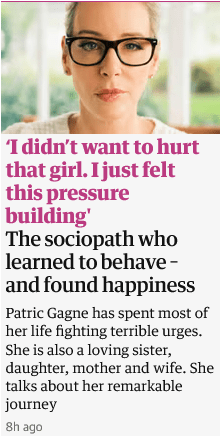
This person does not exist

That’s what other people have been telling me for years, that people such as this person do not exist, that they are just made up by feeble-minded women with an “anxiety” problem.

But this, too, is part of natural neurodiversity. Her brain structure is different and SHE did not cause this.

Contemplating such realities is also part of bioethics.

https://www.theguardian.com/lifeandstyle/2024/apr/08/patric-gagne-sociopath-fighting-urges

Portsmouth made the Guardian again

This time it’s not about Portsmouth having the highest number of forced prepaid meters or rejected blue badge applications for non-visible disabilities or impairments such as autism or certain neurological disorders.

It looks like the Guardian went to the high street in fairly fancy Cosham – which is on the mainland, not on Portsea Island – and asked random shoppers how they would vote. They also went to poorer Paulsgrove – also on the mainland – and spoke with candidates who aren’t Penny Mordaunt.

I’ve heard her speak at the Guildhall. I understand why people vote for her.

Did the Guardian actually manage to miss most of the constituency Portsmouth North? It starts at around New Road. That’s in the middle of Portsea Island.

Also, they should have taken a photo from the ridge (the cliffs over Cosham). That way you can get not only the Spinnaker Tower but almost all of Portsmouth in the shot, complete with its geographic location. You need good weather for it, but the weather on the south coast is almost always good.

Instead, they used a stock photo (Alamy) that’s was taken as far south as you can get in Portsmouth South.

If Portsmouth wasn’t so extremely insular, it would be a lovely place. Penny Mordaunt gets that insularity, too. Not only did she come across as seasoned* from the start, and highly capable, people there see her as “one of us”. That’s why they vote Conservative.

Her swimsuit stunt and the challenge she undertook of saying the word “cock” (dick, pecker, bell) as often as she could in a speech in Parliament, that appeals to many of the locals. It cemented her popularity.

She is local. She was in the Navy and her mother died of breast cancer when Penny was a teenager. She’s dyslexic, if I’m not mistaken.

She’s very appealing and she has matured enough for people to be able to see her as a future PM now. They would love that.

(Someone from self-declared underdog city Portsmouth as PM? Hell yes.)

(Even Boris Johnson has mentioned Portsmouth and described it as having nothing but a big drugs problem and too many Labour MPs. If anything that will have made people more determined to vote for Penny Mordaunt, won’t it?)

Go one town to the west (Fareham), and you run into Suella Braverman. Can you hear me sigh?

(*She worked on the elder Bush team in the States.)

Continue reading →

People in New York got rattled, I hear (4.8 earthquake)

Believe it or not, I’m a fully qualified geologist and I was intrigued by this, so I asked the Google Meister whether it could dig up something on USGS and faults and New York. That’s how I stumbled upon this map of historic earthquakes in this 2020 article.

This does not show the fault that runs through NYC, obviously, but it’s likely undoubtedly part of the same system.

https://www.researchgate.net/publication/347286597_Borehole_research_in_New_York_State_can_advance_utilization_of_low-enthalpy_geothermal_energy_management_of_potential_risks_and_understanding_of_deep_sedimentary_and_crystalline_geologic_systems/

Today’s Scientific American has the skinny, so to speak (but not really, at 18:09 BST, but they are promising to keep updating the article): https://www.scientificamerican.com/article/earthquake-shakes-new-jersey-new-york-state-pennsylvania-and-more/

USGS info: https://earthquake.usgs.gov/earthquakes/eventpage/at00sbh3yv/region-info

General info at Cornell, based in Ithaca, visible in the above map as well as the one below: https://deepgeothermalheat.engineering.cornell.edu/cubo-science-intro/earthquakes-in-new-york-state/

To sum it up, it’s not as rare as most people assume, but most earthquakes in the area are a lot less noticeable.

From the Cornell source
Continue reading →

A book for lawyers, activists and homeless teenagers

“Bringing Down Goliath: How Good Law Can Topple the Powerful”


The paperback was released on 4 April 2024. You can order it from your local independent bookshop at Bookshop.org:

Bringing Down Goliath is Jo Maugham’s first book. Initially released in 2023, it tells Jo’s story – from homelessness at 16 to first Queen’s Counsel, next King’s Counsel and then campaigning lawyer.

(I still feel that QC has a much better ring to it than KC.)

Jo’s book also provides you with the inside story of the origins and successes as well as future of the Good Law Project.

With the rule of law in England under threat like never before, “Bringing Down Goliath” struck a chord, became a Sunday Times bestseller as well as a 2023 highlight in the Guardian.

Jo Maugham has also argued before the Dutch courts. I remember him taking on a case within the Brexit context, concerning British citizens in the Netherlands.

Facebook in for a major battle? (republished)

I just learned that Facebook made the blunder of conducting a massive psychological experiment on the users of its English-language version without their explicit consent. This is extremely unethical.

This is bound to have legal consequences.court

The Independent published about it today. The paper reporting the results of the experiment appeared in PNAS.

I hope to see class actions in every country that uses the English version of Facebook because this is most definitely not right. No amount of word-twisting by Facebook (or the researchers) can cover up that no users ever consented to this kind of experiment being carried out on them.

In addition, the university researchers involved in the study should be investigated and disciplined. If they were in my employ, I would sack them instantly.

They have damaged the scientific reputation of their universities and, in my view, do not belong in academia. I trust that Cornell University and the University of California will take the appropriate steps.

On the other hand, these researchers are highlighting a serious danger that lurks behind social media, but it does not appear that this was the motivation for their unforgivable conduct.


Can YOU still justify supporting Facebook? (republished)

Facebook has just added one more feat to its long history of appallingly unethical actions.

https://www.theguardian.com/technology/2019/oct/04/facebook-exempts-political-ads-ban-making-false-claims

It began with the mood manipulation experiments for which the affected users had given no consent.

I thought that this would have major consequences for Facebook.

I was wrong. People just shrugged. They made fusses over Starbucks instead.

So Facebook took it further and further. It meddled in the US elections. It meddled in the UK’s Brexit referendum (the Cambridge Analytica scandal). Its boss gave governments the finger by not showing up for hearings. It paid kids to give it access to their entire digital lives.

And now this. Can you still justify using Facebook (and Instagram, and WhatsApp)?

I can’t.


The Facebook saga continues (republished)

Anyone who still uses Facebook in spite of that company’s highly unethical practices, such as meddling in the US elections and mood manipulation experiments without the users’ consent, has to look at himself or herself in the mirror and ask questions. There are other platforms that allow people to stay in touch with friends and family, if that is why he or she uses Facebook.

Mark Zuckerberg’s failure to show up recently as part of an international inquiry showed contempt.

Facebook had been aware that an update to its Android app that let it collect records of users’ calls and texts would be controversial. “To mitigate any bad PR, Facebook planned to make it as hard as possible for users to know that this was one of the underlying features,” Mr Collins wrote.

This comes from this BBC article:

https://www.bbc.co.uk/news/technology-46456695

I have said it before.

https://angelinasouren.com/2014/06/30/facebook-in-trouble/

https://angelinasouren.com/2014/06/29/facebook-in-for-a-major-battle/

https://angelinasouren.com/2014/07/05/facebook-getting-away-with-it/

There are many alternatives, such as Diaspora. Read more on Wikipedia about Diaspora.

Facebook in trouble? (republished)

Facebook appears to know it is in trouble over the experiment it conducted (see previous post). On CNN, I read this morning that a spokesperson said it was research “to improve our services”.

It looks like Facebook is trying to jump through hoops. But Facebook doesn’t fit through the hoops.

When users consented to their data being used to improve Facebook’s services, most users will have assumed that this referred to services provided to the users, not services Facebook provides to advertisers. (When you’re happy, you are more optimistic, hence more likely to click on advertisements. Pessimists have a more realistic view of the world than optimists, but optimists likely see themselves as more successful than pessimists.)

And when Facebook users consented to their data being used to improve the services, they sure as hell did not consent to psychological experiments being conducted on them.

They may have expected Facebook to analyse the data and make use of the results of those analyses, yes, but they were likely thinking in terms of technology or something along those lines. Upgrading server x that delivers Facebook to country y. They may also have expected to see baby products being advertised to those who clicked on such ads and posted baby pictures, and office products being shown to people who stated that they are self-employed.

Facebook tweaking the streams of users to bring them the items it thought users wanted to see, that is one thing. I can be annoyed about Facebook not showing my friends’ posts in my timeline, no matter how many boxes I tick to try and get them to show and I can be annoyed about commercial posts I get shown no matter how many boxes I tick in an attempt to get rid of posts about products I cannot even buy because I am many miles away on the other side of the world, but that is an entirely different ballpark compared with Facebook deliberately tweaking the streams of users to make them feel happy or make them feel miserable, or even attempting to see whether it can or not.

Facebook – and the two university researchers along with it – has crossed a line, again. This time, Facebook has made an unforgivable mistake.

It is true that other media manipulate us all the time. But we expect that. We know that the BBC only reports what it wants to report and does not present an objective overview of society. We know that commercials feed us bullshit, that buying that car or buying that dress or perfume won’t make glamorous models suddenly find us irresistible. And I know that when CNN – CNN Money, that is – writes that “it does not appear that Facebook faces any legal implications”, CNN is trying to manipulate its audience too.

That does not apply when it comes to messages from our friends. It may still be true that we have one or two friends – or children – who may consciously or subconsciously try to manipulate us, but when it comes to messages our friends post combined, we do not expect those messages to be manipulated by a third party in such a way that we become happier. And we certainly don’t expect our Facebook streams to be manipulated to make us miserable.

Happy or sad?


Facebook could have conducted this experiment equally well after explaining what it wanted to do and allowing users informed consent. It chose not to.

The US Army provided some of the funding for this experiment. That does not help.

I have meanwhile realised how Facebook may be able to get away with this in a court of law. Facebook could claim that it was carrying out this experiment because it was concerned about the number of suicides and other problems precipitated by bullying on Facebook. It could say that it was trying to figure out how it could tweak the streams of its users to prevent such problems for its users. Unless some whistleblower provides evidence to refute this, that might very well work.